

Webshare is a strong choice if you want affordable, self-serve proxy infrastructure with a clean dashboard, SOCKS5 support, flexible plans, and excellent developer documentation.
It is best for developers, SMBs, and budget-conscious scraping teams that want raw proxy access without enterprise pricing. That said, it is not ideal if you need mobile proxies, ZIP or carrier targeting, PayPal, crypto payments, or managed CAPTCHA unblocking.
Key Features
- Free 10-proxy starter plan
- Datacenter, static residential, and rotating residential proxies
- HTTP(S) and SOCKS5 support
- Sticky sessions, rotating endpoints, and backbone connections
- Country and city targeting with ASN-related controls
- Strong API access with developer-friendly documentation
Best For
- Budget-conscious proxy users
- Developers and SMBs needing affordable proxy infrastructure
- Scraping and automation teams that want API-first proxy access
- Users who value clean dashboard controls and strong documentation
- Not ideal for mobile proxies, deep targeting, or managed unblocking
Pros
- Very competitive pricing
- Free plan with no credit card required
- Strong dashboard and easy setup flow
- Good proxy-type coverage for the price
- Excellent Help Center, API docs, and setup guides
- Public status page and incident visibility
Cons
- No mobile proxies
- No ZIP, carrier, or device targeting
- Mixed results on stricter real-world targets
- No PayPal or crypto payment support
- English-only dashboard
- No verified Discord, Telegram, Slack, or public roadmap
Proxy Score Breakdown
Network Quality & Reach: 3.8 / 5
Performance & Reliability: 3.5 / 5
Security & Privacy: 3.7 / 5
Features & Flexibility: 4.2 / 5
Ease of Use & Dashboard: 4.5 / 5
Pricing & Value: 4.2 / 5
Support & Documentation: 4.3 / 5
Table of Contents
Introduction to Webshare
Webshare is a low-cost proxy provider built around self-serve proxy access, a clean dashboard, and developer-friendly controls. It offers datacenter proxies, static residential proxies, and rotating residential proxies, with support for common protocols like HTTP(S) and SOCKS5.
In this Webshare proxy review, we look beyond the headline pricing. We evaluate how Webshare performs across network reach, reliability, security, dashboard usability, API flexibility, pricing, and support quality.
The short version is simple. Webshare is one of the more practical options for developers, small teams, and budget-conscious proxy users. It is not the most advanced provider for mobile proxies or managed CAPTCHA unblocking, but it delivers strong value for raw proxy access.
What This Webshare Review Covers
This review provides a structured analysis of Webshare’s proxy products, dashboard, pricing model, performance profile, and real-world suitability.
We cover:
- Network quality: proxy types, IP pool size, geo coverage, rotation, and targeting depth
- Performance: speed, success rates, uptime, and reliability under normal use
- Security and privacy: IP sourcing, logging claims, encryption, jurisdiction, and compliance
- Features: SOCKS5, API access, sticky sessions, rotation, sub-users, and automation controls
- Ease of use: dashboard design, setup flow, usage monitoring, and documentation
- Pricing: free access, paid plans, refund rules, transparency, and payment methods
- Support: live help, email support, Help Center quality, onboarding, and status updates
This Webshare review is based on publicly available data, provider documentation, dashboard observations, third-party benchmark sources, user feedback, and our structured proxy scoring framework.
- Official Webshare product pages, pricing pages, Help Center articles, and API documentation
- Independent benchmark and review data from sources such as Proxyway and TechRadar
- Public user feedback from platforms such as G2, Trustpilot, and status monitoring sources
- Dashboard observations, including proxy lists, setup guides, usage charts, proxy status, and activity views
- Reviewer-tested support flow, including chatbot-to-human escalation
We did not treat marketing claims as proof on their own. When a feature was not clearly confirmed, we scored it conservatively. This is especially important for areas like IP cleanliness, no-logs claims, ASN diversity, mobile targeting, and enterprise-grade controls.
Some links in this article may be affiliate links. We only recommend services that align with our editorial standards.
Who This Review Is For
Budget Proxy Buyers
Webshare is a strong fit if you want affordable proxy access with a free starter plan, low-entry paid plans, and flexible scaling across datacenter, static residential, and rotating residential proxies.
Developers & Automation Teams
Developers who need raw proxy access, SOCKS5 support, API controls, activity logs, proxy replacement tools, and clear setup documentation will find Webshare practical for technical workflows.
Scraping & SEO Users
Webshare can work well for basic scraping, SERP checks, rank monitoring, price tracking, and geo-specific research, especially when users choose the right proxy type for the target.
Small Teams & SMBs
Small teams that need a clean dashboard, usage charts, proxy status visibility, sub-user options, and strong documentation may find Webshare easier to manage than more complex enterprise platforms.
Not for Mobile Proxy Needs
If you need mobile proxies, carrier targeting, 3G or 4G filtering, device-level targeting, or social automation that depends on mobile IPs, Webshare is probably not the best fit.
Not for Managed Unblocking
Teams looking for a managed scraping API, built-in CAPTCHA solving, browser rendering, guaranteed unblocking, PayPal, crypto payments, or deep ZIP and carrier targeting should compare more specialized providers.
Overall, this review is written for readers who want a practical answer, not just a feature list. Webshare has clear strengths in pricing, dashboard usability, API access, and documentation, while its main limits appear in advanced targeting, mobile proxy support, and strict-target unblocking.
Network Quality & Reach
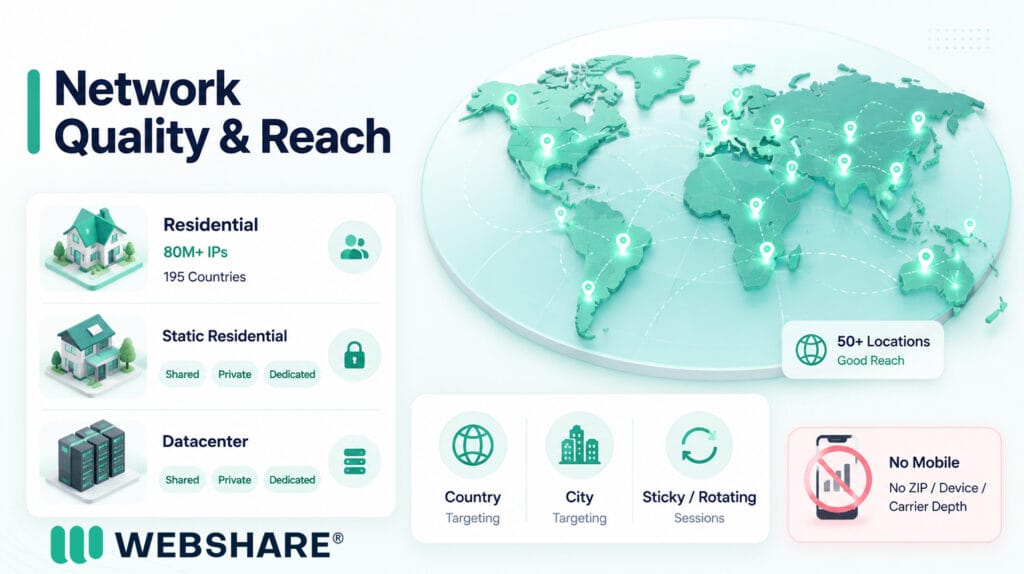
Webshare performs well in network scale and proxy access variety. Its biggest advantage is the claimed 80M+ residential IP pool, broad country coverage, and support for multiple proxy products, including datacenter, static residential, and rotating residential proxies.
The main limitation is depth. Webshare does not currently offer mobile proxies, and its advanced targeting is not as granular as providers with ZIP, carrier, device, or full enterprise-grade ASN controls. That keeps the network score in the Good range rather than Excellent.
Network Quality & Reach Score: 3.8 / 5
Strong IP scale and proxy variety, but limited by missing mobile proxies and deeper targeting controls.
IP Pool Size & Proxy Types
Webshare’s network scale is one of its strongest points. The provider currently claims access to 80M+ residential IPs, which puts it well above the 10M+ threshold used in our scoring system for top marks in total IP pool size.
It also offers three main proxy product types: Proxy Server / Datacenter, Static Residential / ISP-style proxies, and Rotating Residential proxies. This gives Webshare enough variety for most common scraping, SEO, automation, and account-management workflows.
Rotating Residential Proxies
Best for scraping, automation, SEO monitoring, and geo-sensitive tasks where a large rotating residential IP pool is useful.
Static Residential / ISP Proxies
Designed for stable sessions with residential-style ISP registration, making them useful for account workflows, persistent connections, and lower-risk access.
Proxy Server / Datacenter Proxies
Useful for faster, cheaper proxy workflows, especially simple automation, testing, bulk requests, and low to medium protection targets.
Shared, Private & Dedicated Access
Webshare offers different exclusivity levels for proxy servers and static residential proxies, helping users balance price, reputation, and stability.
Mobile Proxies
Not currently offered as a standalone Webshare product, so users needing 4G, 5G, LTE, carrier-based, or mobile-social workflows should compare other providers.
A key advantage is that Webshare does not only offer shared access. Its datacenter and static residential products include shared, private, and dedicated options, which gives users more control over cost, exclusivity, and reputation.
This matters because shared IPs are cheaper, but they can carry more risk on stricter websites. Dedicated IPs cost more, but they reduce overlap with other users and are usually better for tasks that need consistency.
| Proxy Access Type | How It Works | Best For |
|---|---|---|
| Shared | Lower-cost proxies used by multiple customers | Budget scraping, testing, simple automation |
| Private | Semi-dedicated proxies with limited user overlap | More stable tasks with moderate reputation needs |
| Dedicated | Exclusive proxies assigned to one customer | Account workflows, whitelisting, long sessions |
The missing piece is mobile proxy coverage. Webshare has strong variety for the price, but it does not cover all four major proxy types. Providers with residential, datacenter, ISP, and mobile proxies score higher here because they can support more social, app-testing, and carrier-specific use cases.
Webshare has strong IP scale and useful product variety for its price range. It is a good fit for users who need residential, static ISP-style, or datacenter proxies, but it is not the right choice if mobile proxy access is required.
Geographic Distribution & Targeting
Webshare has strong country-level reach, especially for its residential proxy network. Its current positioning claims residential proxy coverage across 195 countries, which gives it broad global usefulness for scraping, SEO checks, localization testing, and market research.
That said, the coverage is not identical across every Webshare product. Its general proxy locations page highlights 50+ listed proxy locations, while the broader 195-country claim applies mainly to the residential network. For the review, it is better to phrase this as broad residential coverage, with more limited public location visibility for other proxy products.
Webshare Targeting Options
- Residential proxy coverage advertised across 195 countries
- Proxy Server locations page publicly highlights 50+ locations
- City targeting is confirmed for rotating residential proxies
- ZIP-level targeting is not publicly confirmed
City targeting is also available, but it appears more limited than what you get from premium enterprise proxy networks. Webshare confirms city targeting for Rotating Residential proxies, including city-based username formatting through the endpoint generator.
This is useful for common geo-specific workflows, such as local SERP checks, regional price monitoring, and location-based scraping. However, I did not find confirmed support for ZIP-code targeting, device targeting, or broad ISP-level filtering inside the same city-targeting workflow.
| Targeting Level | Webshare Support | Review Notes |
|---|---|---|
| Country | Supported | Strong residential coverage, with 195-country claim |
| City | Supported | Confirmed for rotating residential proxies |
| ZIP Code | Not confirmed | No public documentation confirms ZIP-level targeting |
| Carrier / Mobile | Not supported | No standalone mobile proxy product found |
Geo consistency is the harder part to score. Webshare clearly documents country and city filtering, but I did not find a public benchmark showing a verified geo-accuracy percentage, such as 95%+ of IPs resolving to the selected country or city.
Because of that, we scored geo stability conservatively. The coverage is strong, but the verified accuracy data is not detailed enough to give it a premium geo-targeting score.
Webshare is strong for country-level and basic city-level targeting, especially on residential proxies. It is less suitable for users who need ZIP targeting, mobile carrier filters, or highly verified geo-accuracy for strict location-sensitive workflows.
Rotation & Session Management
Webshare gives users a useful mix of rotating and sticky session behavior. For self-serve proxy users, that is enough to cover most common workflows, including scraping, SEO monitoring, price tracking, and login-based sessions.
The strongest part is flexibility across connection methods. Webshare supports rotating endpoints, direct connections, and backbone connections, while its API documentation also confirms session ID behavior for keeping the same exit IP during a sticky session.
Rotating Endpoint
Assigns proxies from the available pool, useful for scraping and tasks that benefit from frequent IP changes.
Sticky Sessions
Allows the same exit IP to be maintained through session ID behavior, which helps with logins and persistent workflows.
Recurring Replacement
Supports replacement timing options, which gives users more control than a fixed static proxy list.
Connection Methods
Direct, rotating, and backbone connection options give technical users more setup flexibility.
Where Webshare loses points is not basic rotation support. It clearly has that. The limitation is that rotation reliability under load is not publicly benchmarked in a way that proves clean switching at enterprise scale.
Its TTL controls are also useful, but not fully transparent across every proxy product. Webshare documents multiple timing and timeout controls, yet the public docs do not confirm full granular TTL behavior for all proxy types.
For most users, this is still a strong setup. If you are rotating through residential IPs, maintaining sticky sessions for account flows, or using API-controlled sessions, Webshare gives enough control to be practical. If you need advanced enterprise rotation guarantees, leak-tested switching, or very precise per-request TTL rules, it is less complete than premium providers.
IP Reputation & ASN Diversity
Webshare shows positive signs for IP quality, especially on its residential and static residential / ISP-style products. Public benchmark data referenced in our scoring notes showed strong infrastructure success rates for residential and dedicated ISP proxies, with better real-target performance than shared datacenter proxies.
The weaker area is shared datacenter reputation. Webshare’s shared proxy servers are affordable, but they are more likely to face CAPTCHA or blocking on stricter targets. This is especially relevant for Google-style scraping, where shared datacenter IPs often face heavier anti-bot checks.
For stricter workloads, the proxy type matters a lot. Dedicated ISP-style proxies and residential proxies are the safer options when reputation matters. Shared datacenter proxies are better treated as a low-cost option for lighter tasks, testing, or targets with weaker anti-bot protection.
Residential
Stronger fit for scraping and geo-sensitive workflows where natural IP reputation matters.
Static ISP
Better for persistent sessions, account workflows, and tasks that need stable residential-style IPs.
Shared Datacenter
Affordable and fast, but more exposed to CAPTCHA and block issues on stricter websites.
ASN diversity is also only partially visible. Webshare provides ASN-related controls for proxy replacement and filtering, and its static residential proxies are associated with recognized residential ISPs. That is a good signal, but it is not the same as publishing a confirmed ASN count or third-party ASN diversity benchmark.
So, the score stays moderate. Webshare looks usable for many practical tasks, but we cannot rate IP reputation higher without direct blacklist-rate data, verified ASN spread, or stronger CAPTCHA-specific testing across multiple target categories.
Targeting Capabilities
Webshare covers the targeting basics well. Users can work with country targeting, confirmed city targeting for rotating residential proxies, and some ASN-related controls for proxy replacement and API filtering.
Where it falls behind premium proxy networks is advanced precision. We did not find confirmed support for ZIP-code targeting, device targeting, mobile carrier filters, or full per-request ISP/ASN targeting across the whole platform.
Webshare Targeting Reality Check
Supported
Country targeting, city targeting for rotating residential proxies, and basic location-based proxy selection.
Limited
ASN controls are available for proxy replacement and filtering, but not confirmed as full-scale per-request ASN targeting.
Missing or Not Confirmed
No confirmed ZIP targeting, device targeting, mobile proxies, 3G/4G/5G carrier filters, or advanced mobile workflow controls.
For most users, this is acceptable. If your workflow needs country or city-level routing, Webshare should be practical enough. This covers many common scraping, SEO monitoring, and automation tasks.
For power users, the limits matter more. If you need exact ZIP-level targeting, mobile carrier selection, or advanced ISP/ASN targeting for anti-detection work, Webshare is not as complete as enterprise-focused proxy platforms.
Network Quality & Reach Score
Webshare has strong network scale for its price range. Its biggest advantages are the claimed 80M+ residential IP pool, broad residential country coverage, and support for datacenter, static residential, and rotating residential proxies. The main deductions come from missing mobile proxies, limited ZIP or carrier targeting, and limited public verification around ASN diversity, IP cleanliness, and geo accuracy.
- ✅ Claims 80M+ rotating residential IPs
- ✅ Residential coverage is advertised across 195 countries
- ✅ Offers datacenter, static residential / ISP-style, and rotating residential proxies
- ✅ Shared, private, and dedicated access options are available for selected proxy products
- ✅ Country and city targeting are supported for common geo-based workflows
- ✅ Sticky sessions, rotating endpoints, and recurring replacement options are supported
- ⚠️ No standalone mobile proxy product found
- ⚠️ ZIP, device, and carrier-level targeting are not publicly confirmed
- ⚠️ ASN controls exist, but full enterprise-grade ASN targeting is not clearly confirmed across all products
- ⚠️ No full public blacklist-rate, ASN-distribution, or geo-consistency audit found
Performance & Reliability
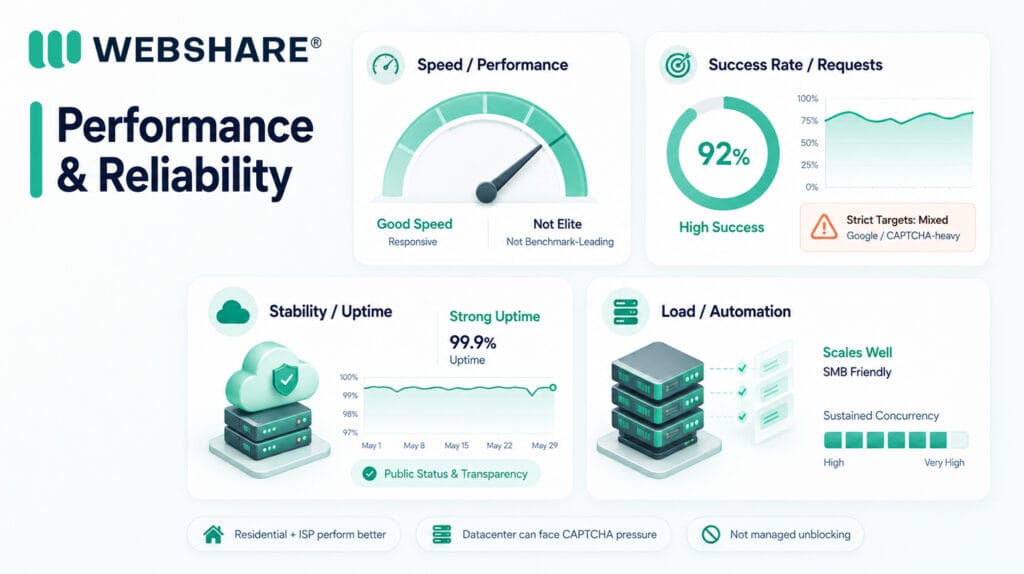
Webshare earns a Good score for performance and reliability. Its strongest points are request completion, uptime visibility, and stable infrastructure across residential, datacenter, and ISP-style proxy products.
The main limitation is consistency on stricter real-world targets. Webshare can perform well for normal scraping, SEO monitoring, automation, and testing, but shared datacenter proxies face more CAPTCHA pressure on sites like Google. Residential proxies are more usable for strict targets, although they are not the fastest in benchmark comparisons.
Performance & Reliability Score: 3.5 / 5
Reliable for many practical workloads, but not benchmark-leading on strict targets or residential latency.
Speed & Latency
Webshare’s speed is usable, but the benchmark numbers show a clear split between proxy types. Datacenter and dedicated ISP/static residential proxies are faster, while rotating residential proxies are slower but still practical for many scraping and automation workflows.
In Proxyway’s April 2025 benchmark, Webshare’s shared datacenter proxies averaged 0.75 seconds against a nearby CDN target. Dedicated ISP proxies averaged 0.42 seconds under similar synthetic test conditions. Residential proxies were slower, with infrastructure response times ranging from about 1.05 to 1.57 seconds across tested gateways.
Datacenter
Fastest Webshare category in benchmark notes, useful for low-cost automation and lighter targets.
Static ISP
Stronger balance of speed and reputation, especially for persistent sessions and account workflows.
Residential
Usable and high-success, but slower than the best residential networks in benchmark comparisons.
| Proxy Type | Benchmark Result | Performance Notes |
|---|---|---|
| Dedicated ISP Proxies | 0.42s average response time | Fastest result in the available benchmark data, with good stability for persistent sessions. |
| Shared Datacenter Proxies | 0.75s average response time | Fast and affordable, but reputation is weaker on strict targets. |
| Rotating Residential Proxies | 1.05s to 1.57s infrastructure response time | Usable, but slower than top residential networks in benchmark comparisons. |
| Residential on Real Targets | 5.44s average across Amazon, Google, and Instagram | Real-world targets add more delay, especially when anti-bot systems are involved. |
The key takeaway is that Webshare is not slow across the board. Its server-based products are fast enough for many practical workflows. The weaker point is residential latency, especially on real websites where response times averaged 5.44 seconds across Amazon, Google, and Instagram in the cited benchmark data.
For speed-sensitive tasks on less protected websites, Webshare’s datacenter proxies are the better value. For stricter targets, residential or dedicated ISP proxies may be more reliable, but users should expect slower response times.
Webshare performs best on datacenter and dedicated ISP proxies. Its residential proxies are usable, but not benchmark-leading, especially on real-world targets where response times can be several seconds slower.
Success Rate & Error Handling
Webshare’s success-rate data is good overall, but it depends heavily on the proxy type and target website. The strongest results come from infrastructure testing, where Webshare performed well across residential, datacenter, and dedicated ISP proxies.
In Proxyway’s April 2025 benchmark, Webshare residential proxies reached 99.27% to 99.75% infrastructure success rates across tested gateways. On real-world targets, residential proxies achieved 92.19% total success across Amazon, Google, and Instagram. That is solid, but not perfect.
Residential Infrastructure Success
Strong success range across tested residential gateways.
Residential Real-Target Success
Tested across Amazon, Google, and Instagram.
Shared Datacenter Infrastructure
Measured across 70,000 requests over 7 days.
Shared Datacenter Real-Target Success
Lower result across Amazon and Google, mainly due to Google CAPTCHA pressure.
The main warning is shared datacenter performance on strict targets. Webshare’s shared datacenter proxies performed well in infrastructure tests, but their real-target success dropped sharply. Google was the hardest case, with repeated CAPTCHA challenges reducing success to 9.02% in the benchmark data.
This does not mean Webshare is bad for scraping. It means proxy selection matters. For normal scraping, developer automation, and low to medium protection targets, Webshare can perform well. For stricter websites, users should usually consider residential, private, dedicated, or static ISP-style proxies instead of shared datacenter proxies.
Which Proxy Type Should You Use?
Error handling is better than average for a low-cost proxy provider. Webshare documents common proxy problems, including non-working proxies, blocked proxies, slow proxies, wrong-country issues, and configuration errors.
It also provides API error visibility. The scoring data notes standard API errors such as 400, 401, 403, 404, and 405, plus proxy-specific guidance around errors like no_proxies_allocated 407. This is useful for developers because it makes failures easier to diagnose.
Webshare also offers partial recovery automation through Auto-Replace. The feature can replace proxies that are not working, returning incorrect geolocation, or experiencing slowdown. On paid plans, replacement for proxies not working for more than 15 minutes is enabled by default. This helps with proxy-list maintenance, but it is not the same as a full managed scraping retry engine.
Uptime & Connection Stability
Uptime is one of the stronger parts of Webshare’s performance profile. Webshare’s own documentation points to a 99.98% uptime target, and the provider maintains a public status page for active incidents, historical disruptions, and service updates.
That visibility matters. Many budget proxy providers do not offer a clear status system, which makes it harder to know whether a failed connection is caused by your setup, your target website, or the proxy network itself.
Webshare Stability Signals
Third-party status monitoring also supports a positive, but not perfect, stability score. The scoring notes found that StatusGator has tracked Webshare since October 8, 2022, gives its status-page accuracy an A / Excellent rating, and reports an average acknowledgment delay under 15 minutes. At the same time, recent warning and down events were visible, including increased proxy error-rate incidents in June 2026.
Connection stability also looks solid from repeated-request testing. Proxyway measured Webshare shared datacenter proxies at 98.61% success and dedicated ISP proxies at 98.27% success across 70,000 requests over 7 days. That does not prove a near-zero drop rate, but it is a strong signal that the infrastructure can stay usable over repeated requests.
Why It Scores Well
Public uptime target, status page, third-party status tracking, and strong repeated-request success data.
Why It Is Not Perfect
Recent status incidents exist, and there is no direct public drop-rate percentage from continuous independent uptime testing.
A practical note: not every disconnect should be treated as random instability. Webshare documents session timeout and idle timeout behavior, so some connection endings may happen because of configured timeout rules rather than network failure. This is useful for users running longer sessions, bots, or scripts that stay idle between requests.
Performance Under Load
Webshare looks capable under repeated usage, especially for self-serve users, developers, and small to mid-sized scraping teams. The strongest signals are its thread-based plan structure, repeated-request benchmark data, and large-scale request claims.
According to the scoring data, Webshare’s rotating proxy plans list 500 to 3,000 threads, depending on the plan. Webshare also claims to handle 650B+ monthly proxy requests, which suggests the platform is designed for high-volume usage rather than only light browsing or small scripts.
The independent benchmark data is also useful here. Proxyway tested Webshare shared datacenter and dedicated ISP proxies with 70,000 requests over 7 days. Shared datacenter proxies reached 98.61% infrastructure success, while dedicated ISP proxies reached 98.27% infrastructure success under the same request-volume framework.
That supports a positive load score, but not a perfect one. The test shows strong repeated-request stability, but it is not the same as a full public stress test at very high concurrency, such as 1,000+ requests per minute across multiple targets.
Load Suitability
The main caveat is fair use. Webshare’s unlimited-bandwidth plans are still subject to a Fair Usage Policy, and the scoring notes state that bandwidth may be temporarily throttled if usage significantly exceeds plan thresholds. This is normal for many proxy providers, but it matters if you plan to run sustained high-volume scraping.
So, Webshare scales well for its target audience. It is strong for self-serve teams, developers, and SMB workflows, but high-volume enterprise users should check thread limits, bandwidth rules, and fair-use terms before relying on it for heavy production traffic.
Real-World Use Cases
Webshare is best understood as a self-serve proxy platform, not a managed scraping or unblocking product. It gives users proxy access, rotation tools, dashboard controls, API access, and documentation, but it does not fully handle anti-bot bypass, CAPTCHA solving, browser rendering, or request retries for you.
That makes it practical for many normal proxy workflows, especially when users choose the right proxy type. Datacenter proxies are better for speed and cost. Residential and static ISP-style proxies are better when reputation and session stability matter more.
| Use Case | Suitability | Best Webshare Option | Notes |
|---|---|---|---|
| Basic scraping | Good | Datacenter or Residential | Works well for low to medium protection targets, especially with controlled request rates. |
| SEO monitoring | Good | Residential | Useful for geo-based checks, but Google-heavy workflows may face CAPTCHA pressure. |
| Developer automation | Strong | Datacenter, ISP, or API-managed proxies | Good fit because Webshare offers API access, clear error docs, and self-serve proxy controls. |
| Price monitoring | Good | Residential or Static ISP | Good for recurring checks, especially when sessions or locations need to stay stable. |
| Strict targets like Google / Amazon | Mixed | Residential or Dedicated ISP | Residential and ISP proxies perform better, while shared datacenter proxies can struggle with CAPTCHA-heavy targets. |
| Social media automation | Caution | Static ISP or Residential | Can work for some workflows, but Webshare does not offer mobile proxies, which many social use cases prefer. |
| Managed unblocking | Not ideal | Not a core Webshare product | No confirmed managed scraping API, CAPTCHA-solving layer, or full automatic request retry engine. |
For real-world use, the safest positioning is this: Webshare is reliable enough for practical proxy work, but it is not a premium anti-bot solution.
It is a good choice for developers, small teams, SEO users, and budget-conscious scrapers who can manage their own request logic. It is less ideal for teams that expect the provider to solve blocking, retries, fingerprinting, rendering, and CAPTCHA handling automatically.
Webshare can support scraping and automation well, but stricter targets require careful proxy selection, slower request patterns, and stronger client-side retry logic. It should not be treated as a managed unblocking platform.
Performance & Reliability Score
Webshare performs well for normal scraping, SEO monitoring, developer automation, and proxy-based workflows. It shows strong infrastructure success rates, good uptime visibility, and solid repeated-request stability. The main deductions come from slower residential latency, mixed real-target performance, CAPTCHA pressure on shared datacenter proxies, and no confirmed full request-level retry engine.
- ✅ Residential proxies reached 99.27% to 99.75% infrastructure success in benchmark data
- ✅ Residential proxies achieved 92.19% real-target success across Amazon, Google, and Instagram
- ✅ Shared datacenter proxies reached 98.61% infrastructure success over 70,000 requests
- ✅ Dedicated ISP proxies reached 98.27% infrastructure success in repeated-request testing
- ✅ Webshare maintains a public status page and claims a 99.98% uptime target
- ✅ Error clarity is supported through Help Center troubleshooting and API error documentation
- ⚠️ Residential real-target response time averaged 5.44s across Amazon, Google, and Instagram
- ⚠️ Shared datacenter proxies struggled on strict Google-style targets due to CAPTCHA pressure
- ⚠️ Auto-Replace helps with proxy maintenance, but full request-level retry logic is not confirmed
- ⚠️ Unlimited-bandwidth plans remain subject to fair-use limits and possible throttling
Security & Privacy
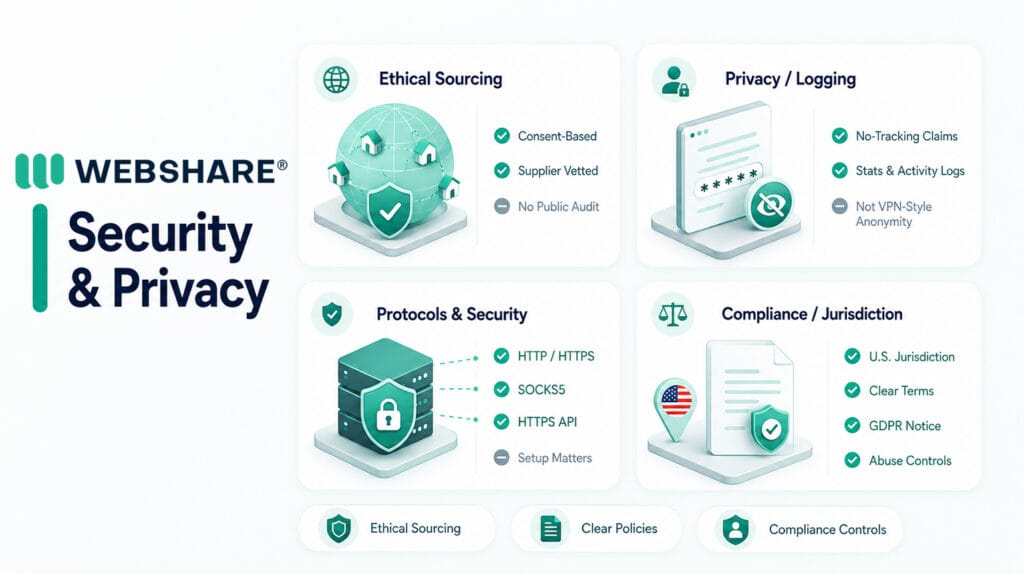
Webshare earns a Good score for security and privacy. Its strongest areas are IP sourcing transparency, legal clarity, and abuse/compliance controls.
The main limitation is verification depth. Webshare publishes privacy-friendly and compliance-focused language, but we did not find a public third-party sourcing audit, no-logs audit, SOC 2 report, or full transparency report.
Security & Privacy Score: 3.7 / 5
Stronger than many budget proxy providers on sourcing and compliance, but not audit-backed privacy.
IP Sourcing Transparency
Webshare is relatively transparent about residential proxy sourcing. Its public materials describe a sourcing model based on user consent, user awareness, clear information, and user reward.
This is important because residential proxies route traffic through real user devices. Poorly sourced residential networks can create consent, legal, and reputational risks. Webshare does a better job than many low-cost proxy providers by explaining how its residential network is supposed to be sourced.
User Consent
Webshare describes residential sourcing around end-user awareness and explicit consent.
User Reward
Its sourcing explanation includes reward-based participation, which is a positive residential proxy signal.
Supplier Vetting
Webshare says suppliers must follow contractual obligations around awareness and consent.
Webshare also separates residential proxies from static residential / ISP-style proxies. Residential proxies come from physical user devices, while static residential proxies are described as ISP-issued static IPs. That distinction helps users understand what kind of network they are buying.
The limitation is that this transparency is still based on public provider claims. We did not find a public third-party audit, supplier list, consent-flow verification, or independent residential sourcing report.
Webshare’s sourcing transparency is better than many budget proxy providers. It clearly explains consent-based residential sourcing and supplier vetting, but it does not reach audit-level transparency.
Logging & Anonymity Policy
Webshare uses privacy-friendly language on some product pages, including no-logs and no-tracking style claims. That is a positive signal, especially for users who want basic proxy privacy rather than fully managed scraping.
However, this should not be treated like an audited VPN no-logs policy. Webshare’s broader Privacy Policy covers account, billing, support, usage, and security-related data. Its dashboard and developer materials also confirm that activity logs, proxy statistics, request counts, bandwidth usage, success/failure data, and error reasons can exist inside the platform.
Target-Facing Privacy
Webshare proxies can hide your original IP address from destination websites, which is the core privacy function expected from proxy use.
Account-Level Data
Webshare still maintains account, billing, usage, activity, transaction, and operational data needed to run the service.
This distinction matters. Webshare can provide practical anonymity from the websites you connect to, but it is not designed as a privacy-first anonymity service like a no-logs VPN.
For example, activity logs and dashboard statistics are useful for debugging, usage tracking, and team management. They help users understand bandwidth, request volume, error reasons, and proxy performance. But they also mean Webshare’s privacy model is not “zero visibility.”
What Webshare May Track Operationally
So, Webshare is fine for normal professional proxy workflows, such as scraping, automation, SEO monitoring, and development tasks. But privacy-sensitive users should understand that this is not an audited no-logs environment.
Encryption & Traffic Security
Webshare supports the main proxy protocols expected from a professional proxy provider, including HTTP/HTTPS and SOCKS5. Its API also uses HTTPS endpoints, which is important for secure account and automation workflows.
The key point is that proxy security depends partly on how the user configures the app, scraper, browser, or automation tool. Webshare provides secure options, but it does not turn every proxy connection into an encrypted VPN-style tunnel.
HTTP / HTTPS
Standard proxy support for browsers, scraping tools, and automation workflows.
SOCKS5
Useful for broader app compatibility, but SOCKS5 does not encrypt traffic by default.
HTTPS API
API access uses HTTPS, which protects dashboard and automation requests in transit.
Setup Dependent
DNS and IP leak protection depend on the browser, app, or scraper configuration.
Authentication is also part of the security picture. Webshare supports credential-based proxy access, and its SOCKS5 materials reference secure authentication. This helps protect proxy access from unauthorized use, especially in team or automation environments.
The main caveat is SOCKS5 encryption. SOCKS5 is flexible and widely supported, but it does not encrypt transmitted data by default. Users still need HTTPS websites, secure app settings, and careful DNS handling when working with sensitive traffic.
User Configuration Matters
- Use HTTPS websites or encrypted app connections whenever possible
- Check whether your browser, scraper, or app sends DNS through the proxy
- Use SOCKS5 carefully, since SOCKS5 alone is not full traffic encryption
- Test your setup before using proxies for sensitive workflows
Webshare also provides some leak-awareness guidance. The scoring notes found that Webshare explains DNS leaks and recommends using leak-testing tools. That is useful, but it is not the same as provider-enforced DNS/IP leak protection.
So, the security posture is solid for normal professional proxy use. It is suitable for scraping, automation, account workflows, and API-driven proxy management, but users should not treat it as a privacy-hardened VPN replacement.
Jurisdiction & Legal Clarity
Webshare is clear about its legal presence. The research identifies Webshare Software as a 🇺🇸 U.S.-based company, with a California presence and Delaware corporate structure referenced in its legal materials. This gives users better legal clarity than proxy providers that hide their company identity, location, or governing terms.
The legal documentation is also reasonably complete. Webshare provides a Privacy Policy, Terms of Service, compliance-related pages, and separate privacy disclosures for users in the EEA, Switzerland, and the UK.
Legal Clarity Signals
This is a positive trust signal. Webshare does not appear legally opaque, and its documents explain user obligations, service rules, prohibited activities, privacy handling, arbitration, and data-related disclosures.
The main privacy caveat is jurisdiction. The United States is a clear and established legal environment, but it is not usually considered a privacy-haven jurisdiction. Users with strict privacy requirements should understand that Webshare operates under a U.S.-based legal framework.
Positive
Webshare’s company identity, legal terms, privacy documents, and GDPR-related disclosures are easier to verify than many budget proxy providers.
Caveat
🇺🇸 U.S. jurisdiction is legally clear, but it is not the same as a privacy-friendly offshore jurisdiction for highly sensitive users.
For most business, scraping, SEO, and automation use cases, this level of legal clarity is good. The remaining weakness is that the legal documents are not a proxy-specific transparency report. They do not fully explain traffic metadata retention, law-enforcement request handling, or historical disclosure activity.
Abuse Handling & Compliance
Webshare has a stronger compliance posture than many low-cost proxy providers. Its public policies cover restricted activities, abuse monitoring, proxy-use verification, and account review when activity looks risky or inappropriate.
This matters because proxy networks can be misused for spam, phishing, click fraud, copyright abuse, ticketing abuse, and aggressive scraping. Webshare’s documentation makes it clear that those activities can lead to refusal of service, verification, suspension, or termination.
Webshare Compliance Controls
Compliance Policy
Webshare documents abuse monitoring, risk review, and refusal of inappropriate or unethical use cases.
Restricted Activities
Prohibited uses include spam, phishing-style activity, click fraud, ticketing abuse, and copyright abuse.
Proxy-Use Verification
Accounts may be reviewed or verified when activity triggers risk signals, such as unusually aggressive requests.
Webshare also provides a clearer compliance framework around GDPR and DMCA than many budget proxy services. Its privacy disclosures mention EEA, Switzerland, and UK users, while its terms include DMCA notice handling and repeat-infringer language.
That said, this is still policy-level compliance rather than full public transparency. We did not find a public transparency report, external compliance audit, SOC 2 report, or detailed history showing how abuse reports and legal requests are handled in practice.
Strong Signals
Restricted-use rules, abuse handling, proxy-use verification, GDPR disclosures, and DMCA response language are publicly documented.
Missing Proof
No public transparency report, SOC 2 report, or detailed abuse-response statistics were found.
Overall, Webshare looks responsible for a self-serve proxy provider. Its abuse and compliance controls are stronger than a basic “do not break the law” policy, but they are not backed by audit-grade reporting.
Security & Privacy Score
Webshare performs well on security and privacy for a low-cost proxy provider. Its strongest points are clear residential proxy sourcing language, supplier-vetting claims, legal transparency, compliance policies, and abuse-handling controls. The main deductions come from the lack of a public third-party sourcing audit, no audited no-logs policy, and limited proxy-specific traffic-retention detail.
- ✅ Residential proxy sourcing is described around consent, awareness, clear disclosure, and user reward
- ✅ Webshare states that supplier vetting includes contractual consent and awareness obligations
- ✅ Static residential / ISP-style proxies are clearly separated from end-user residential device sourcing
- ✅ HTTP/HTTPS, SOCKS5, HTTPS API access, and authenticated proxy use are supported
- ✅ U.S. legal presence, Privacy Policy, Terms of Service, and GDPR/EEA disclosures are publicly available
- ✅ Abuse handling, restricted activities, proxy-use verification, GDPR, and DMCA language are documented
- ⚠️ No public third-party residential sourcing audit or supplier verification report found
- ⚠️ Product pages include no-logs/no-tracking language, but no audited proxy-specific no-logs policy was found
- ⚠️ Activity logs, proxy statistics, account data, billing records, and transaction history may still exist operationally
- ⚠️ SOCKS5 is not encrypted by default, and DNS/IP leak protection depends on user configuration
- ⚠️ U.S. jurisdiction is legally clear, but it is not privacy-haven territory
Features & Flexibility
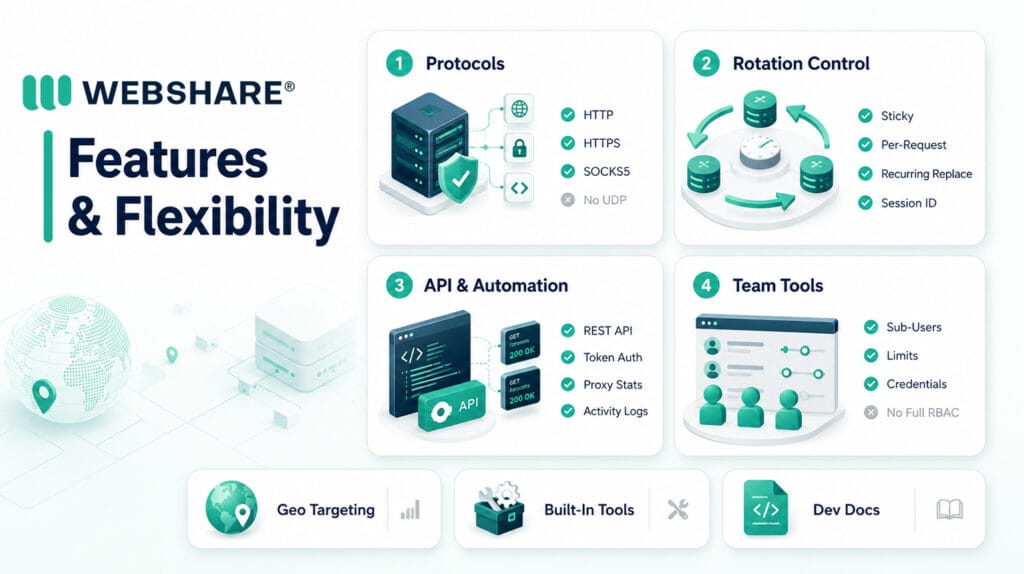
Features & Flexibility is one of Webshare’s strongest categories. The platform does well because it supports HTTP, HTTPS, and SOCKS5, offers flexible connection methods, provides strong API access, and includes useful session, rotation, and sub-user controls.
The main weakness is advanced targeting. Webshare is strong for common proxy workflows, but it does not confirm mobile proxies, carrier targeting, device targeting, ZIP targeting, or full ISP/ASN targeting across every product.
Features & Flexibility Score: 4.2 / 5
Excellent protocol support, strong API controls, and useful automation features, with weaker advanced targeting depth.
Protocol Support
Protocol support is one of Webshare’s clearest strengths. Webshare supports HTTP, HTTPS/SSL, and SOCKS5, which covers the main protocols most users need for scraping tools, browsers, automation scripts, account workflows, and API-driven proxy management.
SOCKS5 support is especially useful because it is included across major Webshare proxy plans, including datacenter, static residential, and residential proxies. Webshare also supports HTTP and SOCKS5 across key connection types, including Direct, Rotating, and Backbone connections.
HTTP
Standard proxy support for browsers, scrapers, automation tools, and basic web traffic workflows.
HTTPS / SSL
Useful for secure website connections and professional proxy workflows that need encrypted destination traffic.
SOCKS5
Included across major proxy plans, making Webshare flexible for apps, scripts, and tools that prefer SOCKS5.
Protocol switching is also practical. Users do not need to buy a separate product just to move between HTTP and SOCKS5. In most workflows, switching is handled through connection settings, proxy configuration, and the selected connection method.
This is strong enough for most developers and automation teams. The only important limitation is UDP. Webshare supports TCP-based HTTP and SOCKS5 connections, but UDP proxy connections are not supported. That does not hurt normal scraping or browser workflows much, but it matters for users who need UDP-specific traffic support.
Protocol Flexibility by Connection Method
Session & Rotation Control
Webshare gives users strong session and rotation control for a self-serve proxy platform. It supports sticky sessions, per-request rotation, recurring replacements, and session behavior through username/API parameters.
This makes it practical for developers and automation teams that need both short-lived rotation and more stable session behavior. Sticky sessions help when a workflow needs the same exit IP for multiple steps, while per-request rotation is better for scraping or distributed request patterns.
Webshare Session Control Options
The strongest rotation feature is flexibility. Webshare supports rotation from every request through rotating endpoints, while recurring replacements allow scheduled proxy refreshes, including intervals such as every 5 minutes, daily, monthly, or a custom frequency.
That gives users more control than a simple static proxy list. For scraping, this can help spread requests across more IPs. For account-based workflows, sticky sessions or static residential proxies are better because they avoid changing identity too often.
Best for Rotation
Scraping, SEO checks, price monitoring, and workflows where changing IPs often is useful.
Best for Sticky Sessions
Login flows, account workflows, carts, dashboards, and multi-step sessions that need the same exit IP.
There is still a limit. Webshare documents useful rotation timing and session behavior, but full granular TTL control is not confirmed across every proxy workflow. Public documentation supports strong scheduled replacement and session ID behavior, but not a fully advanced enterprise rotation engine with detailed TTL rules across all products.
Filtering and Targeting Rules
Webshare covers the targeting features most users need for normal scraping, SEO monitoring, and automation. Country targeting is well supported, and city targeting is confirmed for rotating residential proxies.
The weaker area is advanced targeting. Webshare has some ASN-related controls, mainly for proxy replacement and API workflows, but it does not confirm full carrier, device, ZIP, or mobile targeting.
Webshare Filtering & Targeting Options
For common geo workflows, Webshare is strong enough. Users can target countries, and rotating residential users can use city-level targeting through the endpoint workflow. That makes it practical for location-based scraping, local SERP checks, and regional price monitoring.
Where Webshare is weaker is advanced anti-detection targeting. ASN tools exist, but they are mostly tied to replacement and filtering controls rather than full per-request ASN or ISP targeting across the whole network.
Good Fit
Country targeting, city targeting, regional scraping, SEO checks, price monitoring, and basic geo-specific automation.
Limited Fit
Full ISP targeting, advanced ASN routing, ZIP-level checks, device filters, carrier targeting, and mobile-heavy workflows.
This is why the filtering score is lower than the protocol and API scores. Webshare has strong technical flexibility, but its targeting depth is more practical than enterprise-grade.
API Access & Automation
Webshare’s API support is one of its biggest advantages. This is not just a basic account API. Webshare provides a practical REST API for proxy list management, proxy replacement, proxy statistics, activity logs, subscriptions, invoices, and account-level automation.
For developers, this makes Webshare easier to integrate into scraping systems, internal dashboards, automation scripts, and proxy-management workflows. The API uses token-style authentication, with examples showing Authorization: Token APIKEY.
Webshare API Controls
The API is especially useful because it covers real proxy operations, not only billing or account details. Users can retrieve proxy lists, filter and order proxies, manage replacements, check usage statistics, and build automated workflows around proxy health or performance.
Webshare also supports automation through examples and tutorials. Its documentation includes examples in Python, JavaScript, and cURL, while Webshare Academy covers common scraping and automation stacks such as Python Requests, Node.js, Axios, Selenium, Puppeteer, Playwright, Scrapy, cURL, and Wget.
Strong for Developers
REST API access, token authentication, proxy list controls, stats endpoints, activity logs, and practical code examples make Webshare easy to automate.
Missing Extras
Official SDKs and a public Postman collection were not confirmed, so some users will rely on API docs and code examples instead.
This is why Webshare scores very high in API and automation. It gives technical users enough control to build their own proxy workflows without relying only on the dashboard.
The only reason it does not receive a perfect score is that official SDKs and a public Postman collection were not confirmed. The documentation and tutorials are strong, but dedicated SDK packages would make the developer experience even better.
Sub-User and Team Management
Webshare includes useful team-management features, especially for small teams, agencies, and users who want to separate projects. The platform supports sub-users, separate proxy credentials, bandwidth limits, thread limits, and proxy list customization.
This is stronger than basic single-user proxy access. It lets teams separate workflows without sharing one main proxy login across every script, client, or internal user.
Subuser Workflow
Create a separate residential subpackage under the active parent package.
Assign a traffic amount and package duration within the parent package limits.
Generate proxy lists inside the subuser package and adjust rotation settings when needed.
Check package information, remaining traffic, expiration date, and usage through API endpoints.
Sub-Users
Webshare supports sub-user accounts, which helps teams separate projects, users, clients, or automation workflows.
Separate Credentials
Each sub-user can have separate proxy credentials, reducing the need to share one main account credential everywhere.
Usage Limits
Bandwidth limits, thread limits, and proxy list controls make sub-users useful for managing team or client usage.
Webshare’s API also supports sub-user management. The scoring notes mention API actions for listing, creating, updating, deleting, refreshing, and using sub-users through the X-Subuser header.
That is helpful for developers who want to manage team access programmatically instead of only through the dashboard.
Useful for Teams
Good for agencies, developers, SMBs, and users managing multiple scraping, SEO, or automation projects.
Not Full RBAC
Full enterprise-style role-based access control, such as billing-only, read-only, admin, or analyst roles, is not clearly confirmed.
Usage tracking is also good. Webshare documents sub-user limits, aggregate statistics, proxy stats, activity data, bandwidth tracking, and dashboard analytics. This gives admins enough visibility to control usage and monitor activity across different workflows.
The limitation is enterprise governance. Webshare is strong for practical team separation, but it does not appear to be a full enterprise permissions platform with granular roles, detailed audit logs, or advanced permission layers.
Built-in Tools & Utilities
Webshare also provides a few built-in utility tools that can help users verify proxies, check IP details, and troubleshoot basic setup issues.
These tools are useful, but they should be treated as convenience utilities, not core performance features. They do not directly improve proxy speed, IP reputation, success rate, or unblocking ability.
Webshare Utility Tools
For everyday users, these tools can make setup easier. A proxy checker helps confirm whether a proxy is working. A blacklist check can provide a quick reputation signal. My IP tools help users confirm that traffic is leaving through the expected proxy.
For developers, these utilities are helpful during testing, but they do not replace dedicated observability tools, log monitoring, uptime monitoring, or large-scale proxy health checks./html
Webshare’s built-in tools are useful for quick verification and basic troubleshooting. They do not directly affect the Features & Flexibility score and should not be treated as a replacement for dedicated monitoring or performance testing tools.
Features & Flexibility Score
Webshare performs very strongly in Features & Flexibility. Its biggest strengths are broad protocol support, strong rotation controls, developer-friendly API access, automation documentation, and useful sub-user management. The main deductions come from weaker advanced targeting depth, no mobile proxy product, no confirmed carrier or device targeting, and no full enterprise RBAC system.
- ✅ HTTP, HTTPS / SSL, and SOCKS5 proxy support are documented
- ✅ SOCKS5 is available across major Webshare proxy plans
- ✅ Direct, Rotating, and Backbone connection methods add setup flexibility
- ✅ Sticky sessions, per-request rotation, recurring replacements, and session ID behavior are supported
- ✅ REST API access includes token authentication, proxy lists, replacement tools, statistics, and activity logs
- ✅ Python, JavaScript, cURL examples, and Academy tutorials make Webshare strong for developers
- ✅ Sub-users, separate credentials, bandwidth limits, thread limits, and usage tracking are supported
- ⚠️ UDP proxy connections are not supported
- ⚠️ TTL and sticky-session behavior can vary by product and is not fully enterprise-grade
- ⚠️ ZIP targeting, carrier targeting, mobile proxies, and device-level filters are not confirmed
- ⚠️ Official SDKs, a public Postman collection, and full role-based access control were not confirmed
Ease of Use & Dashboard
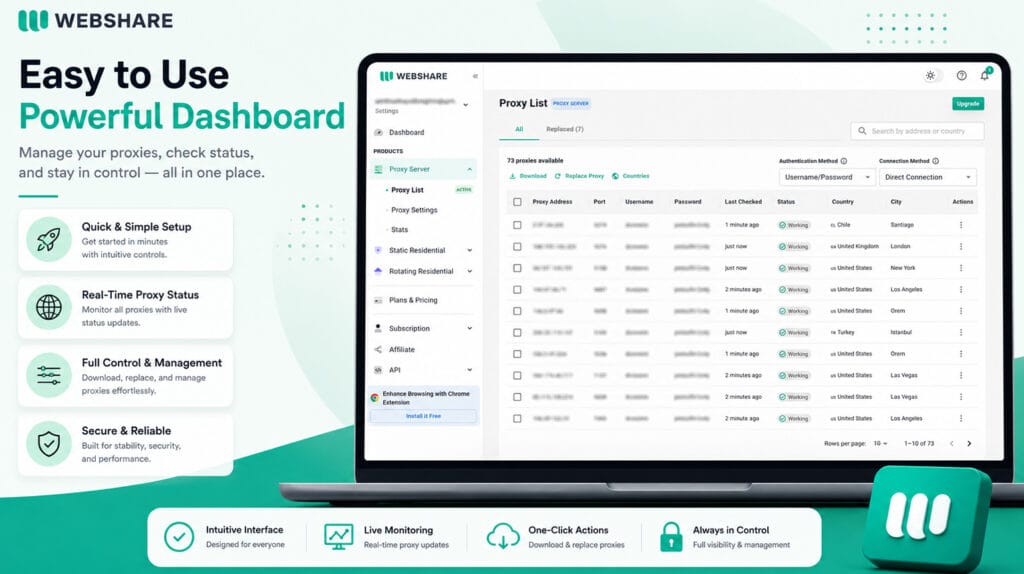
Webshare performs extremely well in Ease of Use & Dashboard. This is one of its strongest categories, mainly because the dashboard feels clean, modern, and practical for both beginners and technical users.
In daily proxy management, Webshare’s dashboard feels clean and practical, with quick access to proxy products, proxy lists, usage charts, setup guides, plan details, bandwidth data, and API controls.
Ease of Use & Dashboard Score: 4.5 / 5
Excellent dashboard usability, setup flow, documentation, and monitoring, with weaker localization and formal accessibility support.
Dashboard Design & Navigation
Webshare’s dashboard is one of the stronger dashboards in its price tier. The interface is clean, dark-mode friendly, and organized around a left sidebar that separates the main areas clearly, including proxy products, subscription settings, and API access.
The proxy list page is especially useful. It shows the important connection details in a table format, including proxy address, port, username, password, status, country, city, and actions. Working and not-working badges make proxy health easier to scan at a glance.
Sidebar Navigation
Key areas are separated into clear dashboard sections, making product switching and proxy management easier.
Proxy List Table
Proxy address, port, credentials, status, country, city, and actions are visible in a scannable table.
Status Badges
Working and not-working badges help users identify proxy health without opening extra diagnostic screens.
The main dashboard also gives users a quick view of plan and usage data. The reviewed screenshots show plan cards, bandwidth allowance, bandwidth used, total requests, date filters, and visual usage charts.
This makes the dashboard useful beyond basic proxy access. Users can see how much bandwidth they have used, how request volume changes over time, and whether usage is trending toward the plan limit.
Dashboard Visibility
Navigation is not perfect only because mobile responsiveness was not fully verified. The desktop dashboard looks polished and easy to use, but we do not have enough public evidence to call it fully optimized across mobile and tablet layouts.
Setup & Onboarding Process
Webshare is very beginner-friendly for a technical proxy product. The setup flow is helped by three things: a free plan entry point, a clear Proxy List page, and guided setup options for different connection methods.
New users can start with free datacenter proxies, then move into the dashboard and copy the proxy address, port, username, and password directly from the Proxy List page. This makes the first setup much easier than providers that require manual endpoint construction from the start.
Typical Webshare Setup Flow
Start with Webshare’s free proxy access or choose a paid proxy product based on the workflow.
View proxy address, port, username, password, status, country, city, and available proxy actions in one place.
Choose Direct, Rotating, or Backbone connection depending on whether the workflow needs static access, rotation, or stable backconnect behavior.
Use the Proxy List page or Endpoint Generator to copy the proxy host, port, username, password, location, and session settings.
Add the proxy details to a browser, scraper, anti-detect browser, cURL command, API workflow, or automation tool.
The connection method dropdown is another strong usability point. Users can choose between Direct, Rotating, and Backbone connection methods depending on the workflow. This makes Webshare easier to use than providers that force users to interpret several endpoint formats without dashboard guidance.
For rotating residential proxies, the Endpoint Generator adds another layer of simplicity. Users can choose location, authentication method, session type, and endpoint count, then copy or export the generated endpoints.
Proxy List Page
Proxy address, port, username, password, status, country, city, and actions are visible in one place.
Connection Methods
Direct, Rotating, and Backbone options help users match the proxy setup to the task.
Endpoint Generator
Residential users can generate endpoints by location, authentication method, session type, and endpoint count.
Webshare also helps users with setup guide cards inside the dashboard. These cover common tools and devices, which reduces friction for users who want to connect proxies to a browser, desktop, mobile device, or automation environment.
This is why Webshare earns a perfect setup score. It does not remove all technical complexity, because proxies still require correct configuration, but it makes the first connection process clear and repeatable.
Documentation & Guides
Webshare’s documentation is one of its strongest usability advantages. It supports both sides of the audience: beginners who need setup help and developers who need API examples, proxy logic, and automation tutorials.
The Help Center covers setup, billing, products, connection methods, account settings, troubleshooting, verification, sub-users, and API-related workflows. Webshare Academy goes deeper with scraping and automation guides for tools like Python Requests, Node.js, Axios, Selenium, Scrapy, Puppeteer, Playwright, cURL, Wget, Linux, and Ubuntu.
Help Center
Covers account setup, proxy products, connection methods, billing, troubleshooting, and common support questions.
Webshare Academy
Includes practical scraping and proxy tutorials for common developer tools, browsers, frameworks, and command-line workflows.
API Docs
Provides REST API references, token-auth examples, proxy list access, proxy stats, activity logs, and automation-ready code examples.
The troubleshooting coverage is also strong. Webshare documents common proxy problems such as non-working proxies, blocked proxies, slow speed, proxy errors, wrong-country issues, connection restrictions, and manual replacement.
This makes the platform easier to use after setup. Users are not left guessing when a proxy fails, gets blocked, shows the wrong country, or needs replacement.
Troubleshooting Coverage
The developer documentation is especially useful. Webshare provides examples in Python, JavaScript, and cURL, along with API details for authentication, proxy lists, filtering, ordering, error codes, and rate-limit behavior.
That matters because many proxy users do not only copy proxies into a browser. They connect proxies to scrapers, automation scripts, anti-detect browsers, command-line tools, and internal systems.
Real-Time Usage Monitoring
Webshare gives users strong visibility into proxy usage. The dashboard includes practical usage data such as bandwidth used, total requests, projected bandwidth, average concurrency, and date-based filtering.
This is useful because proxy users often need to know whether a campaign is consuming too much bandwidth, whether request volume is increasing, or whether a workflow is close to plan limits.
Webshare Usage Monitoring
The stronger part is that Webshare does not limit monitoring to the dashboard. Its API also supports proxy statistics, activity logs, filtering, and exports, which helps developers build their own monitoring or reporting workflows.
Activity logs can be filtered by fields such as time range, error reason, byte size, and verification category. Proxy statistics can also be retrieved programmatically, with hourly aggregation noted in the scoring data.
Strong Visibility
Dashboard charts, proxy statistics, usage cards, activity logs, filtering, and export options give users good operational visibility.
Monitoring Caveat
Some proxy statistics are described as hourly aggregated, so this should not be treated as full real-time per-session telemetry.
For most users, this level of monitoring is more than enough. It helps with budget control, troubleshooting, bandwidth planning, and understanding how proxy activity changes over time.
For enterprise observability, there are still limits. Webshare’s monitoring is strong for a proxy dashboard, but it does not replace dedicated uptime monitoring, external logging systems, or full request-by-request analytics across complex scraping infrastructure.
Accessibility & Language Options
This is the weakest part of Webshare’s dashboard category. The dashboard is clean and comfortable to use, especially on desktop, but its localization and formal accessibility support are limited.
The interface appears to be English-only, and no clear multilingual dashboard option was confirmed in the available documentation. That matters for global users who may want a localized UI, translated setup prompts, or non-English dashboard navigation.
Usability Strengths
Webshare supports a browser-based dashboard, dark/light mode, clean desktop navigation, and device setup guides for common platforms.
Localization Limits
The dashboard appears English-only, and no confirmed multilingual UI or visible language selector was found.
Webshare does get credit for general comfort features. The dashboard is browser-based, supports dark and light mode, and is supported by device setup guides for platforms like Windows, iPhone, and Android.
However, device setup guides are not the same as full dashboard accessibility. I did not find clear public evidence of WCAG compliance, screen-reader optimization, keyboard-navigation standards, or a fully verified mobile-dashboard experience.
Accessibility & Language Snapshot
For most English-speaking desktop users, this will not be a major issue. The dashboard is easy to navigate, and the setup flow is clear.
For teams that need multilingual support, formal accessibility documentation, or verified mobile dashboard optimization, Webshare is weaker than its overall usability score suggests.
Ease of Use & Dashboard Score
Webshare has one of the stronger dashboards in its price tier. The interface is clean, visual, and practical, with clear proxy tables, setup flows, usage charts, proxy status badges, API access, and strong documentation. The main deductions come from limited localization, English-only dashboard evidence, and no confirmed formal accessibility compliance.
- ✅ Clean dashboard with clear sidebar navigation and product sections
- ✅ Proxy List page shows proxy address, port, credentials, status, country, city, and actions
- ✅ Working and not-working badges make proxy status easy to scan
- ✅ Plan cards, bandwidth usage, request totals, date filters, and usage charts are available
- ✅ Free entry point, endpoint generation, and setup guide cards make onboarding beginner-friendly
- ✅ Help Center, Academy, API docs, troubleshooting pages, and developer examples are strong
- ✅ Usage monitoring includes bandwidth used, total requests, projected bandwidth, average concurrency, activity logs, and API stats
- ⚠️ Some proxy statistics are hourly aggregated, not full real-time per-session telemetry
- ⚠️ Dashboard localization appears limited, with no confirmed multilingual UI
- ⚠️ No confirmed WCAG compliance, advanced accessibility documentation, or verified mobile-dashboard optimization found
Pricing & Value
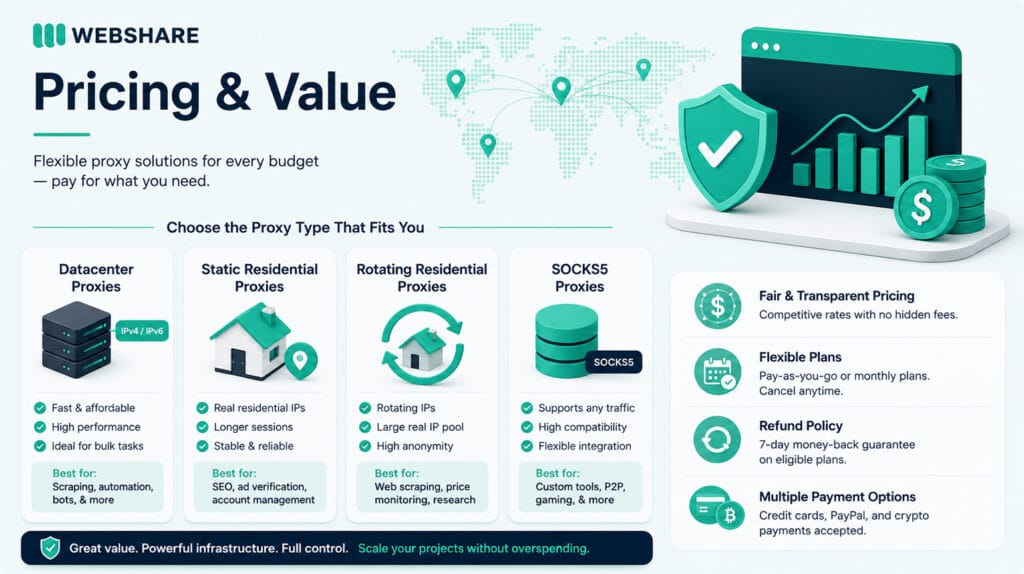
Webshare scores very well for Pricing & Value. Its strongest advantages are the free proxy plan, low entry pricing, flexible scaling, and competitive rates across Proxy Server, Static Residential, and Rotating Residential products.
The main limitations are billing flexibility and payment access. Webshare is mostly subscription-based rather than true pay-as-you-go, refunds are clear but strict, and PayPal or crypto payments are not supported.
Pricing & Value Score: 4.2 / 5
Excellent value for budget-conscious users, with small deductions for refund limits, fair-use caveats, and payment-method gaps.
Pricing Breakdown & Value-for-Money
Webshare is one of the stronger value picks in the budget proxy market. It combines low entry pricing with a clean dashboard, SOCKS5 support, API access, proxy statistics, activity logs, and multiple proxy product types.
At the time of writing, Webshare lists several low-entry proxy options across residential and datacenter categories. Pricing can change, so the figures below should be treated as a snapshot rather than fixed long-term pricing. Users should always confirm the latest rates on Webshare’s official pricing page before purchasing.
Webshare Pricing Snapshot
Prices shown below are starting prices at the time of writing and may vary by plan size, billing cycle, proxy type, location, stock, and future pricing updates.
Residential
Datacenter
Note: Private and dedicated options are available for selected static residential and proxy server plans. Rotating residential is priced by bandwidth, while static residential and proxy server plans are generally priced by IP or proxy count.
This pricing structure makes Webshare flexible for different budgets. Users can start with free datacenter proxies, buy rotating residential traffic by bandwidth, choose static residential IPs for stable sessions, or move to private and dedicated proxy server options when they need better exclusivity. The main caveat is that prices and availability can change, so the pricing page should be checked before buying.
For paid users, Webshare is also priced aggressively. The available pricing data shows low-cost entry options for proxy servers, rotating residential bandwidth, and static residential IPs. However, in the main review body, it is better not to lock the article around too many exact prices because proxy pricing changes often. A safer approach is to describe Webshare as having low entry pricing and link users to the current pricing page.
Why Webshare Scores Well on Value
- Free 10-proxy starter plan with no credit card required
- Low entry paid plans across multiple proxy product types
- Rotating Residential plans scale by bandwidth
- Static Residential plans scale by IP count
- Proxy Server plans scale by proxy count
- Strong dashboard, API, SOCKS5, and usage tools included for the price
The value score is not perfect because Webshare is not the strongest option for every advanced use case. Users who need mobile proxies, managed unblocking, deeper targeting, or premium real-target performance may still need a higher-end provider.
For most budget-conscious users, though, Webshare’s price-to-feature ratio is excellent.
Plan Flexibility & Scaling
Webshare gives users a flexible plan structure across its main proxy products. Instead of forcing every user into the same billing model, it separates pricing by use case: GB-based plans for rotating residential proxies, IP-based plans for static residential proxies, and proxy-count plans for proxy servers.
This makes scaling easier for different workflows. A scraper can scale bandwidth, an account-management workflow can scale static IPs, and a developer using datacenter proxies can scale proxy count.
Webshare Plan Scaling Model
Rotating Residential
Scales mainly by bandwidth, making it suitable for scraping, automation, and rotating traffic workflows.
Static Residential
Scales by IP count, which fits users who need stable ISP-style addresses for longer sessions.
Proxy Server
Scales by proxy count, making it useful for low-cost datacenter-style workflows and testing.
Webshare also supports monthly and yearly billing options, which gives users a choice between short-term flexibility and lower long-term pricing. For larger users, Webshare offers custom or enterprise-style plans through a contact flow rather than a fully public enterprise pricing table.
The account structure is also flexible. Users can manage multiple plans under one account, adjust subscriptions, change certain plan settings, upgrade or downgrade, and customize selected plan elements such as proxy subtype, proxy count, country allocation, bandwidth, or replacement settings.
Scaling Strengths
Monthly/yearly billing, GB-based plans, IP-count plans, proxy-count plans, multiple plans under one account, and custom enterprise options.
Scaling Caveats
Full product switching can require canceling one subscription and buying another, and yearly-plan changes may affect billing cycles.
For most self-serve users and growing teams, Webshare is flexible enough. It supports small tests, gradual scaling, and larger custom plans without pushing everyone into enterprise sales from the beginning.
The main reason it does not score a perfect 5 is that product switching is not completely seamless, and enterprise terms are not fully public.
Trial, Refund, or Pay-As-You-Go
Webshare has an excellent free entry point. Users can start with 10 free datacenter proxies and 1GB/month bandwidth without adding a credit card. That makes Webshare easier to test than many proxy providers that require payment before users can see the dashboard or try real proxy access.
This is especially useful for beginners, developers, and small teams that want to test connection setup, proxy formats, dashboard usability, and basic compatibility before buying a paid plan.
Webshare Free Entry Option
The refund policy is clear, but it is strict. Webshare states that refund requests must be made within 48 hours of purchase and must stay under usage limits. The scoring notes list limits of less than 1GB for Proxy Server or Static Residential plans, less than 0.1GB for Rotating Residential plans, and fewer than 1,000 proxies in the subscription.
That is fair enough for quick testing, but it is not a broad no-questions-asked refund policy. Users should test quickly, avoid heavy usage before deciding, and contact support directly if they want a refund.
What Works Well
Free test access is strong, paid entry is low, and the refund rules are specific enough to understand before purchase.
What to Watch
Refunds are time-limited, usage-limited, support-mediated, and canceling a subscription does not automatically trigger a refund.
Webshare also has very low-cost paid entry plans, but it is not a pure pay-as-you-go provider. Most plans are structured around monthly or yearly subscriptions rather than a wallet-style credit balance where users top up traffic whenever needed.
For most users, that tradeoff is acceptable. The free plan and low starting prices make Webshare easy to try, but users who want pure pay-as-you-go billing may prefer a provider built around credit-based usage.
Transparency & Hidden Fees
Webshare is mostly transparent with pricing. Its pricing page separates Proxy Server, Static Residential, and Rotating Residential plans, with visible plan limits, bandwidth amounts, proxy counts, billing options, and discount information.
The main caveat is that users still need to read the details around Fair Usage Policy, refunds, auto-renewal, and cancellation. These are not hidden fees, but they can affect expectations if users assume every plan works like unlimited pay-as-you-go access.
Pricing Transparency Snapshot
A positive point is that Webshare does not appear to rely on surprise overage billing. When bandwidth limits are reached, proxies stop functioning until the plan is changed or renewed, rather than silently continuing and charging unexpected overages.
That is better for budget control, especially for beginners and small teams. It helps users avoid accidentally running up a large bill from a misconfigured scraper or automation script.
Budget-Friendly Clarity
Pricing, bandwidth, proxy counts, billing cycles, and plan limits are mostly visible before purchase.
Read Before Buying
Fair-use rules, refund limits, auto-renewal, cancellation timing, and enterprise pricing need closer review.
The biggest expectation risk is around “unlimited” language. Webshare’s unlimited-bandwidth plans are still subject to fair-use thresholds, which means heavy sustained usage may be throttled after certain limits.
That does not make the pricing misleading, but it should be explained clearly. Users running high-volume scraping or production automation should check the Fair Usage Policy before choosing a plan.
Payment Methods & Access
Webshare supports mainstream payment access, but it is not the most flexible provider for payment methods. Users can pay with major card networks, plus Apple Pay and Google Pay, which is enough for many customers.
The limitation is that Webshare does not support PayPal or crypto payments. That makes it less flexible than proxy providers that support cards, wallets, PayPal, crypto, and regional payment gateways.
Webshare Payment Options
Card coverage is broad enough for most users. Webshare supports major international card networks, which makes it accessible for many countries and business users.
Still, some users may face regional restrictions. Apple Pay and Google Pay availability depends on country, bank, device, and card support. Webshare also operates under normal regional and sanctions-related restrictions, so it is not universally available in every location.
Good Access
Cards, Apple Pay, Google Pay, and broad card-network support make Webshare easy enough to buy for many mainstream users.
Payment Limits
PayPal and crypto are not supported, and some payments may depend on location, card issuer, device support, or regional restrictions.
For most professional users, the available payment methods are acceptable. But users who prefer crypto for privacy, PayPal for buyer convenience, or local payment gateways may find Webshare less flexible than some competitors.
Pricing & Value Score
Webshare is one of the stronger value picks for budget-conscious proxy users. It combines a free starter plan, low entry pricing, flexible scaling, and strong dashboard/API features. The main tradeoffs are strict refund rules, fair-use caveats, subscription-based billing, and limited payment options.
- ✅ Free 10-proxy plan with 1GB/month bandwidth and no credit card required
- ✅ Competitive starting prices across Proxy Server, Static Residential, and Rotating Residential products
- ✅ Flexible scaling by bandwidth, IP count, proxy count, monthly/yearly billing, and custom enterprise options
- ✅ Private and dedicated options are available for selected proxy server and static residential plans
- ⚠️ Prices can change, so starting prices should be treated as a time-of-writing snapshot
- ⚠️ Refunds, fair-use rules, product switching, and auto-renewal terms should be checked before purchase
- ⚠️ Webshare is mostly subscription-based and does not support PayPal or crypto payments
Support & Documentation
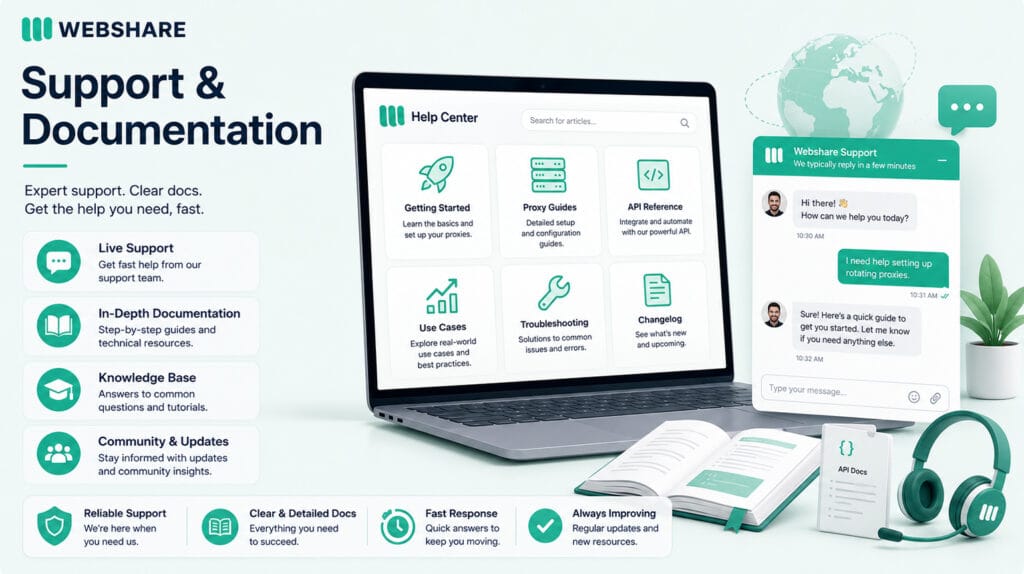
Webshare performs strongly in Support & Documentation. Its biggest advantages are the searchable Help Center, detailed setup guides, troubleshooting articles, API documentation, public status visibility, and a 24/7 website support flow with chatbot-to-human escalation.
The main limitations are outside the official support system. We did not confirm an official Discord, Telegram, Slack, public roadmap, or formal changelog, so Webshare is stronger for direct support and documentation than community-based support.
Support & Documentation Score: 4.3 / 5
Strong documentation, fast support access, and public status visibility, with small deductions for limited community channels and roadmap transparency.
Support Availability & Channels
Webshare offers a strong official support flow. Users can contact support by email, use the website support widget, and escalate from the chatbot to a human representative when needed.
The website also presents support as available around the clock, and our reviewer-tested experience found that requesting a human representative connected within minutes. That makes Webshare stronger than providers that only rely on slow email support or limited business-hour live chat.
| Support Channel | Availability Signal | Best Use |
|---|---|---|
| Email Support | Official support email is publicly listed and referenced across support materials. | Billing, account issues, refunds, proxy problems, and written support follow-up. |
| 24/7 Chatbot | Website support widget provides immediate first-line help. | Quick questions, setup help, basic troubleshooting, and support routing. |
| Human Escalation | Available through the chat flow when the chatbot cannot resolve the issue. | More specific proxy, account, billing, or troubleshooting issues that need human review. |
| Discord, Telegram, Slack | No verified official customer-support community was confirmed. | Not a major support strength for Webshare; users should rely on official support and documentation instead. |
The only major weakness is the lack of verified alternative support communities. We did not confirm an official Discord, Telegram, Slack, or similar two-way community channel for customer support.
That is not a major issue for most users because Webshare’s official support and documentation are strong. Still, users who prefer community support, public discussions, or announcement-style channels may find Webshare less open than providers with active public communities.
Strong Official Support
Email support, 24/7 chatbot access, and human escalation make the official support flow practical and easy to reach.
Limited Community Channels
No verified Discord, Telegram, Slack, or public support community was confirmed during review.
Overall, Webshare’s support availability is strong where it matters most: official contact paths, quick website support access, and a usable escalation route. The deduction comes from the missing alternative support/community layer.
Response Time & Helpfulness
Webshare performs well on support speed. Its website presents support as available around the clock, and our reviewer-tested support flow found that the AI chatbot could escalate to a human representative within minutes.
That is a strong result for a self-serve proxy provider, especially in Webshare’s price range. It means users are not limited to reading documentation or waiting for slow email support when a setup, billing, or proxy issue needs attention.
Real Response Insights
During review, Webshare’s support flow started with an AI chatbot, but human escalation was available and connected within minutes after requesting a representative. That supports Webshare’s 24/7 support positioning and makes the support experience feel practical rather than purely automated.
Helpfulness is also positive overall. Public user sentiment often praises Webshare for fast replies, easy onboarding, and practical support. This fits our experience with the support flow.
That said, support quality may vary with more complex cases. Some users report friction around account verification, blocked proxies, replacement needs, or billing/cancellation questions. These issues do not make support weak, but they show why Webshare should score very well rather than perfectly.
Support Quality Takeaway
- ✅ Fast first response through chatbot-based support
- ✅ Human escalation is available when the bot cannot resolve the issue
- ✅ Helpful enough for setup, billing, proxy access, and troubleshooting questions
- ⚠️ Complex issues may still vary, especially verification, blocked proxies, replacements, or billing disputes
For most users, Webshare’s support should feel responsive and useful. The best experience is likely for common issues such as proxy setup, account access, dashboard questions, plan changes, and basic troubleshooting.
For advanced technical cases, users may still need to explain the issue clearly, share error details, and rely on documentation or API references alongside support.
Knowledge Base & FAQs
Webshare’s knowledge base is one of the strongest parts of its support experience. The Help Center is searchable, organized into clear categories, and covers the issues proxy users are most likely to face after purchase.
This includes setup help, account settings, billing, proxy products, integrations, security, troubleshooting, and API-related topics. For self-serve users, this reduces dependence on support because many common issues can be solved directly from the documentation.
Documentation Resource Index
Covers getting started, products, billing, account settings, integrations, security, and troubleshooting.
Includes guides for proxies not working, blocked proxies, slow speed, wrong-country issues, proxy errors, and system status checks.
Documents authentication, request structure, proxy lists, proxy statistics, activity logs, billing, invoices, and automation workflows.
Adds practical guides for tools and workflows such as Python Requests, Scrapy, Selenium, Puppeteer, Playwright, cURL, and Node.js.
The troubleshooting coverage is especially useful. Webshare does not only explain how to buy proxies or copy credentials. It also documents what to do when proxies fail, become blocked, respond slowly, return errors, or appear in the wrong country.
That matters because proxy users often need help after setup, not just during setup.
Common Issues Covered
Navigation is also strong. The Help Center has a clear search bar, practical categories, related articles, and article-level structure that makes it easier to find answers without contacting support.
This is a major advantage for developers and SMB users, because they can usually move from setup to troubleshooting to API integration without leaving Webshare’s documentation ecosystem.
Community Feedback & Public Ratings
Webshare’s public reputation is generally positive, especially for a budget-friendly proxy provider. The most common praise points are affordable pricing, easy setup, clean dashboard, free proxy access, and useful documentation.
This public sentiment matches our scoring. Webshare performs best when judged as a self-serve, value-oriented proxy service rather than a premium managed scraping platform.
Public Feedback Snapshot
Users often praise pricing, ease of use, onboarding, and support responsiveness, although some complaints mention verification, billing, or blocked proxies.
Feedback generally supports Webshare’s usability and value positioning, especially for users who want a simple proxy dashboard and predictable pricing.
Third-party review coverage highlights Webshare’s affordability, dashboard analytics, API support, and flexible plans, while noting that it lacks some advanced tools found in higher-end competitors.
Benchmark data supports Webshare’s infrastructure strength, but also shows weaker results on stricter real-world targets compared with top premium providers.
The positive pattern is clear. Webshare is often liked by users who want a proxy service that is affordable, quick to set up, and easy to manage without needing enterprise sales.
The negative feedback is also consistent with the limitations found in this review. Users running stricter targets, heavier scraping workloads, or account-sensitive workflows may run into more friction than users running simple testing, automation, or lower-risk proxy tasks.
Common Praise
Low pricing, free proxies, clean dashboard, simple onboarding, API access, useful documentation, and responsive support.
Common Criticism
Mixed results on stricter targets, account verification friction, payment limits, blocked proxies, and limited deep targeting.
Overall, Webshare’s public reputation supports the review score. It is not flawless, and it should not be positioned as a premium enterprise unblocking platform. But for users who want affordable proxy infrastructure with a strong dashboard and documentation, the wider feedback is mostly favorable.
Status Page, Changelog & Public Presence
Webshare does well on status transparency. It maintains a public system-status path that helps users check whether a proxy issue is isolated to their account or part of a wider service incident.
This is important for proxy users because connection problems are not always caused by bad credentials or blocked targets. Sometimes the issue can be related to provider-side incidents, degraded proxy pools, or temporary service interruptions.
Status Transparency Snapshot
Webshare also gets credit because its troubleshooting materials point users toward system-status checks when diagnosing proxy problems. That makes the status page part of the practical support flow, not just a hidden technical page.
Third-party monitoring visibility also helps. StatusGator tracks Webshare components and incident history, which gives users another way to see whether outages or proxy error-rate events have been recorded externally.
The weaker side is roadmap transparency. Webshare publishes blog and educational content, but we did not confirm a formal public product roadmap, public changelog, GitHub-style release log, or open feedback board.
Strong Visibility
Public status page, incident history, troubleshooting references, StatusGator visibility, and active blog content.
Roadmap Gap
No clearly confirmed public roadmap, formal changelog, open feedback board, or community release tracker was found.
For day-to-day reliability checks, Webshare is transparent enough. Users can check service health, review incidents, and use troubleshooting guidance before assuming a proxy list is broken.
For product-planning visibility, it is weaker. Larger teams that want to track feature releases, upcoming changes, or roadmap commitments may need to rely on direct support rather than public changelog information.
Support & Documentation Score
Webshare performs strongly in Support & Documentation. Its best strengths are fast official support access, strong self-serve documentation, detailed troubleshooting coverage, API docs, setup guides, and public status visibility. The main gaps are the lack of verified community support channels and no clearly confirmed public roadmap or formal changelog.
- ✅ Email support, 24/7 chatbot access, and human escalation are available
- ✅ Reviewer-tested support escalation connected to a human representative within minutes
- ✅ Help Center, troubleshooting guides, setup documentation, API docs, and Academy tutorials are strong
- ✅ Public status page and incident visibility help users check wider service issues
- ✅ Public feedback is generally positive around price, dashboard, ease of use, and support speed
- ⚠️ No verified Discord, Telegram, Slack, or public support community was confirmed
- ⚠️ No formal public roadmap, structured changelog, or open feedback board was confirmed
Who Should and Shouldn’t Use Webshare?
Webshare is a strong fit for users who want affordable proxy infrastructure, a clean dashboard, SOCKS5 support, API access, and flexible self-serve plans.
It is not the right choice for every advanced proxy workflow, especially if you need mobile proxies, deep targeting, managed CAPTCHA solving, or premium residential performance on strict targets.
Ideal Users & Scenarios
Webshare is a good fit for users who want practical proxy access without enterprise-level pricing. It works best when the user understands their workflow and wants to manage proxies through a dashboard, API, or direct connection setup.
Webshare Is Best For
Good for users who want low entry pricing and free test access before upgrading.
Useful for scraping tools, bots, scripts, API workflows, and proxy-controlled automation.
A practical option for teams that need proxy access without premium enterprise contracts.
Good for users who want protocol flexibility, API control, and dashboard-based proxy management.
Suitable for basic monitoring, market research, QA checks, and lower-risk data workflows.
A good fit for users who prefer clean controls, proxy lists, usage stats, and setup guides.
Not Recommended For
Webshare is less suitable when the project needs advanced targeting, managed unblocking, or very high success rates on strict websites.
Webshare May Not Be the Best Fit If You Need
- Mobile proxies or carrier-level targeting
- ZIP code, device-level, or deeper geo-targeting controls
- Managed CAPTCHA solving or full unblocking-as-a-service
- PayPal or crypto payment support
- VPN-style anonymity or privacy-first browsing protection
- The absolute strongest residential performance on strict targets
Quick Fit Verdict
Webshare is best viewed as a budget-friendly, developer-friendly proxy platform, not a fully managed unblocking suite.
Bottom-Line Fit
Choose Webshare if you want affordable proxy infrastructure, free test access, SOCKS5 support, API controls, and a clean dashboard. Look elsewhere if you need mobile proxies, premium managed scraping tools, deep targeting, or the highest success rates on heavily protected websites.
For the right user, Webshare offers strong value. It is especially good for developers, small teams, and budget-conscious proxy users who want control over their setup without paying enterprise pricing.
Pros & Cons
Webshare’s strengths are clear: it is affordable, easy to start with, developer-friendly, and supported by a strong dashboard and documentation system.
Its weaknesses are also important. It does not offer mobile proxies, deep targeting, PayPal, crypto, or a fully managed unblocking layer, so it is better for self-serve proxy infrastructure than premium enterprise scraping.
Pros
- Very competitive pricing
- Free plan with no credit card required
- Datacenter, static residential, and rotating residential options
- HTTP(S) and SOCKS5 support
- Strong API and developer documentation
- Clean dashboard with usage charts and logs
- Fast 24/7 support flow with human escalation
- Public status page and incident visibility
Cons
- No mobile proxies
- No ZIP, carrier, or device-level targeting
- Mixed performance on stricter real-world targets
- No PayPal or crypto payment support
- English-only dashboard
- Refund policy is restrictive
- No public roadmap or verified community channel
Pros & Cons Takeaway
Webshare’s pros are strongest for budget buyers, developers, SMBs, and self-serve proxy users. The free plan, SOCKS5 support, API access, and clean dashboard make it easy to test and scale.
The cons matter more for advanced use cases. Users who need mobile proxies, deeper targeting, managed CAPTCHA solving, privacy-first anonymity, or premium performance on strict targets may need a more specialized provider.
Bottom line: Webshare offers excellent value if you want affordable, developer-friendly proxy infrastructure. It is less suitable if your workflow depends on mobile proxies, deep targeting, or managed unblocking for heavily protected websites.
Final Verdict: Is Proxy6 Worth It?
Webshare is worth it if you want affordable, self-serve proxy infrastructure with a strong dashboard, SOCKS5 support, flexible plans, and excellent documentation.
It is not the most advanced provider for premium unblocking, but it offers very strong value for developers, SMBs, budget-conscious scraping teams, and self-serve proxy users.
Summary Judgment
Webshare’s strongest value is balance. It gives users a free starter plan, low-cost proxy access, datacenter, static residential, and rotating residential options, API controls, usage monitoring, and clean dashboard management without forcing buyers into enterprise pricing.
The tradeoff is that Webshare is not a full managed scraping suite. It does not offer mobile proxies, ZIP or carrier-level targeting, managed CAPTCHA solving, PayPal, crypto, or the strongest residential success rates on stricter targets.

Budget-friendly proxy access with strong targeting, rotation, and developer controls.
Choose Webshare If
- You want a free proxy starter plan
- You need low-cost datacenter or residential proxies
- You use APIs, scripts, or automation tools
- You value a clean dashboard and strong docs
- You need HTTP(S) and SOCKS5 support
- You want good pricing without enterprise complexity
Look Elsewhere If
- You need mobile proxies
- You need carrier, ZIP, or device-level targeting
- You need managed CAPTCHA solving
- You require PayPal or crypto payments
- You want the strongest residential performance on strict targets
- You need a public roadmap or active community support channel
Proxy Score Breakdown
Network Quality & Reach: 3.8 / 5
Performance & Reliability: 3.5 / 5
Security & Privacy: 3.7 / 5
Features & Flexibility: 4.2 / 5
Ease of Use & Dashboard: 4.5 / 5
Pricing & Value: 4.2 / 5
Support & Documentation: 4.3 / 5
Best fit: budget-conscious developers, SMBs, automation teams, and self-serve proxy users.
Score Guide: 5.0 = Outstanding | 4.5 = Excellent | 4.0 = Great | 3.5 = Good | 2.5 = Average | 2.0 = Below Average | 1.0 = Poor
How we rate proxies: Each score is based on network quality, performance, security and privacy, proxy features, ease of use, pricing, support, documentation, and practical testing signals where available. We apply the same review framework across proxy providers for consistency.
Final verdict: Webshare is a Great value pick for users who want affordable proxy access with strong self-serve controls. It is best for budget-conscious developers, SMBs, and automation teams, but not ideal for users who need mobile proxies, deep targeting, managed CAPTCHA solving, or premium unblocking performance.
Frequently Asked Questions
Is Webshare worth it in 2026?
Yes, Webshare is worth it if you want affordable, self-serve proxy infrastructure with a clean dashboard, SOCKS5 support, API access, and flexible plans. It is best for developers, SMBs, and budget-conscious proxy users.
It is not the best choice if you need mobile proxies, managed CAPTCHA solving, deep targeting, or premium unblocking performance on strict websites.
Is Webshare legit?
Yes, Webshare appears to be a legitimate proxy provider. It has established proxy products, public documentation, a searchable Help Center, API docs, a public status page, visible pricing, and a large base of user reviews.
That said, users should still choose the right proxy type for their use case and read the refund, fair-use, and billing terms before buying.
Does Webshare offer free proxies?
Yes. Webshare offers a free proxy plan with 10 free datacenter proxies, 1GB/month bandwidth, and no credit card required.
This makes it easier to test the dashboard, proxy format, connection setup, and basic compatibility before moving to a paid plan.
Does Webshare support SOCKS5?
Yes, Webshare supports SOCKS5, along with HTTP and HTTPS proxy connections.
This is useful for users who need protocol flexibility across browsers, scraping tools, automation scripts, and applications that support SOCKS5 proxy configuration.
Is Webshare good for web scraping?
Webshare can be good for budget scraping, automation, SEO monitoring, testing, and basic data collection workflows.
For stricter targets, users may need rotating residential or static residential proxies, careful session control, retries, and proper scraping logic. Webshare is not a fully managed unblocking or CAPTCHA-solving platform.
Does Webshare have mobile proxies?
No, Webshare does not currently offer mobile proxies. Its main proxy products focus on datacenter-style proxy servers, static residential proxies, and rotating residential proxies.
Users who need carrier targeting, mobile IPs, or device-level targeting should look at providers with dedicated mobile proxy networks.
What are Webshare’s main downsides?
Webshare’s main downsides are the lack of mobile proxies, limited deep targeting, mixed performance on stricter real-world targets, no PayPal or crypto payments, an English-only dashboard, strict refund rules, and no clearly confirmed public roadmap or community support channel.
These limitations do not make Webshare weak overall, but they matter for advanced scraping, privacy-focused, or enterprise-managed workflows.
What are the best Webshare alternatives?
The best Webshare alternative depends on the use case. Decodo and IPRoyal are good alternatives for residential proxy users, Proxy-Seller is strong for flexible proxy variety and targeting, while Bright Data and Oxylabs are better suited for enterprise-grade scraping and managed unblocking needs.
For budget self-serve proxy users, Webshare remains one of the stronger value picks.

Ash Sh.
Senior Research Strategist & Editor
I’m the senior research strategist and editor at VPNProxySolutions.com, where I focus on analyzing VPNs, proxy networks along with various online privacy technologies. With over seven years of experience in cybersecurity research, I’ve developed a structured approach to evaluating providers based on documentation, independent audits, public benchmarks and real-world use cases. My goal is to make complex digital privacy tools easier to understand, whether you’re comparing services, troubleshooting connections or just learning how anonymity works in practice.
About us