

IPRoyal is a reliable, competitively priced proxy provider offering residential, ISP, datacenter, and mobile proxies through an easy-to-use dashboard. Its flexible per-request rotation, sticky sessions, and custom TTL controls suit individuals, developers, agencies, and small to mid-sized teams handling scraping, automation, SEO monitoring, and multi-account workflows. However, independent testing shows weaker results on difficult anti-bot targets, so demanding enterprise scraping may require a premium provider or managed unblocker.
IPRoyal Review at a Glance
IPRoyal combines flexible proxy types, strong rotation controls, an easy dashboard, and competitive pricing for teams and automation workflows.
Key Features
- Residential, ISP, datacenter, mobile, and Web Unblocker
- HTTP/HTTPS and SOCKS5 support
- Rotating and sticky sessions with custom TTL
- Country, state, city, and ISP targeting
- API access and automation examples
- Sub-users, organizations, and traffic controls
- Usage statistics, reports, and public status page
Best For
- Developers and web scrapers
- Small to mid-sized teams
- Users needing multiple proxy types
- SOCKS5 and API automation workflows
- Agencies managing multiple projects
- Users wanting easy setup and fast support
Pros
- Wide proxy selection
- Flexible rotation and sticky sessions
- Clean, beginner-friendly dashboard
- Competitive, flexible plans
- Non-expiring residential traffic
- Useful API and setup guides
- Fast live-chat support
- Public incident reporting
Cons
- Weaker on strict anti-bot targets
- Limited ASN and ZIP targeting
- Entry residential plans cost more
- Conditional free-trial access
- No audited no-logs policy
- Documentation spread across several hubs
- Limited request-level logging
- No public product roadmap
IPRoyal Proxy Score Breakdown
Network Quality & Reach: 4.4 / 5
Performance & Reliability: 3.3 / 5
Security & Privacy: 3.6 / 5
Features & Flexibility: 4.5 / 5
Ease of Use & Dashboard: 4.5 / 5
Pricing & Value: 4.4 / 5
Support & Documentation: 4.6 / 5
Table of Contents
- 1. Introduction
- 2. Network Quality & Reach
- 3. Performance & Reliability
- 4. Security & Privacy
- 5. Features & Flexibility
- 6. Ease of Use & Dashboard
- 7. Pricing & Value
- 8. Support & Documentation
- 9. Who Should & Shouldn’t Use This Proxy
- 10. Pros & Cons
- 10. Alternatives and Competitors; Cons
- 11. Final Verdict
- 12. FAQs
Introduction to IPRoyal
What Is IPRoyal?
IPRoyal is a proxy service offering residential, ISP, datacenter, and mobile proxies, alongside a separate Web Unblocker product for more demanding scraping tasks. Its product range supports use cases such as web scraping, SEO monitoring, market research, automation, ad verification, social media management, and location-based testing.
The provider sits in the mid-market segment. It offers more proxy variety, session control, and team functionality than many basic budget services, while remaining easier to access and generally more affordable than large enterprise-focused proxy platforms.
A key part of IPRoyal’s appeal is flexibility. Users can start with pay-as-you-go residential traffic, short-duration ISP access, dedicated datacenter IPs, rotating mobile traffic, or larger custom plans. Proxy configuration is handled through a clean dashboard with location filters, protocol selection, rotation settings, custom session duration, usage statistics, and downloadable reports.
IPRoyal is a proxy provider, not a consumer VPN service. Its proxies route traffic from selected browsers, applications, scrapers, or automation tools through another IP address. They do not provide the same device-wide encrypted tunnel, kill switch, or privacy protection normally associated with a VPN.
What This IPRoyal Review Covers
This IPRoyal review evaluates the provider across seven weighted categories rather than focusing only on residential proxy pricing or headline network claims.
We examine:
- Network size, IP diversity, and available proxy types
- Country, state, city, ISP, and mobile targeting
- Response times, request success rates, uptime, and blocking
- Residential IP sourcing, logging, protocols, and legal policies
- Rotation modes, sticky sessions, custom TTL, API access, and team tools
- Dashboard design, setup flow, documentation, and usage monitoring
- Pricing models, pay-as-you-go access, trials, refunds, and payment methods
- Support availability, response quality, and public incident reporting
This approach helps show not only what IPRoyal offers, but also where its features work well, where independent testing raises concerns, and which users are most likely to receive good value.
How We Tested and Scored IPRoyal
This IPRoyal review combines official documentation, dashboard observations, independent benchmark data, public user feedback, direct support testing, and our weighted seven-category proxy scoring framework.
- Official IPRoyal product, pricing, legal, sourcing, and policy pages
- IPRoyal Help Center, quick-start guides, API docs, and GitHub examples
- Current dashboard screenshots and proxy configuration observations
- Public uptime, component status, maintenance, and incident history
- Independent performance benchmarks and hands-on third-party reviews
- Public feedback from G2, Trustpilot, and other user-review platforms
- Direct live-chat testing, including bot-to-human escalation in about five minutes
- Weighted scoring across seven categories and more detailed subfactors
We treat each type of evidence differently. IPRoyal’s published network size, success rate, speed, and uptime figures are identified as provider claims rather than independent measurements.
Third-party benchmarks are used to evaluate observed speed, success rates, IP availability, geo consistency, and performance on difficult websites. Dashboard screenshots support our usability and configuration findings, while our direct support test is clearly presented as a hands-on observation.
This separation matters because a proxy provider can perform very well on ordinary infrastructure tests while producing weaker results on websites with strict anti-bot systems.
IPRoyal Proxy Types at a Glance
IPRoyal covers the four main proxy categories, giving users more flexibility than providers focused on only one or two network types. Web Unblocker is also available as a separate managed scraping product.
| IPRoyal Product | Best Suited For | Main Behavior |
|---|---|---|
| Residential Proxies | Scraping, SEO, market research, and geo access | Shared rotating IP pool |
| ISP Proxies | Stable accounts, long sessions, and static workflows | Dedicated static IPs |
| Datacenter Proxies | Fast and lower-cost proxy tasks | Dedicated datacenter IPs |
| Mobile Proxies | Social platforms, mobile testing, and ad verification | Real mobile network IPs |
| Web Unblocker | Managed access to difficult websites | Separate automated scraping product |
Residential proxies provide the broadest location coverage and the most flexible rotation controls. ISP and datacenter proxies are better suited to stable, dedicated-IP workflows, while mobile proxies provide access through real mobile networks. Web Unblocker adds automated retries and anti-bot handling, but it should not be confused with the standard proxy plans evaluated throughout this review.
Who This Review Is For
Developers and Scrapers
For users comparing proxy types, rotation controls, API access, and real-world performance.
SEO and Monitoring Teams
For rank tracking, price monitoring, market research, and location-based testing.
Agencies and Teams
For organizations needing sub-users, project separation, and traffic allocation.
Automation Users
For workflows requiring SOCKS5, rotating endpoints, sticky sessions, and API access.
Social and Mobile Testing
For mobile IP testing, social platforms, ad verification, and carrier-based workflows.
Proxy Buyers Comparing Value
For individuals and businesses comparing IPRoyal with mid-market and premium providers.
Network Quality & Reach
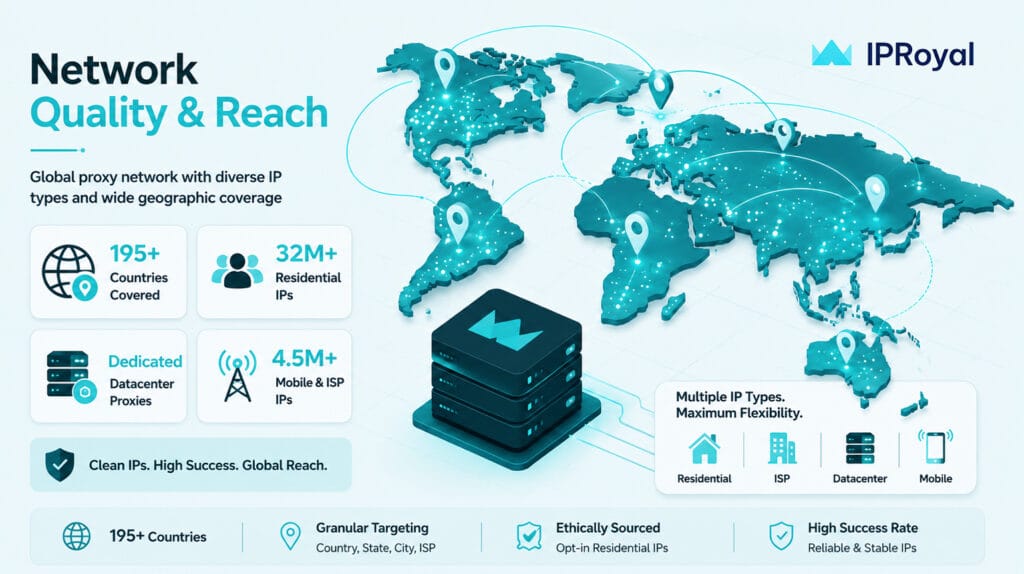
IPRoyal operates a broad and flexible proxy network spanning residential, ISP, datacenter, and mobile products. Its residential service claims more than 32 million IPs across 195+ countries, while dedicated ISP, datacenter, and mobile options support static and specialized workflows. Flexible rotation and city-level targeting strengthen its reach, though active pool availability, ASN depth, and strict-target reputation are less consistently verified.
Network Quality & Reach Score: 4.4 / 5
Excellent proxy variety, global residential reach, flexible rotation, and strong city-level targeting.
IP Pool Size and IPRoyal Proxy Types
IPRoyal’s network combines four main proxy categories: residential, ISP, datacenter, and mobile proxies. This gives users access to both rotating shared pools and dedicated static IPs, allowing the service to support scraping, automation, account management, social media workflows, and speed-focused tasks from one platform.
IPRoyal claims more than 32 million residential IPs, 500,000+ ISP IPs, and 4.5 million+ mobile IPs. Its datacenter network is presented by geographic availability rather than a disclosed total IP count, with coverage across more than 60 locations. The company also summarizes its overall network as more than 34 million ethically sourced proxies.
These numbers should be interpreted carefully. A provider’s advertised pool size usually represents the total network accumulated across locations and time, not the number of IPs simultaneously online and available to every customer.
Residential Proxies
A shared rotating pool for scraping, SEO monitoring, market research, and geo-sensitive tasks across 195+ countries.
ISP Proxies
Dedicated static IPs with ISP-style legitimacy, suited to accounts, persistent sessions, and stable long-term workflows.
Datacenter Proxies
Dedicated private IPs for faster, lower-cost automation, testing, bulk requests, and less restrictive websites.
Mobile Proxies
Real 3G, 4G, 5G, and LTE network IPs for social media, mobile testing, ad verification, and carrier-based tasks.
Shared and Dedicated Access
Residential proxies use shared pool access, while ISP, datacenter, and rented mobile proxies provide dedicated use.
The independent result does not prove that IPRoyal’s claimed pool size is inaccurate. It measures the unique addresses observed under a specific testing method, location mix, and time period. However, it shows why the advertised figure should be described as the claimed total network, not guaranteed simultaneous availability.
IPRoyal still stands out for proxy variety. Residential users access a broad shared pool with rotating and sticky sessions, while ISP and datacenter customers receive dedicated static proxies. Mobile proxies are also reserved for the customer while rented, providing physical mobile-network access rather than ordinary datacenter IPs.
IPRoyal Residential Proxies
IPRoyal’s residential proxies provide access to a large shared pool of real household IP addresses. The provider claims more than 32 million residential IPs across 195+ countries and regions, giving users broad coverage for scraping, SEO monitoring, price tracking, market research, and location-sensitive testing.
Users can request a new IP with every connection or create a sticky session that attempts to retain the same IP for a selected period. Session TTL can be set from 1 second to 7 days, although long sessions depend on the underlying residential device remaining online.
Important: Residential IPs come from a shared rotating network. Customers receive access to the pool, but individual addresses are not permanently assigned or exclusive.
This shared structure is useful when frequent IP changes and broad geographic coverage matter more than permanent ownership of one address. Users who require a fixed, dedicated IP for long-term account access may be better served by IPRoyal’s ISP or datacenter proxies.
IPRoyal ISP Proxies
IPRoyal’s ISP proxies combine the stability of datacenter hosting with IP addresses registered to internet service providers. Each proxy is assigned to one customer, so the IP is not shared with other IPRoyal users during the subscription period.
Unlike rotating residential proxies, ISP proxies remain static. This makes them better suited to account access, whitelisting, eCommerce management, persistent browser profiles, and other workflows where frequent IP changes could trigger verification or disrupt a session.
Dedicated Access
Each ISP proxy is assigned exclusively to the buyer, reducing user overlap and improving session consistency.
Static Sessions
The same IP remains available for long sessions, account logins, whitelisting, and persistent workflows.
Location Selection
Availability includes country, state, and city options, although coverage is narrower than the residential pool.
ISP proxies can appear more trustworthy than standard datacenter IPs because they are associated with internet service providers. However, they are still hosted proxies rather than addresses supplied by continuously changing household devices, so they do not provide the same pool size or rotation flexibility as IPRoyal’s residential product.
IPRoyal Datacenter Proxies
IPRoyal’s datacenter proxies are dedicated private IPs hosted on server infrastructure rather than household or mobile connections. Each proxy is assigned to one customer, helping avoid the reputation overlap commonly associated with heavily shared datacenter pools.
They are generally the most practical IPRoyal option for users prioritizing speed, predictable static access, and lower per-proxy costs. Common uses include bulk requests, testing, automation, market research, and access to websites that do not apply aggressive anti-bot filtering.
| Area | IPRoyal Datacenter Proxies | Practical Impact |
|---|---|---|
| Access Model | Dedicated static IPs | Better consistency and less user overlap |
| Best Use | Speed-focused and lower-cost tasks | Useful for testing, automation, and bulk requests |
| Main Limitation | Smaller location range than residential proxies | Less suitable for strict geo-sensitive or anti-bot targets |
IPRoyal lists datacenter availability across more than 60 locations and supports both HTTP/HTTPS and SOCKS5. However, these proxies remain static and do not provide the large rotating pool or household-level legitimacy of residential proxies.
For users handling straightforward automation or lower-protection websites, datacenter proxies may offer the best balance of speed and cost. For strict targets that closely inspect IP origin or reputation, residential, ISP, mobile, or managed unblocking options are usually safer choices.
IPRoyal Mobile Proxies
IPRoyal’s mobile proxies route traffic through physical mobile devices and SIM cards connected to real carrier networks. The provider claims access to more than 4.5 million mobile IPs, with support for 3G, 4G, 5G, and LTE connections across selected countries and cities.
This makes them better suited than ordinary datacenter proxies for workflows where mobile-network identity matters, including social media management, mobile app testing, ad verification, account management, and location-specific mobile research.
Dedicated Mobile: A rented mobile device and SIM connection reserved for the customer during the plan period.
Rotating Mobile: Access to a broader mobile IP pool with IP switching for automation and repeated requests.
Dedicated mobile proxies are useful when a workflow needs a stable mobile identity, while rotating mobile access is better for tasks that benefit from frequent IP changes. IPRoyal also supports instant IP switching in supported mobile configurations.
The main limitation is availability. Mobile coverage is narrower and more location-dependent than the residential network, and public setup documentation confirms country, state, and city selection more clearly than self-service carrier or connection-type filtering.
Geographic Coverage and City-Level Targeting
IPRoyal’s strongest geographic coverage comes from its residential proxy network, which the provider says spans 195+ countries and regions. Users can target proxies by country, state, and city, making the service suitable for localized scraping, SEO tracking, price monitoring, ad verification, and other location-sensitive tasks.
Coverage varies by proxy type. Residential proxies provide the broadest global reach, while ISP, datacenter, and mobile availability is more limited and depends on the selected product and location. IPRoyal’s ISP proxies, for example, are available in more than 30 countries rather than across the full residential footprint.
| Targeting Level | Availability | Main Caveat |
|---|---|---|
| Country | Residential coverage across 195+ countries and regions | Other proxy types cover fewer locations |
| State and City | Supported across residential and selected static products | Availability depends on the chosen country and proxy type |
| ISP | Available for eligible residential proxy accounts | Requires identity verification and account eligibility |
| ASN and ZIP | Not clearly confirmed in public setup documentation | Should not be presented as standard self-service targeting |
Independent testing provides a positive signal for country-level geo accuracy. In Proxyway’s US ISP sample, 99% of tested IPs resolved to the United States in MaxMind and 100% in IP2Location.
However, only around 60% of the tested ISP proxies showed matching ASN and organization location. This does not necessarily mean the visible proxy location was incorrect, but it shows that IP ownership data can differ from the user-facing geolocation.
Overall, IPRoyal locations are well suited to users who need broad country coverage and practical city-level targeting. The main limitation is deeper network precision: full-pool geo accuracy, self-service ASN selection, and ZIP-level targeting are not publicly verified to the same standard.
Rotation, Sticky Sessions, and TTL Control
IPRoyal offers one of the more flexible session-control systems in its price range. Residential users can request a new IP with every connection, keep the same IP through a sticky session, or manually rotate active sessions. Sticky-session TTL can be customized from 1 second to 7 days, giving users much more control than providers limited to a few fixed session lengths.
Per-Request Rotation
Assigns a new residential IP with each request, useful for scraping, monitoring, and repeated automation.
Sticky Sessions
Keeps the same IP for logins, carts, account sessions, and other workflows that require continuity.
Custom TTL
Lets users set sticky duration from 1 second to 7 days through dashboard and API-style configuration.
Manual Rotation
Allows users to refresh active sessions manually when an IP becomes blocked, slow, or unsuitable.
The main caveat is that a configured TTL is not a guarantee that the same residential IP will remain online for the full period. Residential addresses come from real devices, and the connection can end if the underlying peer disconnects.
Datacenter and ISP proxies behave differently. They are static products, so they generally keep the same assigned IP without relying on rotating gateway settings. This makes them more predictable for whitelisting and long-term account access, while residential proxies remain better for workflows that need frequent IP changes.
IP Quality, Reputation, and Block Risk
IPRoyal’s residential proxies show strong legitimacy signals, but their reputation is less consistent on heavily protected websites. Independent testing found that more than 99% of sampled residential IPs were correctly classified as residential in several regions, which reduces the risk of obvious datacenter-style detection.
However, residential classification does not guarantee that an IP is clean, unflagged, or able to bypass anti-bot systems. IPRoyal does not publish an independently verified blacklist rate, fraud-score distribution, or percentage of IPs free from previous abuse.
| Test Area | Observed Result | What It Means |
|---|---|---|
| Residential Classification | 99.28% for the global residential gateway | Most sampled IPs appeared as genuine residential connections |
| Normal Infrastructure Tests | Approximately 98.97% to 99.87% success | Strong reliability against neutral, lower-protection targets |
| Amazon | 82.70% residential success | Usable, but with noticeable block or failure pressure |
| 66.77% residential success | High failure risk for demanding Google scraping | |
| 74.42% residential success | Mixed suitability for social automation |
Across Amazon, Google, and Instagram, IPRoyal’s residential proxies achieved a combined success rate of 74.63% in Proxyway’s testing. ISP proxies also produced mixed results, reaching 73.72% combined success across Amazon and Google.
Reputation caveat: IPRoyal performs well on ordinary infrastructure targets, but stricter websites show significantly more blocks and failures. Users scraping Google, Amazon, Instagram, or similarly protected platforms should test a small workload before scaling.
The network therefore appears legitimate and broadly usable, but not consistently clean enough to rank among the strongest providers for difficult anti-bot targets. Its IP quality is better suited to general scraping, SEO monitoring, market research, and moderate automation than high-risk scraping where failure rates must remain very low.
ISP, Carrier, ASN, and ZIP Targeting
IPRoyal supports useful targeting beyond basic country selection, but its deepest controls are not equally available to every user. Residential proxies can target by country, state, city, and ISP, while mobile products provide access to real carrier networks. However, public documentation does not clearly confirm self-service ASN, ZIP-code, or device-fingerprint targeting as standard account features.
ISP Targeting
Confirmed for eligible residential accounts, but it requires identity verification and account approval.
Carrier Access
Mobile proxies use real 3G, 4G, 5G, and LTE networks across supported carriers and locations.
ASN Targeting
Not clearly confirmed as a self-service filter in public product or API documentation.
ZIP Targeting
Mentioned in educational content, but not clearly documented in the main setup or API controls.
Device Targeting
No confirmed controls for device model, operating system, screen type, or fingerprint selection.
ISP targeting is the clearest advanced option. IPRoyal’s residential documentation supports ISP selection through proxy configuration and API-generated access. However, this feature is gated behind verified identity and a minimum account-spend requirement, so standard users should not assume it will be available immediately.
Mobile proxies provide access through genuine carrier networks, but the official setup guides emphasize country, state, and city selection more clearly than direct carrier or network-generation filters. Public evidence does not fully prove that every user can choose a named carrier or force a specific 3G, 4G, or 5G connection for each session.
ZIP-level targeting is similarly uncertain. IPRoyal references ZIP precision in one educational comparison article, but ZIP parameters are not clearly listed in the primary residential setup documentation or public API targeting endpoints.
Overall, IPRoyal offers stronger targeting than country-only proxy services, especially through city and eligible ISP controls. It is less suitable for teams that require guaranteed ASN selection, postal-code precision, or device-level fingerprint targeting.
Network Quality & Reach Score
IPRoyal offers excellent network variety and geographic reach for its price range. Its biggest advantages are the claimed 32M+ residential IP pool, coverage across 195+ countries, support for residential, ISP, datacenter, and mobile proxies, and flexible rotation and sticky-session controls. The main deductions come from mixed results on strict anti-bot targets, gated ISP targeting, limited verified ASN diversity, and no clearly confirmed self-service ZIP targeting.
- ✅ Claims 32M+ residential IPs across 195+ countries and regions
- ✅ Offers residential, ISP, datacenter, and mobile proxies
- ✅ Shared rotating and dedicated static access options are available
- ✅ Country, state, and city targeting support localized workflows
- ✅ Per-request rotation and sticky sessions with custom TTL controls
- ✅ HTTP/HTTPS and SOCKS5 support across major proxy products
- ⚠️ Independent testing showed mixed success on strict anti-bot targets
- ⚠️ ISP targeting requires account eligibility and identity verification
- ⚠️ Full ASN diversity and enterprise-grade ASN targeting are not publicly verified
- ⚠️ ZIP and device-level targeting are not clearly confirmed in primary documentation
Performance & Reliability
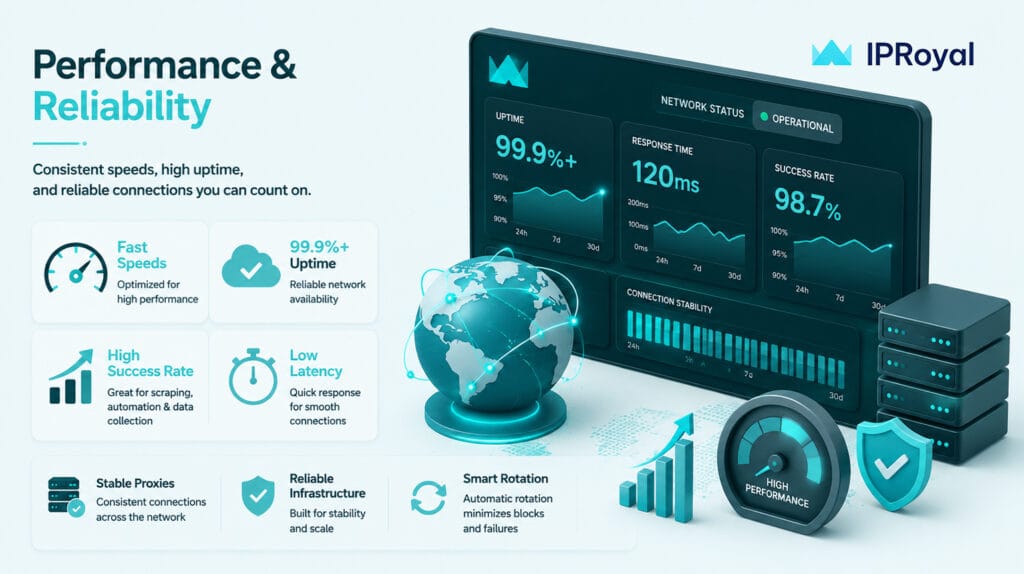
Is IPRoyal fast and reliable for web scraping? For general scraping, SEO monitoring, and routine automation, IPRoyal delivers good baseline performance. Residential proxies completed roughly 98.97% to 99.87% of requests in independent infrastructure tests, while regional latency ranged from 0.48 seconds in the UK to 1.57 seconds in Brazil.
Performance becomes less consistent on websites with stronger anti-bot systems. Residential proxies achieved 74.63% combined success across Amazon, Google, and Instagram, with Google falling to 66.77%. This makes IPRoyal suitable for normal small and mid-sized workloads, but less dependable for strict targets or enterprise scraping that requires consistently high completion rates.
Performance & Reliability Score: 3.3 / 5
Strong residential infrastructure reliability and uptime are offset by strict-target failures, regional latency variation, and limited built-in retry handling.
IPRoyal Speed and Latency
IPRoyal advertises an average residential proxy response time of around 0.5 seconds. Independent testing shows that this is achievable in favorable regions, but it does not represent every gateway, target, or page size.
In Proxyway’s nearby-CDN tests, IPRoyal’s residential proxies averaged 0.48 seconds in the UK and 0.52 seconds in Europe. The US gateway remained reasonably fast at 1.01 seconds, while the global gateway averaged 1.06 seconds. ISP proxies recorded a strong 0.46-second average, although they still trailed the fastest specialist ISP providers.
The larger-page test showed a wider performance gap. A 2 MB page loaded in 1.56 seconds through the US gateway, but took 7 seconds through the global gateway. This suggests that IPRoyal proxy speed depends heavily on the selected region, route, and amount of data being transferred.
Target matters: Neutral infrastructure tests measure basic network speed. Strict websites add rate limits, CAPTCHAs, redirects, and anti-bot checks, which increased IPRoyal’s residential response times to 3.71 seconds on Amazon, 5.97 seconds on Google, and 4.60 seconds on Instagram.
Overall, IPRoyal latency is good rather than market-leading. It performs especially well in the UK, Europe, the US, and ISP tests, but Brazil, India, large global-page requests, and heavily protected targets show greater variation.
Success Rate on Normal and Strict Targets
IPRoyal’s success rate looks very different depending on what the proxy is connecting to. Against neutral infrastructure targets, its residential network performs very well. Against websites with stronger anti-bot systems, completion rates fall sharply. This distinction is essential when judging overall IPRoyal performance.
The provider advertises a 99.4% residential success rate, but independent testing gives that claim important context. Proxyway’s CDN benchmark recorded residential completion rates between 98.97% and 99.87%, depending on the gateway. The global gateway reached 99.56%, while the US gateway achieved 99.43%.
ISP proxies were less consistent but still usable in the same type of test, completing 94.75% of 70,000 CDN requests over seven days.
Normal Infrastructure Targets
These tests measure whether the proxy can connect, transfer data, and complete requests against a neutral CDN endpoint.
- Residential: 98.97% to 99.87%
- Global residential: 99.56%
- US residential: 99.43%
- ISP proxies: 94.75%
Strict Anti-Bot Targets
These websites apply reputation checks, CAPTCHAs, rate limits, behavioral analysis, and other anti-automation controls.
- Amazon: 82.70%
- Google: 66.77%
- Instagram: 74.42%
- Combined residential: 74.63%
The difference is substantial. A proxy can successfully reach a CDN and still fail on Google, Amazon, or Instagram because those websites judge more than basic connectivity. They may analyze IP reputation, request frequency, browser behavior, cookies, headers, and account activity.
This is why infrastructure success does not equal anti-bot success. IPRoyal’s residential network is technically reliable, but difficult targets can still reject, challenge, or delay a large share of requests.
ISP proxies showed a similar pattern. They achieved 73.72% combined success across Amazon and Google, which confirms that a static ISP identity alone does not guarantee strong performance on protected websites.
Overall, IPRoyal provides high completion rates for ordinary scraping and automation targets. Its marketing claims become less representative when workloads involve search engines, major eCommerce platforms, or social networks with aggressive anti-bot controls.
CAPTCHA, Blocks, and Anti-Bot Pressure
Is IPRoyal good for Google scraping? It can work for light or carefully controlled Google tasks, but independent testing shows high block pressure. IPRoyal’s residential proxies achieved only 66.77% success on Google, meaning roughly one-third of requests failed, were challenged, or did not complete successfully.
A residential IP classification helps a proxy look more like a normal household connection, but it does not guarantee access. Strict websites also examine IP history, request frequency, cookies, browser fingerprints, headers, navigation patterns, and account behavior.
Popular-Target Success
Rotating IPs can reduce repeated requests from the same address and may help after a proxy becomes rate-limited or blocked. However, rotation alone does not solve poor browser fingerprints, aggressive request patterns, account-level restrictions, or CAPTCHAs.
For Google scraping, users should keep concurrency controlled, introduce delays, rotate sessions carefully, and maintain realistic request behavior. Testing a small workload before buying large traffic volumes is important because results can differ by keyword, country, endpoint, and scraping method.
When to use another solution: High-volume Google scraping, strict social-platform automation, or workloads that cannot tolerate frequent retries may be better served by a premium residential provider or a managed unblocker with CAPTCHA handling, fingerprint rotation, and automatic retries.
IPRoyal’s separate Web Unblocker includes automated retries and anti-bot handling, but it is a different product from its standard proxy plans. For ordinary residential, ISP, datacenter, and mobile proxies, users remain responsible for most retry logic and scraping behavior.
Overall, IPRoyal is usable for moderate scraping targets, but it is not the strongest option for Google or other heavily protected websites where consistently low block rates are essential.
Uptime & Connection Stability
IPRoyal’s residential infrastructure shows strong uptime and good connection stability. Its public status page reported 100% uptime over 90 days for several residential regions, including the US, Singapore, Japan, and Australia. The EU residential service recorded 99.97% uptime over the same period.
This supports IPRoyal’s official claim of 99.9% residential uptime, but reliability is not identical across every product and region. Some ISP and datacenter services experienced weaker 90-day results, including 96.89% for North American ISP proxies, 98.18% for South American ISP proxies, and 98.88% for Asian ISP proxies during the observed period.
The status page is an important transparency signal because it separates residential, ISP, datacenter, API, and dashboard services. It also records regional incidents, partial outages, and cases where dashboard or API issues did not affect the proxy network itself.
Why Stability Scores Well
Excellent residential uptime, public 90-day service data, regional tracking, and high residential CDN completion rates all support dependable everyday use.
Why It Is Not Perfect
ISP and datacenter uptime varies more by region, and there is no independently verified near-zero connection-drop percentage across the full network.
It is also important to separate proxy uptime from request success. A proxy endpoint can remain online while a destination website blocks the request, returns a CAPTCHA, or rejects the session. This explains why IPRoyal can show near-perfect residential uptime while producing much lower success rates on Google, Amazon, and Instagram.
Overall, IPRoyal’s residential proxies are stable enough for recurring scraping, SEO checks, automation, and long-running workflows. Users relying on specific ISP or datacenter regions should monitor the status page and avoid assuming that every product line matches residential uptime.
Error Handling and Retry Support
IPRoyal provides clear troubleshooting guidance, but its standard proxy plans do not include a fully managed retry system. In most residential, ISP, datacenter, and mobile workflows, failed requests must be retried by the user’s scraper, browser automation tool, or HTTP client.
Rotating residential endpoints make this easier. When a request receives a rate-limit response or another recoverable error, the client can repeat the request through the same rotating endpoint and usually receive a different IP. This supports retry-friendly automation, but the retry still needs to be triggered and controlled by the user’s code.
Request Fails
The target returns an error such as 403, 407, 429, 502, 503, or 504.
Client Handles It
The scraper or application decides whether to wait, retry, change credentials, or rotate the session.
New IP on Retry
A rotating residential endpoint can assign another IP when the request is repeated.
Error transparency is a stronger part of the service. IPRoyal publishes guidance for common proxy and HTTP errors, including authentication failures, forbidden responses, rate limits, timeouts, and gateway problems. The documentation usually explains both the likely cause and the practical fix.
Its dedicated 407 Proxy Authentication Required guide is particularly useful. It explains that the error is commonly caused by missing, invalid, or mismatched credentials and provides separate troubleshooting advice for ordinary users, developers, and network administrators.
- 401 or 407: Check credentials, authentication method, and IP whitelisting
- 403: Change the IP, session type, or request behavior
- 429: Reduce request frequency, add delays, and retry with another IP
- 502 or 503: Wait and retry after a short delay
- 504: Increase timeouts or reduce request pressure
IPRoyal’s Web Unblocker is the main exception. It includes automatic retries, CAPTCHA handling, IP and fingerprint rotation, and anti-bot logic. However, it is a separate managed product and should not be treated as a built-in feature of the regular proxy plans.
Overall, IPRoyal offers good error clarity but only partial retry automation. Developers receive enough documentation and rotation control to build reliable retry logic, while users seeking automatic failover and challenge handling need Web Unblocker or their own middleware.
Performance Under Load
IPRoyal’s residential network handled large benchmark volumes well against neutral infrastructure targets. Proxyway tested up to 1.2 million requests per gateway on the global and EU residential endpoints, while the US, UK, Brazil, and India gateways each processed hundreds of thousands of requests. Success rates remained close to 99% in most of these tests.
The residential service also supports unlimited threads and sessions where applicable, along with per-request rotation and sticky sessions. These controls make it suitable for parallel scraping, SEO monitoring, price tracking, and recurring automation jobs.
The results become less convincing outside residential infrastructure tests. ISP proxies completed 94.75% of the 70,000 CDN requests, which is usable but weaker than expected for static datacenter-hosted IPs.
Strict-target performance also limits practical scalability. Higher concurrency does not help when Google, Amazon, Instagram, or similar websites are blocking a meaningful share of requests. More threads may simply produce more CAPTCHAs, rate limits, and failed attempts unless request behavior is carefully controlled.
Load Suitability
Overall, IPRoyal handles large residential request batches well when the destination is not heavily protected. It is a better fit for individuals, agencies, and small to mid-sized teams than for enterprise operations that cannot tolerate regional variation, target-based blocking, or reliance on client-side retries.
Is IPRoyal Good for Web Scraping and Automation?
IPRoyal is a good fit for general scraping, SEO monitoring, price tracking, and routine automation, especially when users combine residential rotation with city-level targeting and their own retry logic. It is less dependable for strict platforms where blocks, CAPTCHAs, and behavioral checks matter more than basic proxy connectivity.
| Use Case | Suitability | Best IPRoyal Option | Why |
|---|---|---|---|
| General web scraping | Good | Residential or Datacenter | Flexible rotation, broad locations, and strong completion on normal infrastructure targets. |
| SEO monitoring | Good | Residential | Wide country coverage and city targeting support localized rank and SERP checks. |
| Price monitoring | Good | Residential, ISP, or Datacenter | Users can choose rotating access for broad coverage or static IPs for recurring sessions. |
| Google scraping | Mixed | Residential or Web Unblocker | Independent testing recorded only 66.77% residential success, showing substantial block and challenge pressure. |
| Social automation | Mixed | Mobile, ISP, or Residential | Mobile access improves network legitimacy, but strict platforms can still detect automation and block sessions. |
| Developer automation | Good | Residential, ISP, or API-managed proxies | Flexible endpoints, custom TTL, API controls, and clear error guidance support scripted workflows. |
| Enterprise anti-bot scraping | Limited | Web Unblocker or multi-provider setup | Strict-target performance is less consistent, while standard proxies leave most retries and anti-bot handling to the client. |
The best results come from matching the proxy type to the workload. Datacenter proxies suit fast, lower-protection tasks. Residential proxies are better for geo-sensitive scraping and rotating access, while ISP and mobile proxies support longer sessions and account-based workflows.
Practical Recommendation
Overall, IPRoyal is a practical scraping and automation provider for small and mid-sized projects. For Google-heavy workloads, strict social automation, or enterprise anti-bot scraping, users should consider Web Unblocker, a premium alternative, or a multi-provider setup.
Performance & Reliability Score
IPRoyal performs well for general web scraping, SEO monitoring, price tracking, and developer automation. Its residential network delivered very high success rates on neutral infrastructure targets, good regional speeds, and excellent residential uptime visibility. The main deductions come from weaker performance on Google, Amazon, and Instagram, regional latency variation, limited built-in retry handling, and less consistent ISP performance.
- ✅ Residential proxies reached 98.97% to 99.87% success in infrastructure testing
- ✅ UK and EU residential latency averaged 0.48s and 0.52s
- ✅ ISP proxies averaged 0.46s response time in CDN testing
- ✅ Several residential regions showed 100% uptime over 90 days
- ✅ Large residential tests processed up to 1.2 million requests per gateway
- ✅ Public status reporting and troubleshooting documentation improve transparency
- ⚠️ Residential proxies reached only 74.63% combined success across Amazon, Google, and Instagram
- ⚠️ Google success fell to 66.77%, showing substantial anti-bot pressure
- ⚠️ Regional latency varied from 0.48s in the UK to 1.57s in Brazil
- ⚠️ Standard proxy retries remain mostly client-side, while automated retries require Web Unblocker
Security & Privacy
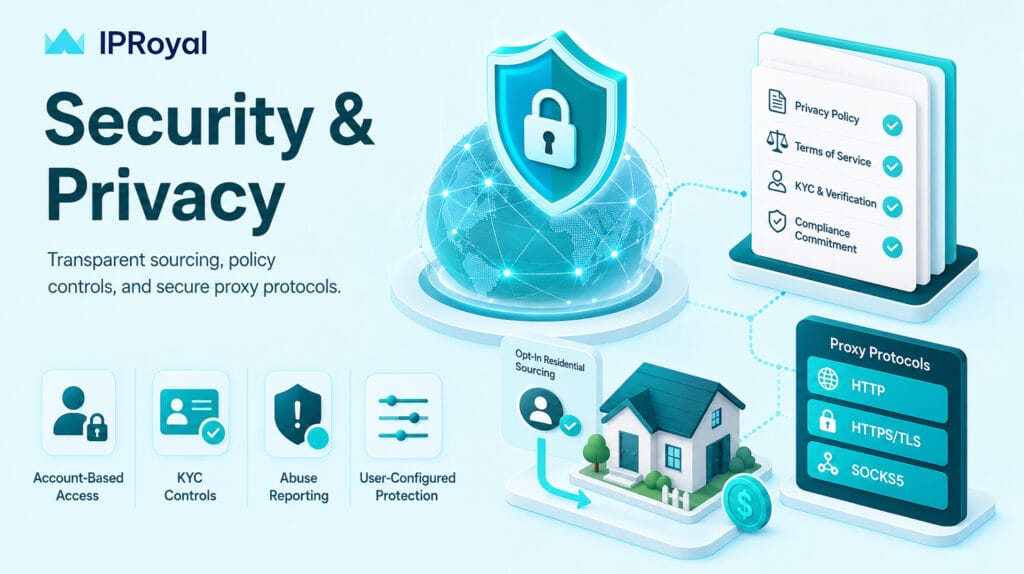
Is IPRoyal legit and safe to use? Yes. IPRoyal is a legitimate proxy provider with a publicly identified UAE legal entity, current policy documents, disclosed residential sourcing, KYC controls, and an abuse-reporting process. Its services also support HTTPS/TLS and SOCKS5 for secure proxy connections when configured correctly.
Its strongest trust signal is the opt-in Pawns.app sourcing model, where participants are compensated and can stop sharing their connection. However, IPRoyal does not publish an explicit proxy no-logs policy, and its Privacy Policy permits processing of IP, traffic, device, login, transaction, and usage data. It should therefore be viewed as an account-based proxy service, not a VPN-style anonymity tool.
Security & Privacy Score: 3.6 / 5
Strong sourcing, legal clarity, and abuse controls are offset by no explicit no-logs policy, account-linked data, and limited leak protection.
Is IPRoyal Legit?
Yes, IPRoyal is a legitimate proxy provider. Its Terms of Service and Privacy Policy identify the operator as IPRoyal Services FZE LLC, a company incorporated in the United Arab Emirates with a listed business address and license details. It also publishes current Terms of Service, a Privacy Policy, an Acceptable Use Policy, a KYC Policy, and a Data Processing Agreement.
The provider applies identity checks and additional verification to higher-risk services, reserves the right to suspend abusive accounts, and offers a public route for reporting misuse. Its residential sourcing is also explained through the opt-in Pawns.app bandwidth-sharing model and external IP service partnerships.
No evidence in the reviewed documentation or independent coverage points to an undisclosed malware-based residential pool. However, there is no public independent audit verifying every Pawns.app participant or third-party sourcing partner.
Legitimacy Signals
- Publicly identified UAE legal entity
- Current privacy, terms, KYC, and acceptable-use documents
- Published abuse-reporting and account-verification controls
- Public explanation of residential proxy sourcing
- No independent audit covering the full sourcing network
IPRoyal is therefore legitimate and suitable for normal commercial proxy use. Its strongest trust signals are legal transparency, sourcing disclosure, and abuse controls rather than audited privacy or anonymity guarantees.
How IPRoyal Sources Residential Proxies
IPRoyal sources much of its residential network through Pawns.app, an opt-in bandwidth-sharing platform. Participants allow part of their internet connection to be used as a residential proxy endpoint, receive compensation, and can pause or leave the network through the app.
This model provides clearer consent than providers that disclose only a vague peer-to-peer network. IPRoyal’s sourcing documentation states that Pawns.app users knowingly join, retain control over participation, and can stop sharing temporarily or permanently.
User Consent
Participants knowingly allow their connection to become part of the residential proxy pool.
Compensation
Pawns.app users receive monetary rewards in exchange for sharing unused bandwidth.
User Control
Contributors can pause sharing or leave the network rather than remaining permanently enrolled.
External Partners
IPRoyal also works with established IP service providers, but those partners are not disclosed in the same detail as Pawns.app.
IPRoyal also states that it monitors contributed proxy pools and performs checks on outside suppliers. However, there is no independent audit confirming consent quality across every Pawns.app device and third-party partner.
Overall, IPRoyal’s residential sourcing is more transparent than many similarly priced services. The opt-in model, compensation, and ability to leave are positive ethical signals, while the unaudited partner network remains the main limitation.
Logging & Anonymity Policy
IPRoyal does not publish an explicit proxy no-logs policy. Its Privacy Policy allows the processing of IP addresses, traffic data, device information, login records, transaction details, usage patterns, and performance data while users access the service.
Service access is also account-based. Login activity, account creation data, payment information, and abuse-prevention checks may be linked to a customer account. This is reasonable for billing and compliance, but it means IPRoyal is not designed to provide full anonymity from the provider itself.
Target-Facing Privacy
IPRoyal proxies can hide the user’s original IP address from destination websites, which is the core privacy benefit of a proxy service.
Provider-Level Data
IPRoyal may process account, login, transaction, device, traffic, and service-usage information needed to operate and protect the platform.
The policy does not provide a short fixed retention period for proxy-related logs. Instead, data may be retained as long as needed for service delivery, legal obligations, fraud prevention, account security, or legal claims.
IPRoyal should therefore be treated as a commercial proxy provider rather than a VPN-style anonymity service. It offers privacy from target websites, but not audited no-logs protection or anonymous account access.
Encryption and Proxy Protocol Security
IPRoyal supports HTTP, HTTPS/TLS, and SOCKS5 across its main proxy products, including residential, ISP, and datacenter proxies. HTTPS/TLS can protect web traffic between the client, proxy, and destination when the target website also uses HTTPS, while SOCKS5 supports a broader range of applications and traffic types.
Security still depends heavily on the user’s setup. Selecting the wrong protocol, allowing DNS requests to bypass the proxy, or misconfiguring a browser or scraper can expose connection data even when the proxy itself is working.
| Protocol | Main Benefit | Security Limitation |
|---|---|---|
| HTTP | Simple compatibility with browsers, scraping tools, and web requests | Does not encrypt unprotected HTTP traffic by itself |
| HTTPS/TLS | Encrypts supported web traffic and protects data in transit | Protection depends on the destination and correct client configuration |
| SOCKS5 | Works with more applications and non-browser traffic | SOCKS5 routing alone does not guarantee payload encryption |
IPRoyal provides setup examples for cURL, Python, JavaScript, PHP, and other common tools. These guides help users route requests through the correct proxy endpoint and verify the outgoing IP, but they do not establish a built-in leak-protection system.
Leak-protection limits: IPRoyal does not advertise a VPN-style kill switch, built-in DNS leak prevention, WebRTC protection, or an independently audited security layer covering all proxy traffic.
Overall, IPRoyal offers good protocol compatibility and secure connection options for ordinary proxy use. However, DNS routing, application leaks, encryption choices, and fail-safe behavior remain largely the user’s responsibility.
Jurisdiction and Legal Documentation
IPRoyal is operated by IPRoyal Services FZE LLC, a legal entity incorporated in the 🇦🇪 United Arab Emirates with a listed business address in Ajman. The same company identity appears consistently across its Terms of Service and Privacy Policy, which gives customers a clear legal entity behind the platform.
The UAE is best viewed as a neutral rather than privacy-first jurisdiction. It has a federal data protection framework, but IPRoyal does not pair its jurisdiction with an audited no-logs policy or other privacy guarantees commonly associated with dedicated anonymity services.
Public Legal Documents
These documents explain service rules, personal-data processing, prohibited activities, customer verification, and processor obligations. The legal documentation is detailed and current, although the Privacy Policy allows broad account and usage data processing.
Overall, IPRoyal offers stronger legal transparency than many lower-cost proxy providers. Its weakness is not missing documentation, but the absence of an audit-backed privacy posture or simplified no-logs commitment.
KYC, Abuse Handling, and Compliance
IPRoyal publishes a dedicated Know Your Customer policy and applies additional verification to higher-risk accounts and proxy products. Its Terms also allow the company to request identity or contact verification when needed to prevent misuse or protect the network.
The provider supports these checks with a public Acceptable Use Policy, account-monitoring controls, and a dedicated abuse-reporting path. Reports involving prohibited activity can be reviewed by its specialist team, and accounts may be restricted or suspended when activity falls outside the service rules.
KYC Controls
Identity, email, phone, or account verification may be required for higher-risk access and abuse prevention.
Acceptable Use
Public rules define prohibited activity and give IPRoyal grounds to restrict or terminate abusive accounts.
Abuse Reporting
Suspected misuse can be submitted through a published abuse-reporting route for review and action.
Data Processing
A public Data Processing Agreement covers processor duties, security, confidentiality, and data-protection obligations.
These policies give IPRoyal a stronger compliance posture than providers with only basic terms. Business customers also benefit from a public Data Processing Agreement that addresses security measures, subprocessors, confidentiality, and breach-related obligations.
Transparency limitation: IPRoyal does not publish an abuse-response SLA, enforcement statistics, law-enforcement request report, or broader abuse transparency report.
Overall, IPRoyal has strong KYC, acceptable-use, and compliance controls. The main weakness is limited public reporting on how quickly abuse cases are handled and how often enforcement actions occur.
Security & Privacy Score
IPRoyal performs well on sourcing transparency, legal documentation, protocol support, and abuse controls. Its strongest points are the disclosed Pawns.app sourcing model, public 🇦🇪 UAE legal entity, current compliance policies, and published KYC process. The main deductions come from the lack of an explicit no-logs policy, account-linked data processing, user-dependent leak protection, and no independent privacy or sourcing audit.
- ✅ Residential sourcing is publicly explained through the opt-in Pawns.app bandwidth-sharing model
- ✅ Pawns.app participants receive compensation and can pause or leave the network
- ✅ IPRoyal Services FZE LLC is publicly identified as a 🇦🇪 UAE-incorporated legal entity
- ✅ Privacy Policy, Terms of Service, Acceptable Use Policy, KYC Policy, and DPA are publicly available
- ✅ HTTP, HTTPS/TLS, and SOCKS5 are supported across major proxy products
- ✅ Higher-risk accounts and products may require additional identity verification
- ✅ A public abuse-reporting route and acceptable-use enforcement process are available
- ⚠️ IPRoyal does not publish an explicit proxy-specific no-logs policy
- ⚠️ IP, traffic, device, login, transaction, and usage data may be processed
- ⚠️ DNS, IP, and WebRTC leak protection depends largely on user configuration
- ⚠️ No independent sourcing, privacy, or full proxy-traffic security audit was found
- ⚠️ No public abuse transparency report, enforcement statistics, or response SLA is available
Features & Flexibility
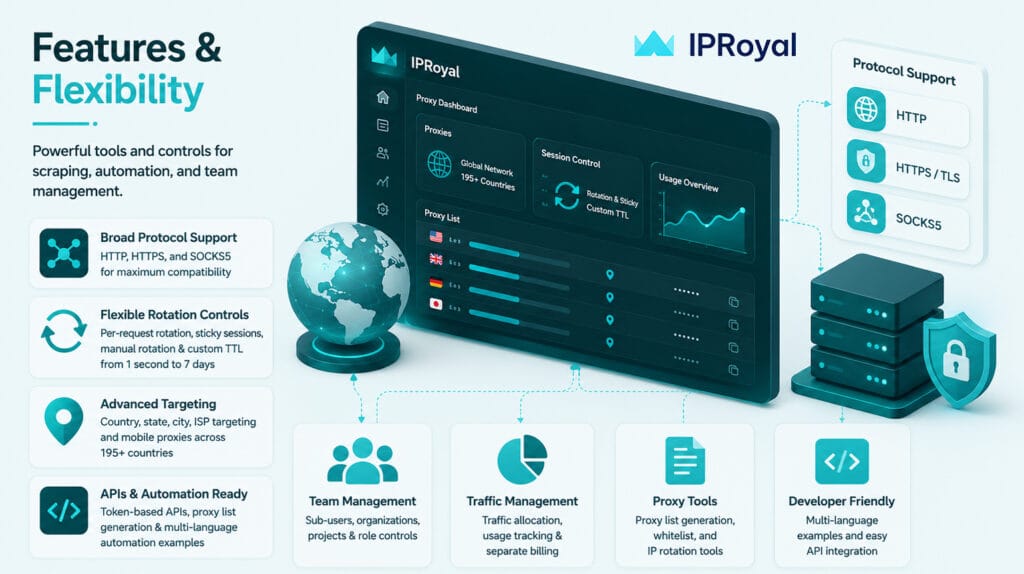
What features does IPRoyal offer for scraping and automation? IPRoyal supports HTTP/HTTPS and SOCKS5, per-request rotation, sticky sessions, manual rotation, and custom TTL settings from 1 second to 7 days. It also provides country, state, city, and eligible ISP targeting, mobile proxies, token-based APIs, and multi-language automation examples.
Its feature set extends to proxy-list generation, mobile IP rotation, residential sub-users, traffic allocation, organizations, projects, and separate billing controls. The main limitations are gated ISP filtering, no clearly confirmed ASN or ZIP targeting, limited device-level controls, and no mature official SDK ecosystem.
Features & Flexibility Score: 4.5 / 5
Broad protocols, outstanding session controls, useful APIs, and strong team tools outweigh limited SDKs and advanced targeting controls.
HTTP, HTTPS, and SOCKS5 Support
IPRoyal supports HTTP, HTTPS, and SOCKS5 across its main residential, ISP, and datacenter proxy products. This gives users broad compatibility with browsers, scraping frameworks, automation tools, command-line clients, and applications that accept standard proxy connections.
HTTP and HTTPS are best suited to web scraping, SEO monitoring, browser automation, and other website-based tasks. HTTPS protects supported web traffic with TLS, although the final level of encryption still depends on the destination website and the user’s configuration.
HTTP
Suitable for standard website requests, scraping tools, browser workflows, and simple automation.
HTTPS
Better for encrypted website connections, account access, and automation involving sensitive web data.
SOCKS5
Useful for applications and traffic types that need more flexibility than a web-only HTTP proxy.
SOCKS5 is particularly useful for custom software, bots, account-management tools, and applications that do not rely exclusively on browser traffic. IPRoyal also confirms TCP and UDP compatibility for ISP and datacenter proxies, although application support and configuration still determine whether both transport types can be used effectively.
Protocol switching is handled through dashboard selections and protocol-specific ports. When users choose HTTP/HTTPS or SOCKS5, IPRoyal updates the formatted proxy credentials and port details accordingly.
Overall, IPRoyal’s proxy protocol coverage is excellent. The only limitation is that protocol changes are configuration-based rather than a fully dynamic per-request switching system.
Sticky Sessions, Rotation, and Custom TTL
IPRoyal offers flexible rotation controls for its residential and mobile proxies. Users can request a new IP on every connection, keep the same IP with a sticky session, or manually rotate active sessions when needed.
The standout feature is its custom TTL range. Sticky sessions can be configured from 1 second to 7 days, giving users much more control than providers that offer only a few fixed session durations.
Per-Request Rotation
Randomized mode assigns a new available IP for each request or connection.
Sticky Sessions
Sticky mode attempts to maintain the same IP for a user-defined session period.
Custom TTL
Session duration can be set anywhere from 1 second to 7 days.
Manual Rotation
Users can manually refresh sessions when they need to replace the current IP.
These controls are useful for scraping, account sessions, ad verification, and automation workflows that need either frequent IP changes or temporary identity consistency.
Session caveat: A long residential TTL does not guarantee that the same IP will remain available for the full period because the underlying peer may disconnect from the network.
ISP and datacenter proxies behave differently because they are generally static products rather than rotating peer networks. Overall, IPRoyal’s per-request rotation, manual controls, and unusually broad TTL range make session flexibility one of its strongest features.
Geo, ISP, and Mobile Targeting
IPRoyal supports country, state, and city targeting across key proxy products, with residential coverage extending to 195 countries. Location data can also be accessed through the residential API, allowing automation workflows to generate proxy lists for specific regions.
ISP targeting is available for residential proxies, but access is restricted. Users must complete identity verification and meet a minimum spending requirement before this filter is enabled.
| Targeting Option | Availability | Main Limitation |
|---|---|---|
| Country | Broad residential coverage across 195 countries | Available pool size varies by location |
| State and City | Supported across residential and selected ISP workflows | Users should include the country when targeting cities |
| ISP | Available through residential configuration and API access | Requires verification and at least $1,000 in account spending |
| Mobile Network | Real 3G, 4G, 5G, and LTE mobile IP access | Carrier selection is less clearly documented as a self-service filter |
IPRoyal’s mobile proxies use IPs from physical devices connected through mobile carriers. This makes them useful for social media management, ad verification, mobile app testing, and workflows where a mobile-network identity matters.
Targeting limits: Public documentation does not clearly confirm self-service ASN or ZIP-code targeting, carrier-level filtering across all mobile plans, or device controls such as operating system, model, user agent, or fingerprint.
Overall, IPRoyal offers strong geographic and mobile targeting for most scraping and automation tasks. Its main weaknesses are gated ISP access and the absence of clearly documented ASN, ZIP, and device-level controls.
IPRoyal API and Automation Tools
IPRoyal provides token-based APIs for automating residential, datacenter, and mobile proxy workflows. The residential API uses bearer authentication and can generate proxy lists based on location, session type, credentials, formatting, and sub-user settings.
Available location endpoints expose countries, states, cities, regions, and eligible ISPs, making it possible to build geographically targeted proxy configurations without relying only on the dashboard.
Token Authentication
Dashboard-issued API tokens authenticate residential, datacenter, and mobile automation requests.
Proxy-List Generation
Residential lists can be generated with location, session, format, credential, and sub-user parameters.
Location Data
API endpoints return available countries, states, cities, regions, and ISP targeting options.
Mobile Rotation
A dedicated endpoint lets supported mobile proxy users trigger IP rotation programmatically.
The documentation includes examples in Python, Node.js, PHP, Java, Go, C#, and cURL. IPRoyal also maintains public GitHub repositories covering Python Requests, scraping workflows, retries, website logins, and integrations in several languages.
These resources make IPRoyal practical for developers building scripts, bots, monitoring tools, and custom scraping pipelines. However, API availability and functionality vary by product, and some targeting features require approval or account eligibility.
Developer-tooling limitation: IPRoyal provides useful code examples and GitHub resources, but no mature suite of official language SDKs or current public Postman collections comparable to enterprise-focused platforms.
Overall, the IPRoyal API is useful for proxy generation, location selection, mobile rotation, and routine automation. It offers strong practical documentation, though its developer ecosystem remains more example-driven than SDK-driven.
Sub-Users, Organizations, and Team Management
IPRoyal supports both residential sub-users and broader organization-based team management. This makes it suitable for agencies, developers, and teams that need to separate proxy access, usage, and billing across multiple people or projects.
Residential sub-users receive their own proxy credentials without gaining access to the main account. Account owners can assign traffic limits, create separate configurations, and recover unused traffic when a sub-user is removed.
Residential Sub-Users
Create unlimited residential sub-users with separate credentials and fixed traffic allocations.
Unique API Access
Team members can use unique API tokens and manage supported proxy configurations independently.
Organizations and Projects
Organizations divide teams, proxy usage, billing, and projects into separate workspaces.
Usage Control
Usage graphs, website filters, downloadable reports, and traffic allocation improve account oversight.
IPRoyal Sub-User Workflow
Create a separate sub-user with unique proxy credentials and no access to the main account.
Assign a fixed traffic amount from the main residential balance and adjust it when project needs change.
Create proxy credentials and configurations for the sub-user without sharing the parent account login.
Track traffic usage and return unused data to the main account when traffic is removed or the sub-user is deleted.
Use organizations and projects to separate team members, proxy usage, billing, and client workflows.
The broader User Management system lets team members configure proxies, place or extend orders, manage subscriptions, view invoices, and create residential sub-users. Organizations add project separation with Admin and Member roles, making it easier to manage multiple clients or internal workstreams from one account.
Enterprise limitation: IPRoyal provides useful team roles and project separation, but not deeply customizable RBAC, detailed per-user audit logs, or advanced permission rules for every account action.
Overall, IPRoyal’s sub-user, organization, project, and traffic-allocation tools are stronger than those of many similarly priced providers. They are especially useful for agencies and small to mid-sized teams, though large enterprises may need more granular access controls.
IPRoyal Web Unblocker
IPRoyal’s Web Unblocker is a separate managed scraping product, not a standard proxy plan. Instead of giving users only proxy credentials, it handles more of the request process automatically, including retries, IP rotation, and anti-bot challenges.
It is designed for websites that are harder to access with ordinary residential, ISP, mobile, or datacenter proxies.
Automated Retries
Failed requests can be retried automatically instead of requiring the user to build all retry logic.
CAPTCHA Handling
The system is built to manage CAPTCHA and other anti-bot challenges during difficult scraping requests.
IP and Fingerprint Rotation
Requests can use changing IPs and browser fingerprints to reduce repeated identity signals.
Request-Based Pricing
Billing is based on managed requests rather than normal proxy bandwidth or static proxy quantities.
Important distinction: Web Unblocker’s automated retries, CAPTCHA handling, and fingerprint rotation should not be treated as features included with ordinary IPRoyal proxy plans.
For routine scraping, SEO monitoring, and automation, standard proxy plans may be sufficient and give users more direct control. For strict targets, Web Unblocker offers a more managed approach, but at a different pricing model and with less low-level proxy control.
Built-in Tools & Utilities
IPRoyal includes several convenience tools that help users test, configure, and verify proxy connections. These utilities are useful during setup and troubleshooting, but they do not directly improve proxy speed, success rate, or IP quality.
Proxy Tester
Helps verify whether a proxy is active and responding before it is added to a workflow.
Online Proxy Checker
Provides a quick browser-based check for proxy status, location, and connection details.
IP Lookup
Displays the visible IP address and associated location information for connection verification.
Browser Extensions
Make it easier to apply and switch proxy settings inside supported browsers.
Windows Proxy Tester
Offers a desktop-based way to test proxy lists and identify failed connections.
These tools reduce setup friction and make it easier to confirm that a proxy is using the expected IP, protocol, and location. They are most helpful for beginners or users managing large proxy lists.
However, they should be treated as supporting utilities rather than core performance features. A proxy checker can identify a failed endpoint, but it cannot improve block rates, latency, pool quality, or anti-bot resistance.
Features & Flexibility Score
IPRoyal performs exceptionally well in Features & Flexibility. Its strongest areas are broad protocol support, highly customizable rotation and TTL controls, useful APIs, mobile proxy access, and strong sub-user and organization tools. The main deductions come from gated ISP targeting, limited ASN, ZIP, and device controls, and the lack of a mature official SDK ecosystem.
- ✅ HTTP, HTTPS, and SOCKS5 are supported across major proxy products
- ✅ ISP and datacenter proxies support both TCP and UDP connections
- ✅ Protocol switching is available through dashboard selections and dedicated ports
- ✅ Residential and mobile proxies support per-request and manual rotation
- ✅ Sticky-session TTL can be configured from 1 second to 7 days
- ✅ Country, state, city, ISP, and mobile-network targeting are available
- ✅ Token-based APIs support proxy generation, location data, and mobile IP rotation
- ✅ Multi-language examples and official GitHub resources support automation workflows
- ✅ Residential sub-users, traffic allocation, organizations, projects, and team roles are supported
- ✅ Web Unblocker adds managed retries, CAPTCHA handling, and fingerprint rotation as a separate product
- ⚠️ ISP targeting requires identity verification and qualifying account spending
- ⚠️ ASN, ZIP-code, carrier, and device-level targeting are not fully confirmed
- ⚠️ No mature official SDK suite or current public Postman collection was found
- ⚠️ Team roles are useful but lack deeply customizable enterprise RBAC
Ease of Use & Dashboard
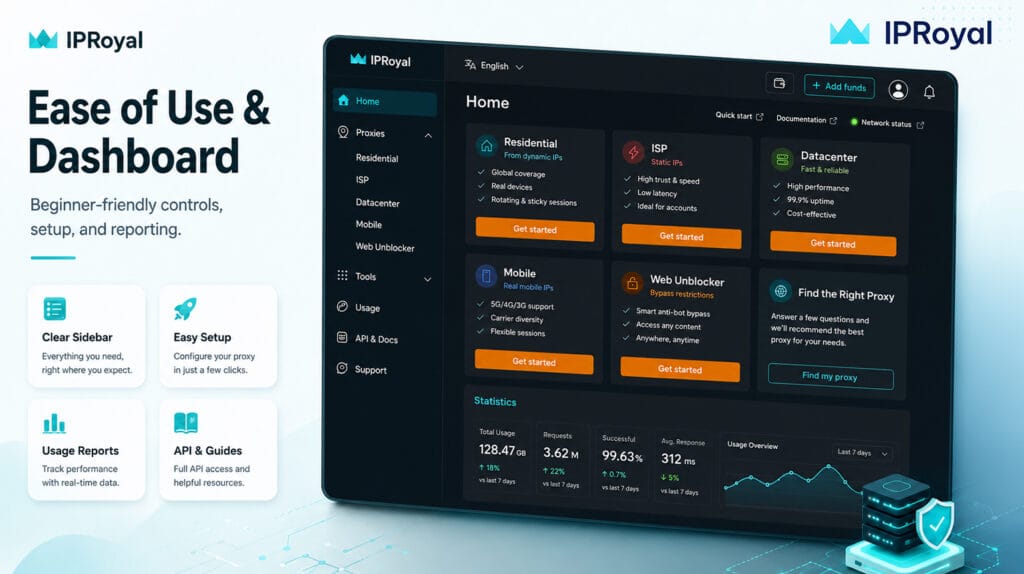
Is IPRoyal easy to use for beginners? Yes. Its modern dashboard organizes proxy products, purchasing, configuration, statistics, and account tools through a clear sidebar. Residential proxy setup follows a logical sequence, with location, rotation, TTL, authentication, protocol, and credentials presented in one place.
IPRoyal also provides usage charts, filters, downloadable reports, quick-start guides, troubleshooting articles, and API examples. The main limitations are fragmented documentation, limited evidence of full request-level logs, and little public proof of mobile or formal accessibility optimization.
Ease of Use & Dashboard Score: 4.5 / 5
Clear setup controls, polished reporting, and strong guides outweigh limited accessibility proof and advanced request-level logging.
IPRoyal Dashboard Design and Navigation
The IPRoyal dashboard has a modern, well-organized desktop interface. Its left sidebar separates proxy products, statistics, account settings, team tools, and billing, while the main workspace uses clear cards and product-specific configuration pages.
The main dashboard includes visible actions such as Buy now, Find My Perfect Proxy, Add funds, and Download report. Residential proxy controls are arranged logically, with location, rotation, TTL, hostname, port, and credentials presented in one setup area.
Sidebar Navigation
- Clear proxy product areas
- Statistics and reporting access
- User and organization tools
- Predictable product-level navigation
Main Workspace
- Structured product cards
- Clear purchase and setup actions
- Visual statistics and filters
- Proxy-selection assistance
The Find My Perfect Proxy tool and onboarding prompts can help beginners choose an appropriate proxy type before purchasing. More experienced users can move directly to product configuration, usage reports, sub-users, or API settings.
Desktop usability is excellent, with readable forms, clear visual hierarchy, and prominent controls. However, most available screenshots and documentation show the desktop interface, so the quality of the mobile and tablet dashboard experience is less clearly verified.
Setting Up IPRoyal Proxies
Setting up IPRoyal is straightforward because the dashboard presents the main configuration choices in a logical order. Beginners can create a usable proxy endpoint without working through advanced settings, while experienced users can customize location, rotation, authentication, and protocol behavior.
How to Set Up IPRoyal
Choose residential, ISP, datacenter, or mobile proxies based on the intended workflow.
Select the required country and, where available, narrow the connection by state, city, or eligible ISP.
Use randomized mode for a new IP on each request or sticky mode to retain one IP temporarily.
For sticky residential or mobile sessions, set the duration from 1 second to 7 days.
Select the supported authentication method and confirm the displayed credentials or approved IP settings.
Choose HTTP/HTTPS or SOCKS5, with the dashboard updating the relevant port and proxy format.
Copy the generated hostname, port, username, and password or export the formatted proxy list.
IPRoyal’s quick-start guides follow the same setup logic, making it easier to understand each setting before connecting a browser, scraper, anti-detect tool, or automation script.
Overall, the setup process is one of IPRoyal’s strongest usability areas. Most users can move from purchase to a configured endpoint within a few minutes, while API-based proxy generation remains available for larger automated deployments.
Documentation and Troubleshooting
IPRoyal provides a broad support library covering quick-start setup, product configuration, APIs, integrations, troubleshooting, and proxy testing. Beginners can use guided setup articles, while developers get multi-language examples and product-specific API documentation.
Documentation Resource Index
Guides for residential, ISP, datacenter, browser extensions, proxy testing, and IP whitelisting.
Detailed instructions for location targeting, rotation, TTL, authentication, protocols, and proxy strings.
Token authentication, proxy generation, location data, order functions, and multi-language request examples.
Error-code guidance for 403, 407, 408, 429, 502, 503, and 504 responses, including authentication and retry advice.
Official GitHub examples cover Python Requests, scraping, retries, website logins, and other integrations.
Checks proxy status, speed, and connection errors before credentials are added to a live workflow.
The troubleshooting material is practical, especially for authentication failures, blocked requests, rate limits, gateway errors, and retry handling. However, the content is distributed across the documentation portal, help center, blog, quick-start pages, and GitHub.
Overall, IPRoyal’s documentation is detailed and useful, but users may need to search across several support hubs instead of relying on one unified knowledge base.
Usage Statistics, Reports, and Logs
IPRoyal provides a visual statistics area for monitoring proxy traffic across residential, ISP, datacenter, and mobile products. Users can switch between product tabs, select a date range, filter usage by website or domain, and view data in either MB or GB.
The dashboard also shows remaining residential traffic and supports downloadable usage reports, which is useful for budgeting, client reporting, and identifying unusual traffic spikes.
| Dashboard Feature | What It Shows | Main Use |
|---|---|---|
| Interactive usage chart | Traffic consumption over a selected period | Identify trends, peaks, and unexpected usage |
| Product tabs | Residential, ISP, datacenter, and mobile statistics | Separate reporting by proxy category |
| Date and domain filters | Usage by time period and visited website | Review project or target-specific consumption |
| MB and GB controls | Traffic displayed in the preferred unit | Improve readability for small or large workloads |
| Downloadable reports | Exportable usage data | Billing, audits, and client reporting |
| Remaining traffic | Residential balance still available | Avoid unexpected traffic depletion |
A visible Logs shortcut suggests that additional account or service records are available. However, public documentation does not clearly confirm detailed request-level logs with filters for individual IPs, sessions, status codes, errors, or endpoints.
Logging limitation: IPRoyal offers strong usage reporting, but the available evidence does not confirm enterprise-grade request logs or detailed error diagnostics.
Overall, IPRoyal’s reporting is excellent for monitoring traffic and generating usage reports. It is less proven for developers who need request-by-request debugging or advanced operational logs.
Languages and Accessibility
IPRoyal’s dashboard supports at least English and Chinese, giving it basic multilingual coverage for international users. The desktop interface is also visually clear, with readable text, large form fields, consistent sidebar navigation, and prominent action buttons.
Language Support
English and Chinese dashboard options are confirmed, but broader localization across additional languages is not clearly documented.
Desktop Usability
Clear visual hierarchy, structured forms, charts, and large controls make the desktop dashboard easy to read and navigate.
Accessibility Evidence
No public WCAG statement, accessibility audit, or detailed evidence of screen-reader and keyboard-navigation optimization was found.
Public evidence for a dedicated mobile-dashboard experience is also limited. The available screenshots and documentation mainly demonstrate desktop workflows, so mobile and tablet usability cannot be rated with the same confidence.
Overall, IPRoyal offers a readable and polished desktop experience with limited multilingual support. It is weaker in documented accessibility compliance, broad localization, and verified mobile optimization.
Ease of Use & Dashboard Score
IPRoyal offers an excellent dashboard experience for both beginners and technical users. Its strongest areas are clear navigation, guided proxy setup, visual usage reporting, downloadable reports, and broad documentation. The main deductions come from fragmented support resources, limited proof of advanced request-level logs, and little public evidence of mobile or formal accessibility optimization.
- ✅ Clean, modern dashboard with clear sidebar navigation and product sections
- ✅ Proxy purchasing, configuration, statistics, billing, and team tools are easy to locate
- ✅ Residential setup clearly presents location, rotation, TTL, authentication, protocol, and credentials
- ✅ Endpoint generation is available through both the dashboard and API
- ✅ Usage monitoring includes charts, product tabs, date filters, domain filters, and MB/GB controls
- ✅ Downloadable reports and remaining-traffic visibility improve account oversight
- ✅ Quick-start guides, API docs, error-code articles, GitHub examples, and proxy-testing tools are available
- ✅ English and Chinese dashboard interfaces provide basic multilingual support
- ⚠️ Documentation is spread across the help center, docs portal, blog, quick-start pages, and GitHub
- ⚠️ Full request-level logs, endpoint error history, and advanced session diagnostics are not clearly confirmed
- ⚠️ Public evidence of mobile-dashboard optimization remains limited
- ⚠️ No confirmed WCAG compliance, accessibility audit, or detailed screen-reader and keyboard support was found
Pricing & Value
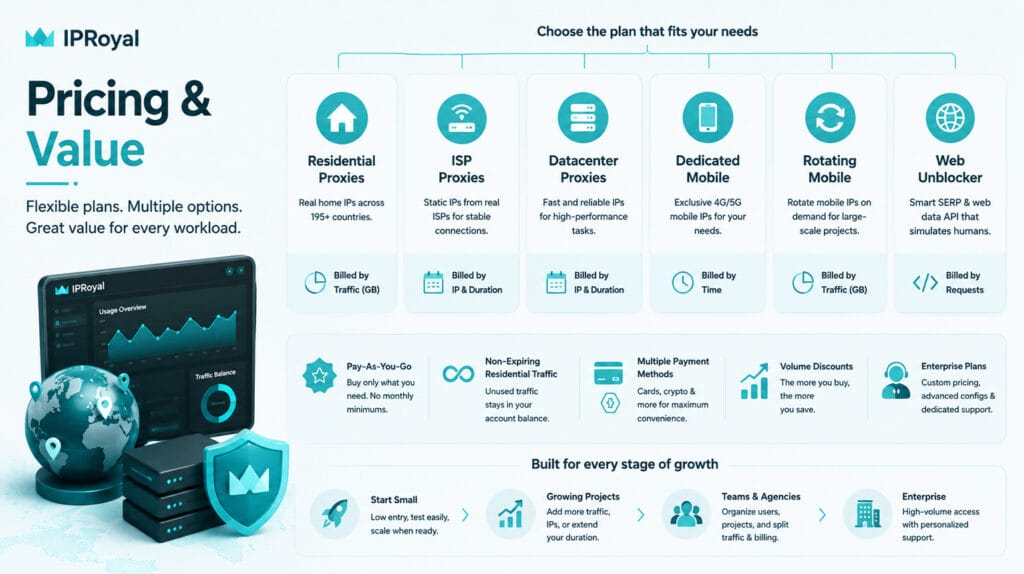
Is IPRoyal affordable, and does it offer good value? Yes. IPRoyal combines competitive mid-market pricing with flexible buying models, including per-GB residential traffic, duration-based ISP and datacenter plans, dedicated and rotating mobile options, request-based Web Unblocker pricing, and custom enterprise plans.
Its strongest value advantages are low-entry purchasing, pay-as-you-go residential access, non-expiring residential traffic, broad payment support, and multiple scaling options. Small residential purchases are not always the cheapest available, while conditional trials and headline “from” prices require closer attention.
Pricing & Value Score: 4.4 / 5
Flexible plans, non-expiring residential traffic, and broad payment access outweigh conditional trials and mid-market entry pricing.
IPRoyal Pricing by Proxy Type
IPRoyal pricing varies by product rather than following one universal plan. Residential and rotating mobile proxies are billed by traffic, ISP and datacenter proxies by IP and rental duration, dedicated mobile proxies by time, and Web Unblocker by request volume.
IPRoyal Pricing Snapshot
Prices below reflect public starting rates at the time of writing. Unit costs generally decrease with larger purchases, longer rental periods, or enterprise volume.
Residential Proxies
Pay-as-you-go is also available. Rates fall with larger traffic purchases, reaching much lower enterprise-volume pricing.
ISP Proxies
Short 24-hour access and longer 30-, 60-, and 90-day plans are available, with better unit value on longer terms.
Datacenter Proxies
The rate drops to about $1.39 per proxy on longer 90-day plans.
Dedicated Mobile
Monthly rentals are available, with the monthly rate decreasing on 60- and 90-day commitments.
Rotating Mobile
Volume discounts reduce the rate to around $5.20 per GB on the largest public tier.
Web Unblocker
Higher request volumes reduce the rate to roughly $0.70 per 1,000 requests.
Enterprise Plans
Large residential, ISP, datacenter, and mobile deployments receive volume pricing and dedicated account support.
Note: Headline “from” prices may apply only to larger purchases, longer commitments, or enterprise thresholds. Check the final checkout price for the selected quantity, duration, and location.
View the latest plans, volume discounts, and availability on IPRoyal’s official website.
The current official pricing pages confirm subscription and pay-as-you-go residential options, duration-based ISP and datacenter plans, separate dedicated and rotating mobile models, request-volume Web Unblocker tiers, and enterprise purchasing paths.
Overall, IPRoyal’s pricing structure is highly flexible. Users can choose a billing unit that matches their workload instead of paying for an oversized universal package, although the lowest advertised “from” rates usually require larger purchases or longer commitments.
Pay-As-You-Go and Non-Expiring Residential Traffic
Does IPRoyal residential traffic expire? Under standard conditions, pay-as-you-go residential traffic does not expire and remains available until it is used. IPRoyal notes that some accounts may have balance-activity requirements, so users should confirm the policy shown in their dashboard.
This makes IPRoyal particularly useful for irregular workloads. Users can buy residential traffic without a monthly minimum, pause a project, and return later without automatically losing the unused balance.
Pay As You Go
- No monthly minimum
- Buy only the traffic needed
- Manually enter or top up GB
- Unused traffic normally remains available
- Best for occasional or unpredictable workloads
Subscription
- Automatic recurring traffic
- 5% discount compared with PAYG
- Visible renewal date and traffic amount
- Can be upgraded or cancelled
- Best for steady monthly usage
Users can also purchase additional traffic manually through Quick top-up or enable Auto top-up, which places a new order when the remaining balance falls below a selected threshold. The payment can be charged to a saved card or the user’s IPRoyal balance.
Billing reminder: Auto top-up can create an automatic charge when traffic reaches the chosen threshold. Allocating traffic to residential sub-users may also reduce the main balance enough to trigger a top-up.
Overall, non-expiring pay-as-you-go traffic is one of IPRoyal’s strongest pricing advantages. It reduces waste for users with seasonal, experimental, or project-based scraping needs, while subscriptions and auto top-ups provide continuity for regular workloads.
Plan Flexibility and Enterprise Scaling
IPRoyal supports several ways to scale, allowing users to match the billing model to the proxy product and workload. Residential and rotating mobile plans scale by traffic, ISP and datacenter proxies by quantity and rental duration, dedicated mobile proxies by time, and Web Unblocker by successful request volume.
IPRoyal Scaling Options
Start with pay-as-you-go residential traffic, short ISP access, or a small Web Unblocker request tier without a large monthly commitment.
Increase residential or rotating mobile GB, rent more static proxies, extend plan duration, or move to higher request-volume Web Unblocker tiers.
Organizations, projects, residential sub-users, traffic allocation, and billing separation help divide resources across teams or clients.
Large-volume customers can request custom pricing, specialized configurations, and support from a dedicated account manager.
Published enterprise thresholds include 10,000 GB or more of residential traffic and 250 or more ISP or datacenter proxies. Mobile requirements can also be handled through custom enterprise arrangements.
The different purchasing models provide several scaling paths:
- Residential and rotating mobile proxies scale by GB.
- ISP and datacenter plans scale by proxy quantity and duration.
- Dedicated mobile proxies scale through daily or multi-month rentals.
- Web Unblocker scales by request volume.
- Enterprise customers receive custom terms and account support.
Overall, IPRoyal offers excellent plan flexibility for individuals, agencies, and larger teams. The main limitation is that enterprise pricing is not fully self-service and requires contacting the sales team for a quote.
Free Trial, Test Access, and Refund Policy
IPRoyal does not offer a universal free trial across every proxy product. A residential trial may appear for eligible users in the dashboard, while verified companies may qualify for enterprise testing after completing registration and ownership checks.
Users who do not qualify for a trial can still test the service through small pay-as-you-go residential purchases, 24-hour ISP access, or low-entry datacenter plans.
Residential Trial
May be offered to eligible users during residential checkout. A valid card is required, and each card can generally activate only one trial.
Enterprise Trial
Available to qualifying companies after business registration and ownership verification.
Low-Cost Testing
Small residential traffic purchases and short ISP or datacenter plans let users test the service without a large commitment.
Refund eligibility depends on the product, request timing, and how much of the service has already been used.
| Plan Type | Typical Refund Conditions | Main Caveat |
|---|---|---|
| Data-Based Plans | Request generally required within 72 hours, with newly allocated data unused | Using the purchased traffic can remove eligibility |
| Proxy-Based Plans | Request generally required within 72 hours and usage kept below 500 MB | Rules vary by proxy product |
| ISP Proxies | Stricter time and traffic limits may apply | Refunds may be unavailable after 24 hours or more than 500 MB of traffic |
| Cryptocurrency Payments | Refunds may still be reviewed under the product policy | Funds cannot necessarily be returned through the original payment method |
Trial limitation: Do not assume free access will be available for every account or proxy type. Check the dashboard before purchase and use the lowest suitable paid plan when no trial appears.
Overall, IPRoyal provides reasonable testing options and clearly documented refund rules, but the experience is less generous than a universal free trial or unconditional money-back guarantee.
Payment Methods
IPRoyal supports a broad range of payment options, including credit cards, PayPal, Google Pay, Apple Pay, Alipay, and more than 25 cryptocurrencies. This gives users more checkout flexibility than providers that rely only on cards or PayPal.
Supported Payment Options
The mix of traditional cards, digital wallets, regional payment services, and cryptocurrencies improves accessibility for international customers. Payment availability may still vary by country, processor, account status, or compliance review.
Verification requirement: PayPal access may require identity verification, and other payment methods can be restricted depending on region or compliance checks.
Overall, IPRoyal offers excellent payment-method coverage and strong global checkout flexibility. The only meaningful limitation is that some methods may require verification or may not appear for every account.
Pricing Transparency and Possible Extra Charges
IPRoyal publishes product-specific pricing for residential, ISP, datacenter, mobile, Web Unblocker, and enterprise plans. Detailed pages explain whether users pay by GB, proxy, rental period, or request volume, making most costs easy to understand before checkout.
The main pricing caveat is the use of headline “from” prices. These usually represent large purchases, longer rental periods, or enterprise volumes rather than the amount a small user will pay when starting.
Clearly Disclosed
- Public product pricing pages
- Visible plan units and durations
- Separate PAYG and subscription prices
- Documented renewal rules
- Published auto top-up controls
Requires Attention
- Headline prices may require high volume
- Subscriptions renew until cancelled
- Auto top-up can trigger automatic charges
- Sub-user allocations may reduce the main balance
- Enterprise pricing requires a sales quote
Pay-as-you-go residential purchases do not automatically renew, while subscription plans generally continue until cancelled. ISP subscriptions may also renew automatically, although some short-term plans require users to enable renewal.
Auto top-up is optional but should be monitored carefully. When residential traffic falls below the selected threshold, IPRoyal may charge the saved payment method or account balance. Assigning traffic to sub-users can reduce the parent balance enough to trigger this threshold.
Before buying: Check the detailed product page and final checkout total rather than relying only on the advertised starting price. Also review subscription renewal and auto top-up settings after purchase.
Overall, IPRoyal’s pricing is transparent and generally matches its documented billing models. The main risks are not hidden fees, but misunderstanding volume-based “from” prices or leaving automatic billing features enabled.
Pricing & Value Score
IPRoyal offers excellent pricing flexibility across residential, ISP, datacenter, mobile, Web Unblocker, and enterprise products. Its strongest advantages are low-entry purchasing, non-expiring residential traffic, multiple billing models, broad payment support, and strong scaling options. The main deductions come from conditional trial access, mid-market residential entry pricing, and headline “from” rates that require additional context.
- ✅ Residential proxies support subscriptions and pay-as-you-go purchasing
- ✅ Pay-as-you-go residential traffic has no monthly minimum and does not expire under standard conditions
- ✅ ISP and datacenter plans offer short-term and multi-month rental options
- ✅ Dedicated and rotating mobile proxies use separate time-based and traffic-based pricing models
- ✅ Web Unblocker provides request-based pricing with volume discounts
- ✅ Enterprise plans support large residential, ISP, datacenter, and mobile deployments
- ✅ Manual top-ups, subscriptions, auto top-up, sub-user allocations, and organization tools support scaling
- ✅ Cards, PayPal, Google Pay, Apple Pay, Alipay, and 25+ cryptocurrencies are supported
- ✅ Product pricing, billing units, plan durations, and refund conditions are publicly documented
- ⚠️ Small residential plans are competitively priced but closer to mid-market than ultra-budget
- ⚠️ Free residential and enterprise trials are conditional rather than universally available
- ⚠️ Headline “from” prices may apply only to larger volumes, longer terms, or enterprise thresholds
- ⚠️ Refund eligibility depends on the product, request timing, and prior usage
- ⚠️ Subscriptions renew automatically, and auto top-up may create charges if not monitored
Support & Documentation
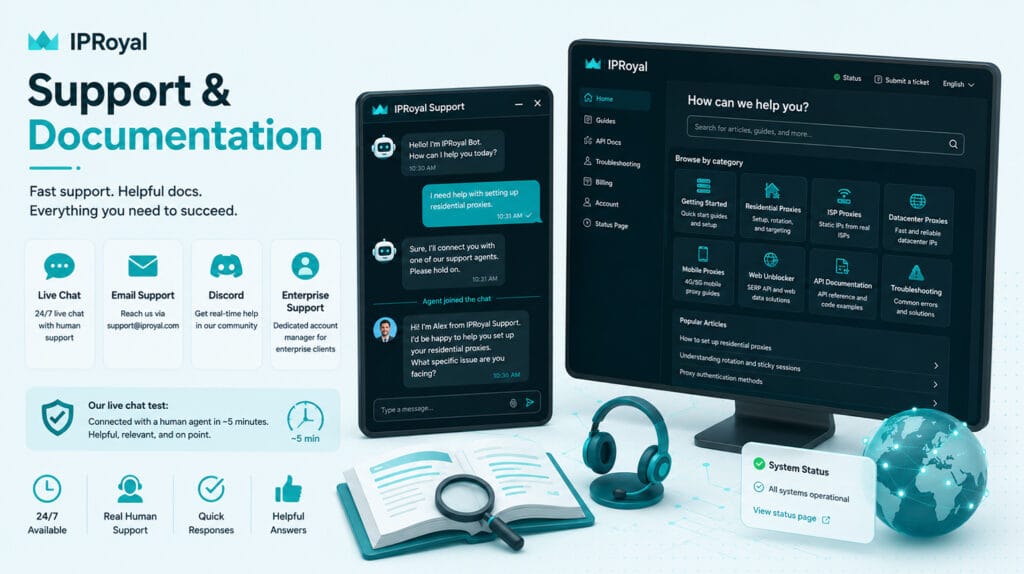
How good is IPRoyal customer support? IPRoyal offers strong customer support through 24/7 live chat, email, Discord, and dedicated enterprise account managers. In our own test, the live-chat bot transferred us to a human agent in about five minutes, and the response was helpful and relevant.
Its support quality is reinforced by a searchable help center, quick-start guides, API documentation, troubleshooting resources, GitHub examples, and a public status page. The main limitations are no phone support, fragmented documentation, and no publicly defined enterprise response SLA or full product roadmap.
Support & Documentation Score: 4.6 / 5
Fast live support, strong documentation, and public status reporting outweigh the lack of phone support and formal SLA transparency.
Support Channels and Availability
IPRoyal provides 24/7 live chat, email, and Discord support for standard customers. Enterprise clients may also receive a dedicated account manager, giving larger teams a more direct escalation path.
24/7 Live Chat
The fastest option for account, payment, setup, and technical questions, with human escalation available.
Email Support
A formal support route is available through support@iproyal.com for longer technical, billing, and account issues.
Discord
Discord provides an additional real-time support path beyond the website and email.
Enterprise Support
Qualifying enterprise customers can receive dedicated account management for larger deployments.
IPRoyal does not advertise phone support, so urgent issues must be handled through chat, email, or Discord. It also does not publish a detailed enterprise ticket SLA showing guaranteed response times, escalation levels, or queue priority.
Support limitation: The channel coverage is excellent, but there is no phone line or publicly defined response-time SLA for enterprise tickets.
Overall, IPRoyal offers more support channels than many similarly priced providers, with 24/7 live chat and Discord being the strongest differentiators.
Response Time and Support Quality
Our support test: We contacted IPRoyal through live chat and were transferred from the automated bot to a human agent in approximately five minutes. The agent provided a helpful and relevant response rather than leaving the conversation at the automated-support stage.
Our IPRoyal Live-Chat Test
The conversation initially began through IPRoyal’s automated chat assistant.
The bot escalated the conversation rather than repeatedly redirecting us to help articles.
The response was helpful, relevant, and clearly written by a support representative.
This direct result supports a top score for initial response time. It also confirms that IPRoyal’s live chat is not limited to automated answers and can provide relatively fast access to human assistance.
Third-party hands-on reviews reinforce this impression. Reviewers describe IPRoyal’s support as responsive and note that agents give direct answers, including transparent explanations when target-specific performance cannot be guaranteed without testing.
Strong Support Signals
- Human escalation in about five minutes
- Helpful response in our test
- 24/7 live-chat availability
- Transparent answers in hands-on reviews
- Positive feedback on support responsiveness
Remaining Caveats
- No published guaranteed response-time SLA
- Email replies may take longer than live chat
- Some public complaints involve refunds
- Product-fit disputes are not always resolved positively
Overall, IPRoyal provides fast and helpful support for most routine account, billing, setup, and technical questions. Our direct test was particularly strong, although disputed refunds and unmet product expectations can still produce less positive experiences.
Help Center and Knowledge Base
IPRoyal has a searchable Help Center organized into practical categories such as billing, account security, residential, ISP, datacenter, mobile, Web Unblocker, and tools and integrations. This makes common setup, payment, and troubleshooting information relatively easy to find.
IPRoyal Documentation Resource Index
Covers billing, refunds, account settings, authentication, protocols, and common questions across all major proxy products.
Explains targeting, rotation, sticky sessions, TTL, proxy strings, dashboard controls, and product-specific configuration.
Includes help for 403, 407, 408, 429, 502, 503, and 504 errors, authentication failures, blocked requests, and retry handling.
Provides guided setup for residential, ISP, datacenter, proxy testing, IP whitelisting, browser extensions, and proxy managers.
Documents token authentication, proxy-list generation, location data, mobile rotation, and multi-language request examples.
Includes examples for Python Requests, scraping workflows, retries, website logins, and integrations in several languages.
Checks proxy status, speed, and connection errors before credentials are added to a live workflow.
The Help Center includes a visible search function and clear product categories, while the technical documentation provides deeper guidance for proxy strings, protocols, authentication, targeting, and API use. Billing and refund policies are also publicly documented rather than being available only through support.
Troubleshooting coverage is strong for common proxy failures, including authentication errors, blocked requests, rate limits, gateway issues, and timeouts. The Proxy Tester adds another practical layer by showing connection status, speed, and error details.
Documentation limitation: Useful information is divided across the Help Center, Docs, Quick-Start Guides, Blog, and GitHub, so advanced users may need to search more than one resource.
Overall, IPRoyal’s knowledge base is broad, searchable, and practical. Its main weakness is fragmentation rather than missing coverage.
Onboarding and Setup Guides
IPRoyal provides a structured onboarding path for both beginners and experienced users. Its Quick-Start hub covers residential, ISP, and datacenter proxies, along with proxy testing, IP whitelisting, browser extensions, proxy managers, and organization features.
The dashboard experience also includes use-case guidance and a Find the Perfect Proxy tool that helps new users choose a suitable proxy type before purchasing.
Quick-Start Hub
Central starting point for product setup, proxy testing, whitelisting, extensions, and common deployment workflows.
Product Guides
Residential, ISP, and datacenter guides explain locations, protocols, rotation, TTL, authentication, and proxy formats.
Integrations
Setup material covers browser extensions, proxy managers, application configuration, and developer request examples.
Proxy Selection
Use-case prompts and the Find the Perfect Proxy widget help beginners identify the right product before setup.
The guides are practical rather than purely technical. They connect configuration choices to use cases such as web scraping, ad verification, testing, market research, and automation.
IPRoyal also explains how to test proxies before deployment, configure IP whitelisting, select HTTP/HTTPS or SOCKS5, and format credentials for external tools.
Onboarding limitation: The setup experience is strong, but IPRoyal does not provide one fully unified interactive walkthrough covering every proxy product and integration.
Overall, IPRoyal’s onboarding is beginner-friendly, use-case aware, and detailed enough for technical users. The main drawback is that setup material is spread across several documentation hubs.
Public Status Page and Incident Transparency
IPRoyal maintains a public status page with real-time service health, historical uptime, incident records, and scheduled maintenance notices. This lets users check whether a problem affects IPRoyal’s infrastructure before contacting support.
The page monitors services by product and region rather than showing only one general platform status. Recent incident records include affected locations, service components, investigation updates, and resolution details.
Status and Incident Visibility
Shows the current operational state of monitored proxy products, systems, and regional components.
Provides service-history data that helps users evaluate reliability beyond the current moment.
Lists affected services, dates, investigation updates, degraded performance, outages, and final resolutions.
Warns users about planned infrastructure work that may temporarily affect specific products or regions.
Users can subscribe through webhook and Slack integrations for incident, resolution, and component-status updates.
This level of visibility is better than providers that disclose outages only through private support conversations. It also helps technical teams integrate IPRoyal incident updates into internal monitoring workflows.
Overall, IPRoyal provides excellent operational transparency through regional monitoring, uptime history, incident reporting, maintenance notices, and automated status notifications.
Product Updates and Community Presence
IPRoyal publishes periodic product-update posts covering dashboard improvements, payment changes, ordering tools, geo-targeting, and new services such as Web Unblocker. These posts act as a lightweight changelog and show that the platform continues to evolve.
Its official GitHub organization adds developer-facing value through public scraping and integration examples, while Discord gives users an additional support and communication channel.
Product Updates
Periodic posts summarize new products, dashboard changes, payment improvements, and feature releases.
GitHub Resources
Public repositories provide scraping, retry, login, and proxy-integration examples for developers.
Discord
Discord provides an additional support and user-contact channel outside the main website.
Status Notifications
Slack and webhook subscriptions deliver incident, maintenance, and component-status updates.
These resources provide useful product and operational visibility, but they do not amount to a fully open development roadmap. IPRoyal does not publish detailed planned milestones, feature-voting boards, or release schedules.
Community limitation: IPRoyal has Discord and public developer resources, but no large independent user forum, public feature-request portal, or complete product roadmap.
Overall, IPRoyal provides good update visibility and useful developer engagement. Its community presence is active enough for support and integrations, but less developed than platforms built around large public forums or open roadmaps.
Support & Documentation Score
IPRoyal performs excellently in Support & Documentation. Its strongest advantages are fast live-chat escalation, multiple support channels, searchable help resources, practical setup guides, developer documentation, and strong public incident reporting. The main deductions come from the lack of phone support, fragmented documentation, and no formal public response SLA or complete product roadmap.
- ✅ 24/7 live chat, email, and Discord support are available
- ✅ Enterprise customers may receive a dedicated account manager
- ✅ Our live-chat test reached a human agent in approximately five minutes
- ✅ The human response in our test was helpful and relevant
- ✅ Third-party testing also reports responsive and transparent support answers
- ✅ The searchable Help Center covers billing, refunds, protocols, authentication, and all major proxy products
- ✅ Quick-start guides cover proxy setup, testing, IP whitelisting, extensions, and proxy managers
- ✅ API documentation and GitHub repositories provide practical developer examples
- ✅ The public status page includes uptime history, incident records, regional monitoring, and maintenance notices
- ✅ Slack and webhook subscriptions provide automated incident notifications
- ⚠️ No phone support is available
- ⚠️ Documentation is divided across the Help Center, Docs, Guides, Blog, and GitHub
- ⚠️ No publicly defined ticket-response or enterprise escalation SLA was found
- ⚠️ Product updates are published, but there is no complete public roadmap or large independent community forum
Who Should and Shouldn’t Use IPRoyal?
IPRoyal is best suited to individuals, developers, agencies, and small to mid-sized teams that value flexible proxy types, SOCKS5 support, long sticky sessions, straightforward setup, and practical team controls. It performs well for general scraping, SEO monitoring, price research, testing, and routine automation.
It is less suitable for users who need premium anti-bot performance on difficult targets, audited no-logs protection, advanced ASN or ZIP targeting, mature SDKs, or enterprise-grade access controls. Large operations may also prefer using IPRoyal alongside another provider rather than relying on it as their only proxy network.
Best overall fit: Flexible scraping and automation workloads where usability, proxy variety, session control, and reasonable pricing matter more than top-tier anti-bot success.
IPRoyal Is Best For
IPRoyal is a strong choice for users who need several proxy types, flexible session controls, and an easy dashboard without paying premium-enterprise prices. Its residential, ISP, datacenter, mobile, and Web Unblocker products cover a wide range of routine scraping, monitoring, testing, and automation workflows.
IPRoyal Is Best For
A practical choice for routine data collection, research, monitoring, and lower-risk scraping targets.
Suitable for rank tracking, localized search checks, competitor research, and product-price monitoring.
Useful for scripts, bots, API workflows, SOCKS5 connections, and custom proxy-controlled applications.
A strong fit for workflows that need temporary IP consistency and customizable session TTL.
Useful for mobile-network testing, ad verification, app checks, and controlled social workflows.
Supports sub-users, traffic allocation, organizations, projects, and separate client workflows.
Residential, ISP, datacenter, mobile, and managed unblocker access are available from one account.
Non-expiring pay-as-you-go traffic works well for seasonal, experimental, or project-based usage.
IPRoyal is particularly appealing to users who want residential, ISP, datacenter, and mobile proxies from one account. Its broad product range reduces the need to manage several providers for ordinary workloads, while the clean dashboard and strong support make setup easier for less experienced users.
IPRoyal May Not Be Ideal For
IPRoyal covers most routine proxy use cases well, but it is not the strongest option for highly demanding anti-bot workloads, privacy-first users, or enterprises requiring advanced administration and guaranteed service commitments.
IPRoyal May Not Be the Best Fit If You Need
- Top-tier performance for strict Google or heavily protected targets
- Large-scale or aggressive social media automation
- One sole proxy supplier for critical enterprise operations
- Clearly verified ZIP code or ASN targeting
- An independently audited no-logs policy
- Advanced SDKs, custom RBAC, or granular enterprise permissions
- A universal self-service free trial
These limitations do not make IPRoyal a weak provider. They mainly show where premium enterprise networks or specialized scraping platforms may offer deeper anti-bot technology, targeting controls, privacy assurances, or administrative features.
Which IPRoyal Proxy Type Should You Choose?
The right IPRoyal product depends on whether you prioritize rotation, session stability, speed, mobile identity, or managed anti-bot handling.
| What You Need | Recommended IPRoyal Product | Why It Fits |
|---|---|---|
| Broad rotating access | Residential Proxies | Large location coverage, per-request rotation, sticky sessions, and flexible traffic-based pricing. |
| Stable account sessions | ISP Proxies | Static residential-style IPs combine long-term stability with stronger legitimacy than standard datacenter addresses. |
| Low-cost speed | Datacenter Proxies | Fast, affordable dedicated IPs for simpler targets, bulk requests, monitoring, and automation. |
| Mobile-network identity | Mobile Proxies | Uses mobile-carrier IPs for app testing, ad verification, mobile content checks, and controlled social workflows. |
| Managed anti-bot access | Web Unblocker | Handles proxy selection, rotation, retries, and anti-bot challenges through a managed request-based service. |
For most general scraping and automation tasks, residential proxies are the safest starting point because they offer the widest targeting and session flexibility. ISP proxies are better when the same IP must remain stable, while datacenter proxies provide the best value for less protected websites.
Mobile proxies should be reserved for workflows that specifically require carrier-level identity. Web Unblocker is the better choice when direct proxy management produces too many blocks, retries, or CAPTCHA challenges.
Pros & Cons
IPRoyal’s main strengths are its broad proxy selection, flexible session controls, clean dashboard, and competitive pricing. It works especially well for individuals, developers, agencies, and smaller teams that need several proxy types from one account.
Its main trade-offs involve less consistent performance on heavily protected targets, limited privacy assurances, and fewer advanced enterprise tools than premium proxy platforms.
Pros
- Residential, ISP, datacenter, and mobile proxies
- Excellent sticky-session and custom TTL controls
- HTTP, HTTPS, and SOCKS5 protocol support
- Clean and intuitive dashboard
- Pay-as-you-go residential traffic that does not expire
- Strong sub-user, organization, and project features
- Broad payment-method support
- Fast live-chat escalation to a human agent
- Public status page with incident and uptime history
Cons
- Weaker performance on strict anti-bot targets
- No explicit or independently audited no-logs policy
- ASN and ZIP-code targeting are not clearly confirmed
- Free-trial access is conditional rather than universal
- Small residential plans are not the cheapest available
- Limited official SDK ecosystem
IPRoyal Alternatives and Competitors
IPRoyal occupies a useful middle position between basic budget proxy services and full enterprise data-collection platforms. It offers residential, ISP, datacenter, and mobile proxies, alongside Web Unblocker, flexible residential sessions, and practical team-management features.
Webshare is more attractive for simple, low-cost proxy access. Decodo provides a broader scraping ecosystem for difficult targets. Bright Data and Oxylabs offer deeper enterprise infrastructure, while Proxy-Seller is a strong alternative for static, IPv6, and granular proxy-purchasing workflows.
| Provider | Best For | Main Advantage Over IPRoyal | Where IPRoyal Is Stronger |
|---|---|---|---|
| Webshare | Low-cost entry, basic datacenter access, lightweight scripts, and beginner testing | Free starting access and a simpler product range for basic proxy workflows | Mobile proxies, managed unblocking, long sticky sessions, residential purchasing flexibility, and structured team features |
| Decodo | Residential scraping, demanding targets, managed APIs, and growing developer workloads | Broader scraping tools, deeper targeting, automated retries, browser rendering, and anti-bot handling | Non-expiring residential traffic, long sticky sessions, and simpler direct proxy management |
| Bright Data | Large enterprise data-collection pipelines, browser automation, and strict-target access | Extensive proxy infrastructure, scraping APIs, managed browsers, datasets, and advanced unblocking tools | Lower operational complexity and a more accessible experience for smaller or occasional workloads |
| Oxylabs | Enterprise scraping, headless-browser automation, AI data pipelines, and managed public-data collection | Deeper enterprise tooling, scalable scraping APIs, browser infrastructure, and advanced operational support | Straightforward proxy purchasing, flexible session controls, and easier small-team adoption |
| Proxy-Seller | Static IPv4, IPv6, ISP, mobile, and location-specific proxy purchases | Broader IPv6 availability and granular static proxy purchasing | Non-expiring residential traffic, longer sticky sessions, Web Unblocker, and multi-team organization features |
IPRoyal remains the most balanced option in this group for users who want several proxy types, strong session controls, an accessible dashboard, and practical team features without adopting a full enterprise scraping platform.
The best alternative depends on your priority. Webshare is better for inexpensive basic access, Decodo for more advanced residential scraping, Bright Data or Oxylabs for enterprise data collection, and Proxy-Seller for static and IPv6-focused workflows.
IPRoyal vs Webshare
Webshare is the better choice for users who want the lowest possible entry cost and a simple self-service proxy platform. Its free datacenter option and straightforward residential, ISP, and datacenter products work well for testing, lightweight scraping, and basic automation.
IPRoyal is more versatile. It adds mobile proxies and Web Unblocker, while its residential service supports pay-as-you-go traffic that does not expire and sticky sessions lasting up to seven days. Its organizations, projects, and sub-user controls also make it more suitable for agencies and teams managing multiple clients or workloads.
Choose Webshare for inexpensive, uncomplicated proxy access. Choose IPRoyal for broader proxy variety, longer residential sessions, flexible traffic purchasing, and stronger multi-team management.
📌 Read our complete Webshare proxy review for its full performance, pricing, features, and support analysis.
IPRoyal vs Decodo
Decodo is the stronger option for users who prioritize residential network depth, advanced geo-targeting, and better support for difficult scraping targets. Its broader ecosystem includes residential, ISP, datacenter, and mobile proxies, along with Web Scraping API tools for automatic rotation, JavaScript rendering, retries, and CAPTCHA handling.
IPRoyal is easier to approach for individuals and smaller teams that primarily want direct proxy access. Its residential traffic does not expire, and sticky sessions can retain the same IP for anywhere from one second to seven days, making it particularly useful for irregular projects and long account-based workflows.
Choose Decodo for deeper scraping tools, larger-scale workloads, and stronger strict-target handling. Choose IPRoyal for simpler proxy management, unusually long sticky sessions, and residential traffic that can remain unused without expiring.
IPRoyal vs Bright Data and Oxylabs
Bright Data and Oxylabs are better suited to enterprise-scale data collection and technically demanding scraping. Both extend beyond raw proxy access with managed unblocking, scraping APIs, browser automation, structured extraction, and infrastructure designed for protected or dynamic websites.
IPRoyal is more practical for individuals, agencies, and smaller teams that primarily need residential, ISP, datacenter, or mobile proxies with straightforward purchasing and session controls. Its Web Unblocker provides managed access when needed, but the overall platform remains more focused and easier to adopt than the broader Bright Data and Oxylabs ecosystems.
Choose Bright Data or Oxylabs when strict-target access, browser automation, advanced APIs, and large-scale managed data collection justify the added complexity. Choose IPRoyal when you want flexible proxy access and useful team controls without deploying a full enterprise scraping platform.
IPRoyal vs Proxy-Seller
Proxy-Seller is the better fit for users focused on static proxy workflows. It offers dedicated IPv4, IPv6, ISP, mobile, and rotating residential products, with flexible per-IP purchasing and discounts based on volume or rental duration. Its dedicated IPv6 availability is a notable advantage over IPRoyal.
IPRoyal is stronger for flexible residential usage and structured team workflows. Its residential traffic does not expire, sticky sessions can last up to seven days, and sub-users can receive separate credentials and allocated traffic from an organization or project pool. IPRoyal also includes Web Unblocker for users who need managed anti-bot handling rather than raw proxy access alone.
Choose Proxy-Seller for dedicated IPv6, granular static proxy purchasing, and straightforward per-IP rentals. Choose IPRoyal for non-expiring residential traffic, longer sticky sessions, managed unblocking, and multi-client team management.
📌 Read our complete Proxy-Seller review for its full proxy-type, pricing, performance, dashboard, and support analysis.
Best IPRoyal Alternative by Use Case
No single provider is a better alternative to IPRoyal for every workload. The best choice depends on whether you prioritize strict-target performance, enterprise scraping tools, low-cost datacenter access, or static proxy availability.
| Your Priority | Best Choice | Why It Fits |
|---|---|---|
| Higher strict-target success | Decodo | Offers deeper scraping tools, automated retries, browser rendering, and stronger support for difficult websites. |
| Very low-cost proxy access | Webshare | Provides a low entry barrier, free datacenter access, and straightforward plans for lightweight workloads. |
| Enterprise data collection | Bright Data or Oxylabs | Better suited to large scraping pipelines, browser automation, managed unblocking, and advanced integrations. |
| Simple datacenter proxies | Webshare | A practical option for inexpensive dedicated IPs, testing, basic automation, and less-protected websites. |
| Static and IPv6 workflows | Proxy-Seller | Offers dedicated IPv4, IPv6, ISP, and location-specific proxy purchases with granular rental options. |
| Balanced all-round flexibility | IPRoyal | Combines several proxy types, long sticky sessions, non-expiring residential traffic, and team controls in one account. |
Our recommendation: Stay with IPRoyal for balanced proxy variety, session flexibility, and usability. Choose Decodo, Bright Data, or Oxylabs when managed scraping and strict-target success matter more. Webshare and Proxy-Seller are better suited to simpler budget or static-proxy workflows.
📌 For more detail, read our complete Webshare review and Proxy-Seller review.
Final Verdict: Is Proxy6 Worth It?
Yes, IPRoyal is worth considering for individuals, developers, agencies, and small to mid-sized teams that want several proxy types, flexible session controls, and straightforward account management. Its residential, ISP, datacenter, and mobile products cover most common proxy workloads, while SOCKS5 support, long sticky sessions, non-expiring residential traffic, and organization features add practical flexibility.
The dashboard is clean, pricing is competitive, and live support connected us to a human agent in approximately five minutes. These strengths make IPRoyal particularly suitable for general scraping, SEO monitoring, research, testing, and routine automation.
Its main weaknesses are less consistent performance on strict anti-bot targets and limited privacy assurances. Users requiring audited no-logs protection, advanced ASN or ZIP targeting, mature SDKs, or enterprise-grade scraping infrastructure may be better served by a more specialized provider.
Flexible proxy access with strong session controls, team tools, and competitive pricing.
Choose IPRoyal If
- You need several proxy types in one account
- You want flexible sticky sessions and custom TTL
- You need HTTP, HTTPS, and SOCKS5 support
- You value non-expiring residential traffic
- You prefer a clean and straightforward dashboard
- You need sub-users, projects, and organizations
- You want responsive live support
Look Elsewhere If
- You need consistently strong results on strict targets
- You require an independently audited no-logs policy
- You need clearly verified ASN or ZIP targeting
- You depend on mature official SDKs
- You need enterprise anti-bot handling from a standard proxy plan
IPRoyal Score Breakdown
Network Quality & Reach: 4.4 / 5
Performance & Reliability: 3.3 / 5
Security & Privacy: 3.6 / 5
Features & Flexibility: 4.5 / 5
Ease of Use & Dashboard: 4.5 / 5
Pricing & Value: 4.4 / 5
Support & Documentation: 4.6 / 5
Best fit: developers, agencies, automation users, and small to mid-sized teams needing flexible proxy access.
Score Guide: 5.0 = Outstanding | 4.5 = Excellent | 4.0 = Great | 3.5 = Good | 2.5 = Average | 2.0 = Below Average | 1.0 = Poor
How we rate proxies: The final score is a weighted result based on network quality and reach, performance and reliability, security and privacy, features and flexibility, ease of use, pricing and value, and support and documentation. Our evaluation combines official provider information, independent evidence, public user feedback, and practical testing signals where available. The same scoring framework is applied across proxy providers for consistency.
Frequently Asked Questions
Is IPRoyal legit and safe?
Yes. IPRoyal is operated by IPRoyal Services FZE LLC and applies account verification, KYC, and abuse-prevention controls. It also explains that residential IPs are sourced through opt-in participation. However, it does not publish an independently audited proxy no-logs policy.
Is IPRoyal good for web scraping?
Yes, IPRoyal works well for general web scraping, SEO monitoring, price tracking, and market research. Performance may be less consistent on Google, social platforms, and other heavily protected targets unless you use Web Unblocker or additional anti-bot tools.
What types of proxies does IPRoyal offer?
IPRoyal offers residential, ISP, datacenter, and mobile proxies. It also provides Web Unblocker, a managed service that handles proxy rotation, retries, and anti-bot challenges.
Does IPRoyal support SOCKS5?
Yes. IPRoyal supports SOCKS5 alongside HTTP and HTTPS. SOCKS5 is available across major products, including residential, ISP, datacenter, and mobile proxies.
How long do IPRoyal sticky sessions last?
Residential sticky sessions can use custom TTL settings from approximately one second to seven days. However, a session may end earlier if the selected residential peer disconnects from the network.
Does IPRoyal residential traffic expire?
No. Purchased pay-as-you-go residential traffic is designed not to expire, subject to IPRoyal’s current service terms and account conditions.
Does IPRoyal offer a free trial?
Trial access is conditional rather than universal. Eligible business users may receive testing access after contacting sales, but IPRoyal does not provide an automatic free trial for every product or customer.
What are the main disadvantages of IPRoyal?
Its main disadvantages are weaker consistency on strict anti-bot targets, no explicit or audited no-logs policy, unclear full ASN and ZIP-code targeting, limited official SDK support, and trial access that is not available to every user.

Ash Sh.
Senior Research Strategist & Editor
I’m the senior research strategist and editor at VPNProxySolutions.com, where I focus on analyzing VPNs, proxy networks along with various online privacy technologies. With over seven years of experience in cybersecurity research, I’ve developed a structured approach to evaluating providers based on documentation, independent audits, public benchmarks and real-world use cases. My goal is to make complex digital privacy tools easier to understand, whether you’re comparing services, troubleshooting connections or just learning how anonymity works in practice.
About us