

Proxy-Seller is a strong-value proxy provider for users who need broad proxy coverage, flexible targeting, API access, and affordable entry plans. It offers residential, ISP, datacenter, IPv6, and mobile proxies, making it a practical choice for scraping, SEO monitoring, automation, ad verification, and account workflows.
Its main strengths are proxy variety, rotation control, targeting depth, developer tools, and pricing. It works best for hands-on users who can manage pacing, retries, and session behavior, but it is not a fully managed scraping API, CAPTCHA-bypass tool, or strict no-logs privacy solution.
Key Features
- Residential, ISP, datacenter, IPv6, and mobile proxies
- HTTP(S) and SOCKS5 support
- Sticky, per-request, and custom TTL rotation
- Country, city, ISP, ASN, ZIP, and carrier targeting
- API access with SDKs for major languages
- 24/7 live chat and broad payment options
Best For
- Budget-conscious proxy users
- Developers and scraping teams needing raw proxy access
- Users who need flexible targeting and rotation controls
- Small to mid-sized teams managing multiple proxy types
- Not ideal for managed CAPTCHA or plug-and-play unblocking
Pros
- Very competitive pricing
- Wide proxy-type coverage
- Strong rotation and targeting controls
- Good API, SDK, and automation support
- Fast live chat and helpful documentation
- Low-entry plans and flexible payment methods
Cons
- No true free trial
- No formal audited no-logs policy
- DNS leak protection may depend on user setup
- Not a managed CAPTCHA or unblocking solution
- Limited public status page, roadmap, or changelog
- Advanced logs and team-role controls are limited
Proxy Score Breakdown
Network Quality & Reach: 4.5 / 5
Performance & Reliability: 3.4 / 5
Security & Privacy: 3.0 / 5
Features & Flexibility: 4.5 / 5
Ease of Use & Dashboard: 3.8 / 5
Pricing & Value: 4.5 / 5
Support & Documentation: 4.2 / 5
Table of Contents
Introduction to Proxy-Seller
Proxy-Seller is a multi-type proxy provider offering residential, ISP, datacenter, IPv6, and mobile proxies from one platform. That makes it more flexible than simple datacenter-only services, but also more important to evaluate carefully across different use cases.
This Proxy-Seller review looks beyond the headline pricing and proxy-type list. We evaluate its network reach, targeting depth, rotation controls, speed, privacy posture, dashboard usability, pricing structure, support quality, and real-world fit for common proxy workflows.
The main question is simple: Is Proxy-Seller a practical choice for scraping, SEO monitoring, automation, account management, and geo-specific proxy tasks? Based on our scoring, the answer is yes for hands-on users who want flexible raw proxy access, but not for users who need a fully managed scraping API or guaranteed CAPTCHA bypass.
What This Proxy-Seller Review Covers
This review provides a structured analysis of Proxy-Seller’s proxy products, including residential proxies, ISP proxies, datacenter proxies, IPv6 proxies, and mobile proxies. We also look at how well the service handles targeting, rotation, API access, dashboard controls, pricing, and support.
We focus on practical buyer questions. Can Proxy-Seller work for SEO monitoring? Is it flexible enough for scraping teams? Does it offer enough targeting control for geo-specific campaigns? How strong is its privacy policy? Is the pricing as good as it looks?
The goal is to give a balanced view of where Proxy-Seller performs well, where it needs careful setup, and where another proxy provider may be a better fit.
- Official Proxy-Seller product pages
- Residential, ISP, mobile, pricing, privacy, offer, and API documentation
- Proxyway testing and benchmark data
- TopProxyLab practical testing and real-world observations
- G2, Trustpilot, HostAdvice, and other user-feedback sources
- Our standardized proxy scoring framework for network quality, performance, security, features, dashboard, pricing, and support
We score Proxy-Seller using the same framework applied across our proxy reviews. Each category is weighted by real-world importance, with the highest weight given to network quality, performance, security, and flexibility.
When public evidence is incomplete, we score conservatively. We do not give full points for unclear claims, missing benchmarks, or features that are only implied but not documented.
Who This Review Is For
Budget Proxy Buyers
Proxy-Seller is a strong fit if you want affordable proxy access across residential, ISP, datacenter, IPv6, and mobile proxy types without jumping straight into enterprise pricing.
Developers & Scraping Teams
Developers who need raw proxy access, API controls, SDK support, sticky sessions, and custom rotation settings may find Proxy-Seller flexible enough for technical workflows.
SEO Monitoring Teams
Proxy-Seller can be useful for SERP tracking, rank monitoring, local SEO checks, and geo-specific research where country, city, ISP, ASN, or ZIP targeting matters.
Agencies & Automation Users
Agencies managing multi-location campaigns, ad verification, social media workflows, or account-based automation may benefit from its proxy variety and rotation controls.
Not for Fully Managed Scraping
If you want a managed scraping API, built-in CAPTCHA solving, browser rendering, automatic retries, or guaranteed unblocking, Proxy-Seller is probably not the right fit.
Not for Strict Enterprise Controls
Teams needing audited no-logs privacy, full RBAC, advanced operational logs, public status history, SLAs, or deep incident reporting should compare more enterprise-focused platforms.
Proxy-Seller is mainly for users who are comfortable managing raw proxy infrastructure. It gives you strong control over proxy type, targeting, rotation, and API access, but you still need to handle request pacing, retries, CAPTCHA strategy, and target-specific setup yourself.
Network Quality & Reach
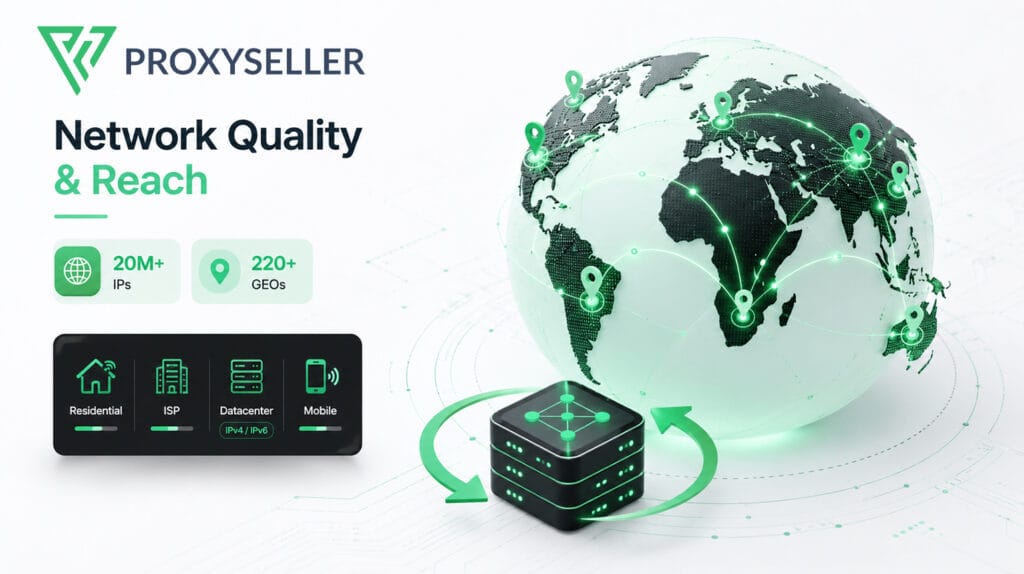
Proxy-Seller scores well for network quality because it offers residential, ISP, datacenter IPv4/IPv6, and mobile proxies in one platform.
Its strength is flexibility. Users can choose cheaper datacenter IPs for simple automation, residential proxies for scraping or SEO monitoring, ISP proxies for stable sessions, and mobile proxies for carrier-based workflows.
The main limitation is verification. Geo consistency, IP cleanliness, ASN diversity, and CAPTCHA rates are not fully proven by public audits or large independent reputation tests.
IP Pool Size & Diversity
Proxy-Seller’s network starts with a large residential proxy claim. The provider says its residential proxy network includes 20M+ rotating residential IPs, which places it in the high-volume tier for residential proxy coverage. This is one of the clearest reasons Proxy-Seller performs well in the Network Quality & Reach category.
The important detail is that this 20M+ IP figure appears to apply mainly to the residential proxy pool. Proxy-Seller does not clearly present it as a combined total across residential, ISP, datacenter, IPv6, and mobile proxies. That distinction matters because residential networks are usually pool-based, while ISP and datacenter proxies are often sold as private or static IPs.
Proxy-Seller also performs well on proxy type variety. It offers the main proxy categories most buyers look for:
Residential Proxies
Best for rotating IP access, scraping, SEO monitoring, and geo-specific browsing where a more natural residential IP profile is useful.
Datacenter IPv4 Proxies
Useful for faster, cheaper static proxy workflows, especially simple automation, testing, and low to medium protection targets.
IPv6 Proxies
A low-cost option for tasks where the target platform supports IPv6 traffic and does not require IPv4-only compatibility.
ISP Proxies
Designed for static sessions with residential-style network registration, making them useful for account workflows and persistent connections.
Mobile Proxies
Built for 4G, 5G, LTE, carrier-based, and social-media-oriented workflows where mobile IP reputation is important.
Proxy-Seller also supports both shared and private access models. Residential proxies are pool-based, while datacenter and ISP proxies are more static or private. Mobile proxies may be shared or dedicated, depending on the plan and country.
This makes Proxy-Seller more flexible than datacenter-only providers. Users can start with cheap static IPs, then move to residential, ISP, or mobile proxies when they need stronger targeting or a more natural IP profile.
The only caveat is that the 20M+ IP claim applies mainly to residential proxies, not every proxy type combined.
Geographic Distribution
Proxy-Seller’s strongest location coverage is on its residential proxy network. The provider claims 220+ residential GEOs, which gives users broad country-level reach for scraping, SEO monitoring, ad verification, and geo-specific browsing.
Targeting also goes deeper than basic country selection. Residential proxy users can filter by country, region, city, ISP, ASN, and ZIP code, depending on the selected location and available pool. This makes Proxy-Seller more flexible than providers that only offer country-level proxy lists.
Residential Proxy Targeting Options
That said, this depth is not equal across every proxy type. Residential proxies have the strongest targeting controls, while datacenter, ISP, and mobile proxy coverage depends more on available locations, stock, carrier options, and plan type.
The balanced takeaway is simple: Proxy-Seller has strong residential reach, but product-dependent location depth. It is a good fit if you need wide residential GEO coverage, but users needing guaranteed city-level accuracy across every proxy type should test their target locations first.
Rotation & Session Management
Rotation control is another strong point for Proxy-Seller, especially on residential proxies. Users can choose between sticky sessions, per-request rotation, and time-based rotation, which covers the main rotation modes needed for scraping, SEO monitoring, automation, and account workflows.
The most useful feature is custom TTL control. Proxy-Seller supports timer-based rotation from 1 to 3600 seconds, giving users more flexibility than providers that only offer fixed intervals like 5, 10, or 30 minutes.
For developers, rotation can also be managed through the API. That means users can create lists, adjust rotation settings, and control residential proxy behavior programmatically instead of relying only on manual dashboard changes.
The main caveat is product scope. These advanced rotation controls are strongest on residential proxies. Datacenter and ISP proxies are mostly static by nature, while mobile proxy rotation depends on the selected plan, country, and carrier availability.
There is also the normal residential proxy limitation: sticky sessions can only stay active while the real exit device remains online. So while Proxy-Seller gives strong session controls, users should still build workflows with retries and fallback logic.
IP Reputation & ASN Diversity
Proxy-Seller shows good functional network quality, especially on residential proxies. Its large claimed residential pool, broad targeting controls, and third-party success-rate signals suggest that the network is usable for many scraping, SEO, and automation workflows.
IP Reputation Verification Notes
Large residential pool, broad targeting, and third-party success-rate data suggest the network is usable for many scraping and SEO workflows.
Proxy-Seller does not publish a public audit showing how many IPs are clean, flagged, blocked, or recycled across reputation databases.
ASN targeting is available, but there is no public ASN-distribution benchmark across the full residential, ISP, datacenter, and mobile network.
Proxy-Seller can work well for general scraping, but stricter targets may still trigger CAPTCHAs, blocks, or timeouts under higher request pressure.
So the takeaway is balanced: Proxy-Seller has a strong and flexible network, but its IP reputation is not fully audit-verified. This is why the Network Quality score is high, but not perfect.
Targeting Capabilities
Proxy-Seller offers strong targeting controls, especially on residential proxies. Users can target by country, region, city, ISP, ASN, and ZIP code, which gives the service more precision than basic country-only proxy providers.
Location Targeting
Residential proxies can be filtered by country, region, city, and ZIP code, depending on location availability and pool depth.
ISP & ASN Targeting
Users can target by ISP and ASN on residential proxies, which helps when a workflow needs a specific network profile.
Mobile Carrier Targeting
Mobile proxies support carrier-based options, including 4G, 5G, and LTE choices, depending on country, stock, and plan type.
Best Use Cases
These controls are useful for SEO monitoring, SERP tracking, localized scraping, ad verification, and account workflows.
Targeting Limitation
Proxy-Seller supports ZIP and carrier-level controls, but we did not find confirmed device-level targeting such as device model, operating system, browser fingerprint, or device class.
Overall, Proxy-Seller performs very well for targeting. It gives users far more control than most budget proxy providers, but the deepest targeting options are strongest on residential and mobile proxies, not equally available across every proxy type.
Network Quality & Reach Score
Proxy-Seller has excellent network breadth for the price. It offers residential, ISP, datacenter IPv4/IPv6, and mobile proxies, with strong residential reach, flexible rotation, and deep targeting controls. The main deductions come from limited public verification around IP reputation, ASN diversity, geo consistency, and CAPTCHA rates.
- ✅ Residential, ISP, datacenter IPv4/IPv6, and mobile proxies are available
- ✅ Claims 20M+ rotating residential IPs across 220+ GEOs
- ✅ Supports country, region, city, ISP, ASN, ZIP, and carrier targeting
- ✅ Sticky, per-request, timed, and custom TTL rotation are supported
- ✅ Mobile options include 4G, 5G, LTE, and carrier-based targeting
- ⚠️ The 20M+ IP claim mainly applies to residential proxies
- ⚠️ Targeting depth varies by proxy type, location, stock, and plan
- ⚠️ No full public blacklist-rate, ASN-distribution, or geo-consistency audit found
Performance & Reliability
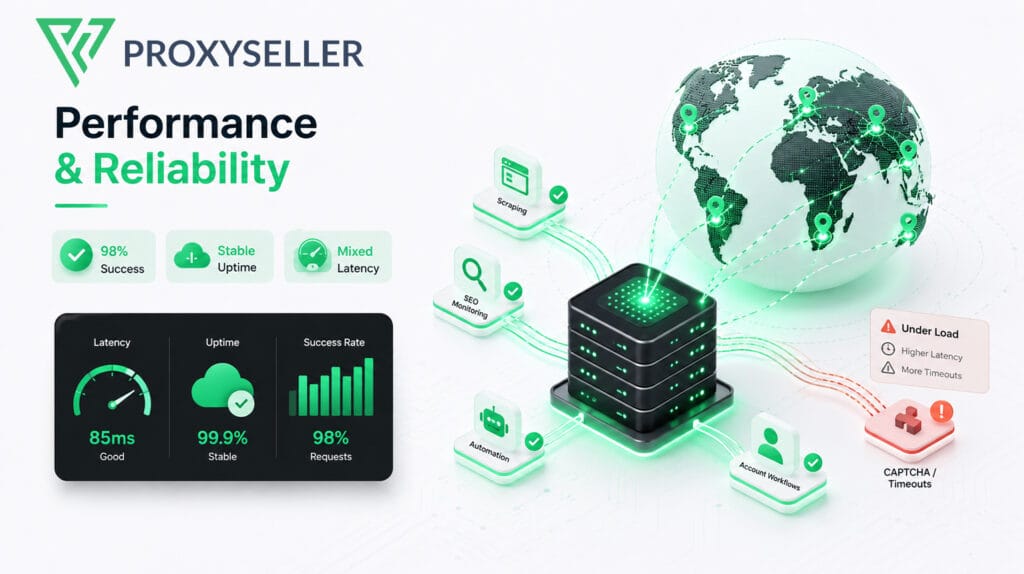
Proxy-Seller performs well enough for normal scraping, SEO monitoring, automation, and account-based workflows, but it should not be treated as a premium managed unblocker.
Its best results come from realistic use cases with smart pacing, rotation, retries, and clean session management. When request pressure increases or the target uses stricter anti-bot systems, performance becomes more mixed.
Speed & Latency
Proxy-Seller speed is generally usable, but not consistently benchmark-leading. Third-party tests show that datacenter proxies perform faster than residential proxies, which is expected because datacenter IPs usually have simpler routing and fewer peer-device variables.
In Proxyway testing, Proxy-Seller datacenter IPv4 proxies averaged around 1.37 seconds across real targets, while ISP proxies averaged around 2.45 seconds. Residential proxies were slower, averaging around 3.79 seconds across tested targets.
Datacenter IPv4
1.37s
Average real-target response time in Proxyway testing. Fastest among the tested Proxy-Seller proxy types.
ISP Proxies
2.45s
Average response time across tested real targets. More stable than residential, but slower than datacenter IPv4.
Residential Proxies
3.79s
Average response time across tested targets. Usable for scraping and SEO, but not consistently premium-speed.
Global Latency Note
TopProxyLab found reasonable local latency in simple tests, but higher variation across global routes. This means Proxy-Seller is fast enough for practical workloads, but performance can change by region, proxy type, and target website.
For most scraping, SEO, and automation workflows, this level of performance is good enough. However, users expecting consistently low latency across every proxy type, country, and target should keep expectations realistic. Proxy-Seller is fast enough for practical workloads, but not a top-tier speed leader.
Success Rate & Error Handling
Proxy-Seller performs well in large-scale residential proxy testing. Proxyway tested its residential proxies with around 780,000 requests over 7 days and reported a success rate close to 98%, with some connection errors but no major downtime.
Real-target performance is more mixed, but still usable. In Proxyway’s real-target testing, Proxy-Seller reached around 91.86% average success across stricter targets, including Amazon, Google, and a photo-focused social platform. This suggests the network can handle normal scraping and SEO workloads, but not with perfect consistency.
TopProxyLab’s practical Google test showed a similar result. Out of 1,000 Google SERP requests, Proxy-Seller completed 923 successful requests, with 54 CAPTCHA events and 23 timeout or error events.
Proxyway Real-Target Test
91.86%
Average success rate across stricter targets, including Amazon, Google, and a photo-focused social platform.
Good enough for normal scraping and SEO workloads, but not perfect across stricter targets.
TopProxyLab Google SERP Test
Out of 1,000 Google SERP requests, Proxy-Seller completed most requests successfully, but CAPTCHA and timeout events still appeared under pressure.
The takeaway is that Proxy-Seller has good success rates for practical proxy workflows, but users still need realistic pacing. CAPTCHAs, blocks, and timeouts become more likely when request pressure increases or when the target has stricter anti-bot systems.
For best results, users should combine Proxy-Seller with retries, delays, rotation rules, clean browser fingerprints, and a CAPTCHA strategy when working with sensitive targets.
Uptime & Connection Stability
Proxy-Seller presents itself as a stable proxy provider, with an official 99% uptime claim and monitored infrastructure. This is a useful reliability signal, but it is still a provider claim rather than a public uptime audit.
Third-party testing supports the idea that Proxy-Seller is generally stable. In Proxyway’s 7-day residential proxy test, the service handled around 780,000 requests with no major downtime reported, although some connection errors did occur.
This means Proxy-Seller should be reliable enough for normal scraping, SEO monitoring, automation, and account workflows. The connection errors seen in testing do not suggest an unstable service, but they do show that users should still expect occasional failed requests.
The main limitation is transparency. Proxy-Seller does not appear to publish a full public status page, historical incident log, or verified 99.9% uptime audit. For most small to mid-sized workflows, that may not matter. For enterprise teams, it is still worth noting.
Proxy-Seller advertises 99% uptime and monitored infrastructure.
Proxyway reported no major downtime across roughly 780,000 residential proxy requests.
No public 99.9% uptime audit, status history, or detailed incident log was found.
Overall, Proxy-Seller has good uptime and connection stability, but not enough public reliability evidence to call it enterprise-grade or fully audit-verified.
Performance Under Load
Proxy-Seller handles large sustained workloads fairly well. The strongest evidence is Proxyway’s residential proxy benchmark, where Proxy-Seller processed around 780,000 requests over 7 days with a success rate close to 98% and no major downtime reported.
That makes the service suitable for moderate to large scraping, SEO monitoring, data collection, and automation tasks, as long as the workflow is paced properly. It is not the kind of provider that collapses immediately under volume.
However, load performance is not the same as strict-target reliability. TopProxyLab’s Google SERP test showed that CAPTCHA events and timeout errors appeared when request pressure increased. The same testing also found weaker results on stricter anti-fraud targets, such as sneaker-related workflows.
The main missing piece is a public high-concurrency stress test. We did not find a clear benchmark showing how Proxy-Seller performs under 50-thread, 100-thread, or very high requests-per-minute conditions.
Overall, Proxy-Seller is strong enough for normal batch workloads, but users should not treat it as a premium anti-bot unblocker. For heavy scraping, it still needs controlled pacing, retries, rotation rules, and target-specific limits.
Real-World Use Cases
Proxy-Seller performs best as a flexible raw proxy provider for users who can manage pacing, retries, rotation, and session behavior. It is suitable for many practical workloads, but it should not be treated as a fully managed anti-bot or CAPTCHA-bypass platform.
SEO Monitoring
A good fit for SERP tracking, local rank checks, competitor research, and geo-specific monitoring when requests are paced properly.
Moderate Scraping
Useful for public-web data collection, especially when paired with delays, retries, rotation rules, and target-specific request limits.
Account-Based Workflows
ISP and mobile proxies can help with workflows that need more stable IP profiles, mobile carrier options, or longer session behavior.
Ad Verification
Works for checking regional ads, localized landing pages, and geo-specific campaign visibility when the required location is available.
Less Reliable for Strict Anti-Bot Targets
Proxy-Seller is less reliable for sneaker sites, ticketing platforms, and high-risk anti-fraud systems. These use cases often need advanced fingerprint control, CAPTCHA handling, and specialized unblocking infrastructure.
Overall, Proxy-Seller is a good match for hands-on users who need flexible proxy access for normal SEO, scraping, automation, and geo-testing workflows. It is less suitable for users expecting a plug-and-play managed scraping API or guaranteed access to strict targets.
Performance & Reliability Score
Proxy-Seller performs well for normal scraping, SEO monitoring, automation, and account workflows. It shows strong residential success rates in testing, but mixed latency, CAPTCHA pressure, and limited built-in retry or failover tools keep it below the excellent tier.
- ✅ Strong residential testing volume, including around 780,000 requests over 7 days
- ✅ Around 98% success in infrastructure testing
- ✅ Real-target success is usable for moderate scraping and SEO workflows
- ✅ No major downtime reported in the 7-day residential benchmark
- ⚠️ Latency varies by proxy type, route, and target
- ⚠️ CAPTCHA and timeout events can appear under higher request pressure
- ⚠️ No confirmed built-in automatic retry, smart failover, or high-concurrency stress test
- ⚠️ Less reliable for strict anti-fraud targets like sneaker and ticketing platforms
Security & Privacy
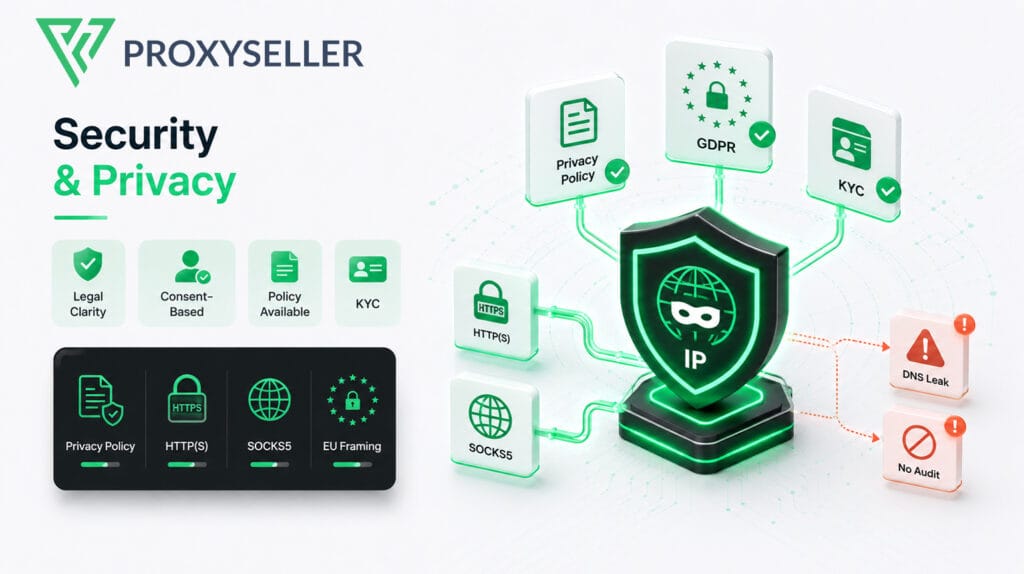
Proxy-Seller has a stronger public compliance posture than many budget proxy providers. It publishes legal documents, identifies its legal entity, references GDPR-style privacy rights, and describes its residential sourcing model in consent-based terms.
That said, privacy-sensitive users should separate legal clarity from proxy-session anonymity. Proxy-Seller looks more transparent than many low-cost providers, but we did not find a formal audited no-logs policy or a public independent sourcing audit.
IP Sourcing Ethics & Methods
Proxy-Seller presents its residential proxy sourcing as consent-based and opt-in. The provider describes the model using terms such as user consent, legitimate partnerships, opt-out mechanisms, fair compensation, and compliance with privacy laws such as GDPR and CCPA.
That is a positive trust signal. It is stronger than vague wording like “real residential IPs” without explaining how those IPs are obtained.
Consent-Based Claims
Proxy-Seller describes its residential IP sourcing as opt-in, consent-based, and built through legitimate partnerships.
Opt-Out & Compensation
The provider references opt-out mechanisms and fair compensation for bandwidth sharing, which lowers sourcing risk compared with unclear P2P models.
Compliance Signals
Proxy-Seller references GDPR, CCPA, data processing terms, acceptable use rules, and ethical sourcing language in its public materials.
Audit Limitation
We did not find a public independent sourcing audit, named partner disclosure, or full residential chain-of-custody report.
The balanced takeaway is that Proxy-Seller’s sourcing explanation is good for its price tier, but not fully audit-verified. We found no clear public red flags in the sourcing language, but the lack of independent verification prevents a perfect trust score.
Logging & Anonymity Policy
Proxy-Seller publishes a public privacy policy, which is better than providers that offer little or no legal documentation. The policy explains how user data may be collected, processed, and used for account access, billing, support, fraud prevention, analytics, and legal compliance.
The main limitation is that we did not find a formal, explicit, audited no-logs policy for proxy traffic. That matters because a general privacy policy is not the same thing as a clear proxy-session no-logs guarantee.
Public Privacy Policy
Proxy-Seller provides a public privacy policy covering account data, service access, billing, support, analytics, and compliance-related processing.
No Formal No-Logs Claim Found
We did not find a dedicated, audited, or clearly separated no-logs policy specifically covering proxy traffic and proxy-session activity.
Account-Linked Data
The privacy policy allows collection of account, payment-related, support, purchase, and usage data, which means the service should not be viewed as fully anonymous.
This does not mean Proxy-Seller is unsafe. It means users should understand the difference between proxy privacy and VPN-style anonymity. Proxy-Seller is suitable for commercial proxy workflows, but it is not positioned as an audited anonymous browsing service.
Overall, Proxy-Seller’s privacy documentation is clear enough for normal business use, but privacy-sensitive users should note the lack of an explicit proxy-traffic no-logs policy and the possibility of account-linked usage data.
Encryption & Traffic Security
Proxy-Seller supports the main protocols most proxy users need, including HTTP(S) and SOCKS5. This gives users good compatibility across browsers, scraping tools, automation frameworks, and proxy managers.
The important distinction is that protocol support does not automatically mean full end-to-end privacy. HTTPS is useful for secure web routing, but SOCKS5 is not encrypted by default unless the application or target connection adds encryption separately.
- HTTPS support: Useful for secure web traffic routing and standard scraping setups.
- HTTP(S) compatibility: Works with common browsers, tools, and automation stacks.
- SOCKS5 support: Flexible for apps and automation, but not encrypted by default.
- Authentication options: Username/password and IP-based access improve account-level control.
Proxy-Seller publishes DNS leak guidance, but third-party testing raised DNS leak concerns in at least one practical test. Users handling privacy-sensitive workflows should test DNS routing themselves and configure their browser, proxy client, or automation stack carefully.
We did not find a public security audit or proof that encrypted transport is enforced across every proxy mode. For most scraping, SEO, and automation tasks, Proxy-Seller’s protocol support is enough. For sensitive privacy use cases, the setup remains partly user-dependent.
Overall, Proxy-Seller is solid on protocol compatibility, but weaker on independently verified leak protection and formal security auditing.
Jurisdiction & Legal Clarity
Proxy-Seller performs well on legal transparency. Its privacy policy identifies the company behind the service as SSV IT PROVIDER ONLINE SERVICES LTD, with a registered address in 🇨🇾 Larnaca, Cyprus.
This is a meaningful trust signal. Many budget proxy providers hide behind brand names, vague contact pages, or unclear offshore structures. Proxy-Seller is stronger here because it names the legal entity, identifies the data controller, and frames its privacy policy under Cyprus and EU-style legal requirements.
Legal Identity Snapshot
Legal Entity: SSV IT PROVIDER ONLINE SERVICES LTD
Jurisdiction: 🇨🇾 Cyprus
Legal Framing: Cyprus law with EU/GDPR-style privacy language
Trust Signal: Public legal entity, registered address, privacy policy, and public offer agreement are available.
The provider’s public documents are also more detailed than average. Its privacy policy explains data-subject rights, processing principles, retention language, and GDPR-aligned concepts such as transparency, purpose limitation, data minimization, and storage limitation.
That said, strong legal clarity does not automatically mean strong anonymity. The same privacy policy allows personal data and usage data processing, and it does not clearly separate proxy traffic logs from website, account, billing, analytics, or support records.
Overall, Proxy-Seller scores strongly for jurisdiction and legal clarity. It is more transparent than many low-cost proxy providers, but users should still treat this as legal transparency, not as a strict no-logs guarantee.
Abuse Handling & Transparency
Proxy-Seller has a clearer abuse and compliance framework than many budget proxy providers. Its Public Offer includes usage restrictions, suspension rights, and language around lawful use of the service.
The provider also states that additional verification may be requested in some cases, including KYC through third-party services such as Sumsub. This suggests Proxy-Seller is not trying to operate as a completely anonymous, no-accountability proxy network.
- Prohibits illegal activity and misuse of the service
- Restricts malware, hacking tools, phishing, and DDoS-related activity
- Prohibits impersonation, ad fraud, and other harmful behavior
- Allows account suspension or refusal of service for serious violations
- May request KYC or usage-purpose clarification in some cases
This is positive from a trust and compliance perspective. It shows that Proxy-Seller has public rules for harmful use and a mechanism to request verification when needed.
That said, the transparency layer is still limited. We did not find a public abuse-reporting portal, law-enforcement request page, transparency report, or detailed enforcement history. The Public Offer explains what is prohibited, but it does not show how abuse reports are handled over time.
Overall, Proxy-Seller has solid abuse restrictions and better compliance language than many low-cost proxy providers. The main limitation is the lack of a public transparency system around abuse reports, takedowns, enforcement, or government requests.
Security & Privacy Score
Proxy-Seller has a stronger compliance posture than many budget proxy providers. It discloses its legal entity, publishes legal documents, references GDPR-style privacy rights, and describes residential sourcing in consent-based terms. The main deductions come from limited no-logs clarity, account-linked data collection, DNS leak concerns, and no independent sourcing audit.
- ✅ Public privacy policy and offer agreement are available
- ✅ Legal entity and Cyprus jurisdiction are disclosed
- ✅ Residential sourcing is described as consent-based and opt-in
- ✅ GDPR, CCPA, opt-out, KYC, and acceptable-use language are present
- ✅ Supports HTTP(S) and SOCKS5 protocols
- ⚠️ No formal audited proxy-traffic no-logs policy found
- ⚠️ Account, payment, support, purchase, and usage data may be collected
- ⚠️ DNS leak concerns appeared in third-party testing
- ⚠️ No public sourcing audit, transparency report, or dedicated abuse portal found
Features & Flexibility
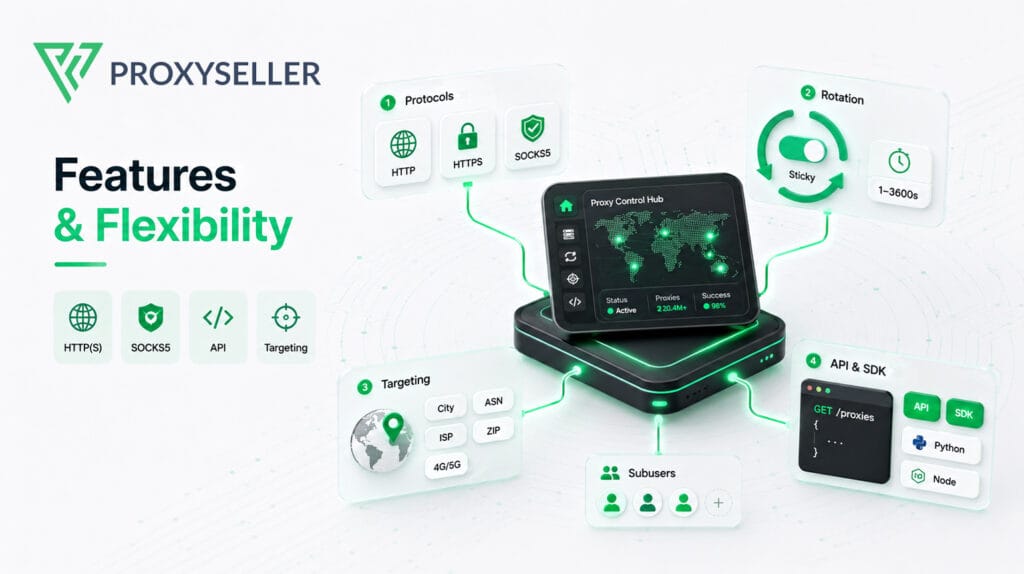
Features and flexibility are among Proxy-Seller’s strongest areas. The service is not just a simple proxy list provider. It offers a flexible raw proxy toolkit with strong protocol support, rotation controls, targeting rules, API access, SDKs, and subuser management.
This makes Proxy-Seller especially useful for technical users, scraping teams, SEO tools, automation workflows, and agencies that want control over how proxies are generated, filtered, rotated, and monitored.
Protocol Support
Proxy-Seller supports the main proxy protocols most users expect: HTTP, HTTPS, and SOCKS5. This gives it broad compatibility with browsers, scraping tools, anti-detect browsers, automation frameworks, SEO software, and proxy managers.
HTTP(S) support is the safest default for most web scraping, SEO monitoring, and browser-based proxy use. SOCKS5 is also available and useful for apps, automation stacks, and tools that need more flexible traffic handling.
Proxy-Seller supports HTTP(S) and SOCKS5, with protocol export options and residential proxy auto-detection in supported setups. SOCKS5 is available, but advanced users should test it with their specific app, browser profile, or automation stack before relying on it at scale.
The only caveat is SOCKS5 behavior on some residential workflows. Proxy-Seller officially supports SOCKS5, but third-party notes suggest it may not always be as seamless as HTTP(S) for every residential setup, port format, or application.
For most users, this is not a major issue. Still, advanced users should test SOCKS5 with their exact browser profile, scraper, bot, or automation stack before relying on it at scale.
Overall, Proxy-Seller is strong on protocol support. HTTP(S) coverage is clear, SOCKS5 is available, and the export and auto-detection options give users more flexibility than basic proxy providers.
Session TTL & Rotation Control
Proxy-Seller is very strong on rotation and session control, especially for residential proxies. Users can choose between sticky sessions, per-request rotation, and time-based rotation, which covers the main workflows needed for scraping, SEO monitoring, account tasks, and automation.
The most useful part is that rotation is not limited to a few fixed presets. Proxy-Seller’s residential API supports sticky mode, per-request rotation, and custom time-based rotation from 1 to 3600 seconds.
| Rotation Mode | How It Works | Best For |
|---|---|---|
| Sticky Session | Keeps the same exit IP while the session stays alive. | Account logins, checkout flows, multi-step browsing, persistent sessions. |
| Session ID + TTL | Uses a session identifier with a custom time-to-live value. | Controlled scraping, session grouping, tasks that need temporary IP stability. |
| Per-Request Rotation | Assigns a new IP on each request. | Large scraping jobs, public data collection, distributed request patterns. |
| Time-Based Rotation | Rotates IPs after a selected interval from 1 to 3600 seconds. | SEO monitoring, repeated checks, scheduled automation, balanced scraping. |
- -1: Sticky mode or no rotation.
- 0: Rotate on every request.
- 1 to 3600 seconds: Custom time-based rotation.
Filtering and Targeting Rules
Proxy-Seller offers strong targeting flexibility, especially on residential proxies. Users can filter by country, region, city, ASN, ISP, ZIP code, and carrier, depending on the proxy type and available pool.
This is one of the reasons Proxy-Seller works well for SEO monitoring, localized scraping, ad verification, and account workflows. It gives users more control than basic providers that only support country-level proxy selection.
Residential proxies appear to have the deepest targeting controls. Proxy-Seller’s documentation supports targeting through login suffixes and API fields, including country, region, city, ASN, ISP, and ZIP code.
Mobile proxies add another layer through carrier and network-generation options, including 4G, 5G, and LTE. This can be useful for mobile account workflows, app testing, regional ad checks, and carrier-sensitive tasks.
The deepest targeting options are strongest on residential proxies. Datacenter, ISP, and mobile proxy targeting can depend on location, available stock, carrier options, and plan type. Users who need exact city, ASN, ZIP, or carrier matching should test availability before scaling.
Overall, Proxy-Seller’s filtering and targeting rules are excellent for a value-focused provider. The main limitation is not lack of targeting, but consistency across every proxy product.
API Access & Automation
Proxy-Seller is strong for developers because it provides public API documentation, API-key access, proxy list management, traffic usage endpoints, rotation controls, and official SDKs for several major programming languages.
This makes it practical for teams that want to automate proxy generation, rotate sessions programmatically, pull usage data, manage packages, or create subuser allocations without doing everything manually inside the dashboard.
The API is especially useful for residential proxy workflows. Users can create proxy lists, apply location filters, change rotation settings, check usage, and manage packages through documented endpoints.
Proxy-Seller also supports subuser package endpoints, which is helpful for agencies, projects, or client-separated workflows. Admins can allocate traffic, adjust validity, inspect remaining traffic, and create lists inside subuser packages.
This is better developer readiness than many value-focused proxy providers offer. The API and SDKs make Proxy-Seller easier to integrate into scripts, bots, dashboards, internal tools, and recurring automation jobs.
That said, Proxy-Seller is still a raw proxy provider, not a fully managed scraping API. It gives users proxy access, rotation, targeting, SDKs, and traffic controls, but users still need to handle request logic, retries, parsing, browser fingerprints, CAPTCHA handling, and target-specific limits.
Overall, Proxy-Seller is highly flexible for technical users. Its API and SDK support are major strengths, especially for teams that want direct control instead of a black-box scraping platform.
Sub-User and Team Management
Proxy-Seller supports subaccounts and subusers for residential proxy packages. This is useful for separating traffic between clients, projects, campaigns, or internal workflows.
The strongest part is traffic control. A main user can create a subuser package, allocate traffic from the parent package, set validity, check remaining traffic, update allocations, and delete subuser packages when they are no longer needed.
Subuser Workflow
Create a separate residential subpackage under the active parent package.
Assign a traffic amount and package duration within the parent package limits.
Generate proxy lists inside the subuser package and adjust rotation settings when needed.
Check package information, remaining traffic, expiration date, and usage through API endpoints.
This is practical for agencies and technical teams that need basic separation between workloads. For example, one subuser can be assigned to an SEO project, another to a scraping task, and another to a client campaign.
The limitation is that Proxy-Seller does not appear to offer full role-based access control. We did not find clear support for roles such as admin, billing-only, read-only, developer-only, or permission-based team access.
Proxy-Seller is strong for subuser traffic allocation, but it is not a full enterprise team dashboard. We did not confirm granular RBAC roles, permission layers, billing-only users, or detailed per-user activity logs.
Built-in Tools & Utilities
Proxy-Seller also includes basic utility tools that help users check proxy functionality and troubleshoot simple connection issues. These are not the main reason to choose the provider, but they add convenience for setup and verification.
The most relevant confirmed tool is the proxy checker, which supports multiple proxy formats, including HTTP, HTTPS, SOCKS4, and SOCKS5. This is useful when users want to validate proxy lists before adding them to browsers, scrapers, bots, or automation tools.
Proxy Checker
Tests whether a proxy is online, reachable, and working correctly before using it in a browser, scraper, or automation tool.
HTTP / HTTPS Checks
Helps users verify standard web proxy formats, which is useful for scraping, SEO tools, and browser-based proxy setups.
SOCKS4 / SOCKS5 Checks
Useful for validating app-based, bot-based, and automation-oriented proxy connections before scaling a workflow.
Ping Method
Provides a basic connectivity signal that can help users check whether a proxy endpoint is responding.
SDK Proxy Checks
Proxy-checking methods appear in SDK functionality, giving developers a convenient way to validate proxies programmatically.
These tools are best viewed as quick verification helpers. They can help users confirm that a proxy is alive, using the right format, and ready for integration before moving into a larger workflow.
That said, they should not be treated as advanced monitoring, anti-ban tooling, or a replacement for proper testing. Users running serious scraping or automation workloads still need their own logging, retry logic, error tracking, and target-specific checks.
Overall, Proxy-Seller’s utility tools add practical value during setup and troubleshooting, but the real strength of this section remains its protocol support, rotation control, targeting depth, API access, and SDK coverage.
Features & Flexibility Score
Proxy-Seller is very strong for technical users who want flexible raw proxy control. It offers HTTP(S), SOCKS5, advanced residential rotation, custom TTL settings, deep targeting, public API access, SDKs, and subuser traffic controls. The main limits are product-dependent targeting depth, SOCKS5 workflow caveats, no confirmed device-level targeting, and limited team-role controls.
- ✅ Supports HTTP, HTTPS, and SOCKS5
- ✅ Sticky, per-request, and time-based residential rotation
- ✅ Custom rotation settings from 1 to 3600 seconds
- ✅ Strong targeting options, including country, city, ASN, ISP, ZIP, and carrier
- ✅ Public API and SDKs for PHP, NodeJS, Python, Java, and Go
- ✅ Subuser traffic allocation and package controls are available
- ⚠️ SOCKS5 and targeting depth may vary by workflow, proxy type, location, and stock
- ⚠️ No confirmed device-level targeting, fingerprint controls, or full RBAC team roles
Ease of Use & Dashboard
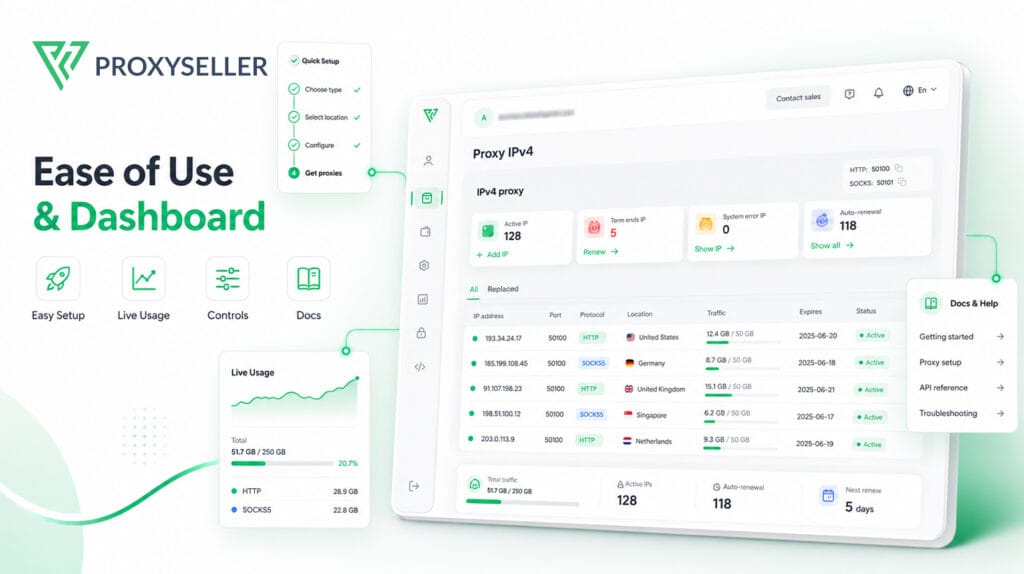
Proxy-Seller’s dashboard is practical and feature-rich, especially for users who already understand proxies. It brings multiple proxy types, proxy list creation, orders, API tools, and account controls into one central workspace.
The trade-off is polish. Proxy-Seller gives users a lot of control, but it is not as beginner-guided or visually refined as the best SaaS-style proxy dashboards. New users may need some time to understand proxy lists, ports, filters, rotation modes, export formats, and authentication options.
Dashboard Design & Navigation
Proxy-Seller’s dashboard is built around practical proxy management rather than a simplified beginner wizard. Users can manage multiple proxy products, access product tabs, view orders, create proxy lists, configure filters, and use API-related tools from the account area.
This is useful if you work with more than one proxy type. A user managing residential, ISP, datacenter, IPv6, and mobile proxies can keep those products inside the same general account environment instead of juggling separate systems.
- Central account area for managing multiple proxy products
- Separate product tabs for proxy configuration and order management
- Residential proxy list creation with filters, ports, and rotation options
- Order history, payment history, repeat purchase, and auto-renewal tools
- API documentation and integration tools available from the account area
- Visual traffic usage indicators for package-level monitoring
For daily use, the dashboard should feel comfortable for proxy-aware users. The workflow supports common tasks such as buying proxies, repeating orders, generating lists, selecting filters, choosing authentication, exporting proxy formats, and managing active packages.
That said, the interface is not perfect. Third-party reviews describe the dashboard as functional, but note some UX rough edges. The platform can feel more technical than beginner-first, especially when users need to understand ports, generated lists, sticky sessions, API tools, and product-specific settings.
Proxy-Seller is usable and practical, but not fully enterprise-polished. Beginners may need documentation or support to understand proxy list generation, rotation settings, filters, export formats, and authentication choices.
Overall, Proxy-Seller’s dashboard is strong for control and everyday proxy management. It is less strong as a hand-holding onboarding experience, but users with basic proxy knowledge should find the core workflow manageable.
Setup & Onboarding Process
Proxy-Seller is fairly easy to set up if you already understand proxies. Users can authenticate with username/password or IP whitelisting, then configure HTTP(S) or SOCKS5 proxies depending on the tool, browser, scraper, or automation workflow.
The setup process is especially flexible for residential proxies. Users can create proxy lists, choose filters, select ports, set rotation behavior, and export the list in the format they need.
Typical Proxy-Seller Setup Flow
Select residential, ISP, datacenter, IPv6, or mobile proxies based on the use case.
Use username/password authentication or IP whitelisting, depending on the tool and workflow.
Apply location filters, choose ports, configure sticky or rotating behavior, and save the list.
Export proxies in the needed format, then add them to a browser, scraper, anti-detect browser, cURL command, or automation tool.
Proxy-Seller also provides setup paths for common use cases. Its documentation covers residential proxy setup, cURL usage, Python examples, browser configuration, and anti-detect browser workflows.
For proxy-aware users, this is a practical setup experience. You can move from purchase to proxy generation and tool integration without needing a custom onboarding call.
The main limitation is that the process still assumes some proxy knowledge. Beginners may need to learn what ports, filters, IP whitelisting, rotation modes, sticky sessions, and export formats mean before they feel comfortable.
Overall, Proxy-Seller’s setup process is efficient for experienced users and manageable for beginners who follow the documentation. It is not the most hand-held onboarding experience, but it gives enough structure to get started quickly.
Documentation & Guides
Proxy-Seller provides good documentation for users who want to set up proxies manually or integrate them into scripts and automation tools. The provider covers API access, residential proxy setup, cURL usage, Python examples, anti-detect browser configuration, and common proxy errors.
This documentation is especially useful for technical users. Instead of only showing a basic proxy list, Proxy-Seller gives users enough guidance to create lists, configure rotation, select authentication, export proxies, and connect them to external tools.
API Docs
Covers API keys, proxy actions, orders, balance, residential lists, package data, and SDK access.
Residential Setup
Explains residential proxy setup, locations, sessions, TTL, rotation, proxy lists, and authentication.
cURL Guide
Helps users test residential proxies from the command line and connect API-generated proxy lists.
Python Examples
Provides practical examples for requests-based proxy setup and scraping-related workflows.
Anti-Detect Browsers
Includes guidance for configuring proxies inside anti-detect browsers and browser-based workflows.
Error Troubleshooting
Covers common proxy errors such as authentication failures, 403, 407, 429, 500, and 502 responses.
Proxy-Seller is also developer-ready. Its documentation includes API references, cURL guidance, Python examples, and SDK support, which makes it more useful than providers that only publish basic setup pages.
The main limitation is organization. The coverage is broad, but some material is split between API docs, setup guides, blog posts, and SDK pages. That can make the learning path feel fragmented for beginners.
Proxy-Seller has good documentation depth, but it is not always presented as one smooth beginner-to-advanced learning path. Users may need to move between the docs, blog tutorials, SDK pages, and setup articles to find the right workflow.
Overall, Proxy-Seller’s documentation is strong for practical setup and developer use. It is not the most polished learning center, but it gives enough guidance for proxy-aware users to configure, test, and automate the service effectively.
Real-Time Usage Monitoring
Proxy-Seller provides useful traffic and package visibility, especially for residential proxy users. Users can check package usage, remaining traffic, expiration data, and subuser allocation, which helps with basic cost control and workload planning.
The dashboard also appears to include visual usage indicators, such as traffic bars, making it easier to see how much bandwidth has been consumed without relying only on raw numbers.
Package Usage
Shows traffic consumption for active packages, helping users track bandwidth use during scraping, SEO, and automation tasks.
Remaining Traffic
Helps users estimate how much residential bandwidth remains before they need to top up, renew, or reduce request volume.
Subuser Allocation
Allows traffic to be split between subusers or projects, which is useful for agencies, clients, and separated workflows.
Visual Traffic Bar
Gives users a quick visual summary of consumed traffic, making package status easier to understand at a glance.
Usage Tables
Supports basic package and list-level visibility, though the depth appears more practical than advanced.
API Usage Data
API endpoints can retrieve package information and traffic usage, which helps developers monitor usage programmatically.
This level of monitoring is enough for most users who need to track bandwidth, packages, expiration, and project-level allocation. It is especially useful if you are managing several residential proxy lists or splitting traffic across subusers.
The limitation is operational depth. We did not find strong evidence of full request-level logs, endpoint-level filtering, error-code dashboards, session history, target-domain tracking, or detailed logs by IP, subuser, time range, and status.
Proxy-Seller gives useful traffic summaries, but it should not be treated as a full observability dashboard. Serious scraping teams may still need external logging, error tracking, retry monitoring, and endpoint-level analytics.
Overall, Proxy-Seller’s usage monitoring is practical for bandwidth and package control, but limited for advanced diagnostics. It is good enough for everyday management, not a replacement for a dedicated monitoring stack.
Accessibility & Language Options
Proxy-Seller offers broad multilingual support across its public website and account entry flow. This is helpful for international users who prefer to browse plans, support pages, and documentation in a familiar language.
The visible language options include more than ten languages, which is stronger than many budget proxy providers. This makes Proxy-Seller more approachable for global users, agencies, and teams working across different regions.
Multilingual Website
The public interface supports many languages, making the service easier to browse for international users.
Account Entry Support
Language selection appears around the public site and account entry flow, which helps users before purchase or login.
Standard Device Use
The service appears usable on standard browsers and devices, especially for desktop-based proxy management.
Mobile Evidence Limited
We did not find strong evidence that the authenticated dashboard is fully optimized as a mobile-first experience.
No WCAG Claim Found
We did not find a formal accessibility statement, WCAG claim, or detailed keyboard-accessibility documentation.
Dashboard Translation Caveat
Public language support is strong, but full localization across every authenticated dashboard screen should not be assumed.
For international users, Proxy-Seller’s language support is a clear advantage. It makes the service easier to evaluate, purchase, and learn compared with providers that only offer an English interface.
The accessibility picture is more limited. We did not find a public accessibility statement, WCAG compliance claim, mobile app, or strong proof that the dashboard is fully optimized for mobile-first use.
Proxy-Seller should be described as multilingual and usable on standard devices, but not as formally accessibility-certified. We did not find enough evidence to claim full WCAG compliance, full mobile optimization, or complete dashboard localization across every screen.
Ease of Use & Dashboard Score
Proxy-Seller is practical once users understand proxy basics. The dashboard supports multiple proxy types, proxy list creation, product tabs, setup tools, API access, and traffic visibility. The main drawbacks are beginner friction, some UX rough edges, limited operational logs, and no strong accessibility or mobile-optimization proof.
- ✅ Central dashboard for managing multiple proxy products
- ✅ Proxy list generator with filters, ports, rotation, and export controls
- ✅ Supports username/password authentication and IP whitelisting
- ✅ Setup guides, API docs, SDKs, and error-code troubleshooting are available
- ✅ Package traffic, remaining bandwidth, subuser allocation, and visual usage bars are supported
- ⚠️ Dashboard can feel technical for beginners
- ⚠️ Documentation is useful, but fragmented across docs, blog posts, API pages, and SDK pages
- ⚠️ Limited evidence of full endpoint, session, IP, or error-log filtering
- ⚠️ No formal accessibility statement, WCAG claim, or full dashboard-localization proof found
Pricing & Value
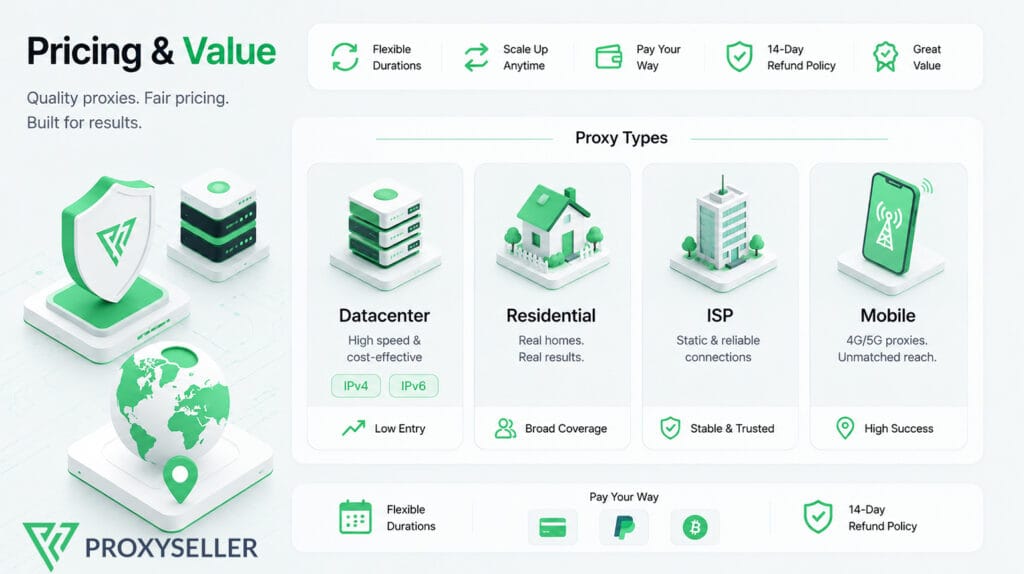
Pricing is one of Proxy-Seller’s clearest competitive advantages. The provider offers low-entry plans, flexible scaling, broad proxy-type coverage, and a wide range of payment methods, making it accessible to both small users and larger teams.
The value is strongest for users who know how to manage their own proxy workflow. Proxy-Seller gives you raw proxy access, rotation controls, targeting options, API access, and SDK support at competitive pricing, but it does not bundle managed CAPTCHA solving, browser automation, or full unblocking infrastructure.
Plan Variety & Pricing Breakdown
Proxy-Seller offers a wide range of pricing models across its proxy products. This is useful because not every user needs the same type of plan. Some workflows need traffic-based residential proxies, while others need fixed ISP or datacenter IPs for stable sessions.
The dedicated pricing page is also useful because it shows live product categories, locations, IP or traffic amounts, and rental periods before purchase. That makes Proxy-Seller more transparent than providers that hide most pricing behind sales forms.
Residential Proxies
From around $0.70/GB, with small paid test options and larger traffic packages for scraping, SEO, and geo-targeted workflows.
ISP Proxies
From around $1/IP, with static residential-style IPs, longer rental periods, and automatic discounts for longer commitments.
Datacenter IPv4
Common locations are listed around $0.90/IP, while some mix packages start around $0.70 to $0.75/IP.
Datacenter IPv6
Many IPv6 locations are listed from around $0.08/IP, making IPv6 one of the lowest-cost options in the catalog.
Mobile Proxies
Mobile 4G, 5G, and LTE plans are available from around $10/IP, with shared and dedicated options depending on location.
Enterprise & Custom
Larger buyers can request quote-based plans, invoices, VAT support, volume discounts, priority support, and account management.
Proxy-Seller’s pricing structure is flexible enough for small tests, recurring automation, SEO monitoring, scraping projects, account workflows, and larger business use cases. You can start with a small residential traffic package, buy a small number of static IPs, or scale into larger allocations when the workflow proves reliable.
The strongest value is for hands-on users. Proxy-Seller gives competitive proxy access, multiple proxy types, rotation controls, targeting, API access, and SDK support at a low entry cost.
These are starting prices, not fixed final prices for every order. Exact cost can vary by proxy type, location, traffic amount, number of IPs, rental period, stock, VAT, discounts, and custom enterprise terms. Always check Proxy-Seller’s live pricing page before purchase.
Overall, Proxy-Seller has one of the more flexible pricing structures in the value-focused proxy market. It is suitable for small buyers, technical users, agencies, and teams that want to scale without immediately committing to high minimum plans.
Proxy-Seller Discount Code:
Use coupon code
HISCZR_358119
at checkout to get approximately 10% off your Proxy-Seller order.
Coupon availability and discount amount may change. Always confirm the discount is applied on the Proxy-Seller checkout page before completing your purchase.
Trial, Refund, or Low Entry Access
Proxy-Seller does not offer a true free trial. Instead, it provides low-entry purchase options and a small paid residential test option, which lets users try the service without committing to a large plan.
This is better than having no test path at all, but it is not risk-free. Users should treat the trial-style residential option as a paid test, not as a refundable free trial.
Buyer Protection Flow
Proxy-Seller does not provide a full free trial, so the safest approach is to test with a low-entry residential package or small proxy order first.
Check the exact proxy type, location, protocol, rotation mode, and target website before scaling to a larger plan.
Refund eligibility may depend on the issue being confirmed, so connection or location problems should be reported early.
Proxy-Seller describes a conditional 72-hour refund window for specific cases, but this is not a broad no-questions-asked guarantee.
| Policy Point | What It Means for Buyers |
|---|---|
| No true free trial | You need to buy a plan or small test option to evaluate the service. |
| Paid residential test | Useful for low-cost testing, but it should not be treated as a refundable free trial. |
| 72-hour conditional refund | Refunds may apply in specific cases, such as inoperable proxies or confirmed connection issues. |
| Trial-style purchase not refundable | The 3-day residential trial-style option is excluded from refund eligibility. |
| Fees may be deducted | Processing, transfer, receiving, or return-payment fees may be excluded from approved refunds. |
Proxy-Seller’s refund policy is transparent enough to be useful, but it is not the same as a simple money-back guarantee. The user may need to contact support, confirm the issue, and meet the required timing and policy conditions.
This means the safest buying approach is to start small. Test the required proxy type, location, protocol, rotation mode, and target website before scaling into larger packages.
Proxy-Seller has a written refund policy, but refunds are conditional. The 3-day residential trial is not refundable, weekly products may have shorter eligibility, and approved refunds may exclude payment or transfer fees.
Overall, Proxy-Seller gives users low-cost ways to test the service, but not a true free trial. This is acceptable for a budget-friendly provider, but buyers should verify performance with a small order before committing to larger usage.
Payment Methods
Proxy-Seller does very well on payment flexibility. It supports mainstream payment methods such as PayPal, Visa, and Mastercard, along with a broad range of cryptocurrency and stablecoin options.
This is a practical advantage for global users. Some buyers prefer cards, some rely on PayPal, and others need crypto or stablecoins for easier international payment access.
| Payment Type | Supported Options | Why It Matters |
|---|---|---|
| Cards | Visa and Mastercard | Simple for most individual buyers, teams, and business cards. |
| PayPal | PayPal checkout support | Useful for buyers who prefer wallet-style payments or avoid direct card entry. |
| Crypto | Bitcoin and multiple stablecoin or network-based options | Improves access for international users and privacy-conscious buyers. |
| Business Billing | Invoices, VAT support, and account balance options | Helpful for agencies, companies, and recurring proxy buyers. |
This range of payment options is stronger than many value-focused proxy providers. It makes Proxy-Seller easier to buy from across different countries, especially for users who cannot rely on only one payment rail.
There are still practical caveats. Payment availability can vary by country, processor rules, compliance checks, crypto network conditions, and possible verification requirements. Refunds may also exclude processing or transfer fees.
Overall, Proxy-Seller earns strong marks for payment accessibility. Cards, PayPal, crypto, stablecoins, invoices, and VAT support make it flexible for individual users, agencies, and international buyers.
Value for Money
Proxy-Seller offers strong value because it combines low-entry pricing with a broad feature set. Users get access to residential, ISP, datacenter, IPv6, and mobile proxies, plus HTTP(S), SOCKS5, rotation controls, targeting options, API access, SDKs, and subuser tools.
That is a lot of functionality for the price. The value is especially strong for users who already have their own scraping tools, browser setup, retry logic, and workflow controls.
Proxy-Seller Value Equation
Low entry cost + multiple proxy types + rotation controls + targeting depth + API and SDK support = strong value for hands-on proxy users.
Strong Value When
- You need affordable raw proxy access.
- You can manage retries, pacing, and rotation logic yourself.
- You want several proxy types under one provider.
- You need API access and SDKs for automation.
- You want to start small before scaling.
Lower Value When
- You need managed scraping instead of raw proxies.
- You expect built-in CAPTCHA solving.
- You need browser automation or fingerprint management included.
- You require premium unblocking for strict anti-bot targets.
- You want a no-risk free trial before purchase.
Proxy-Seller is best understood as a flexible raw proxy provider, not a fully managed scraping platform. It gives users the proxy infrastructure, but the user is still responsible for how requests are sent, how sessions are handled, how errors are retried, and how target-specific blocking is managed.
For SEO monitoring, moderate scraping, testing, automation, and account workflows, the value is strong. For high-risk targets that require CAPTCHA solving, browser fingerprint control, and advanced anti-bot handling, the value depends more on the user’s own stack.
Proxy-Seller’s value is highest when you test a small plan first, confirm the proxy type and location work for your target, then scale gradually with the right rotation and retry settings.
Overall, Proxy-Seller delivers excellent value for budget-conscious and technical users. The main weaknesses are not price-related, but risk-control related: no true free trial, conditional refunds, and the need to manage performance, retries, and anti-detection yourself.
Pricing & Value Score
Proxy-Seller scores very well on pricing because it offers competitive starting prices, low-entry plans, flexible scaling, multiple proxy types, and broad payment support. The main drawbacks are the lack of a true free trial, conditional refunds, and the need to manage scraping performance, retries, and anti-detection yourself.
- ✅ Strong pricing across residential, ISP, datacenter, IPv6, and mobile proxies
- ✅ Low-entry residential traffic and small proxy orders make testing affordable
- ✅ Flexible GB-based, per-IP, custom, and enterprise plan options
- ✅ PayPal, cards, crypto, stablecoins, invoices, and VAT support are available
- ⚠️ No true free trial, and the paid residential trial-style option is not refundable
- ⚠️ Refunds are conditional and may exclude processing or transfer fees
- ⚠️ Best value depends on managing retries, pacing, and anti-detection externally
Support & Documentation
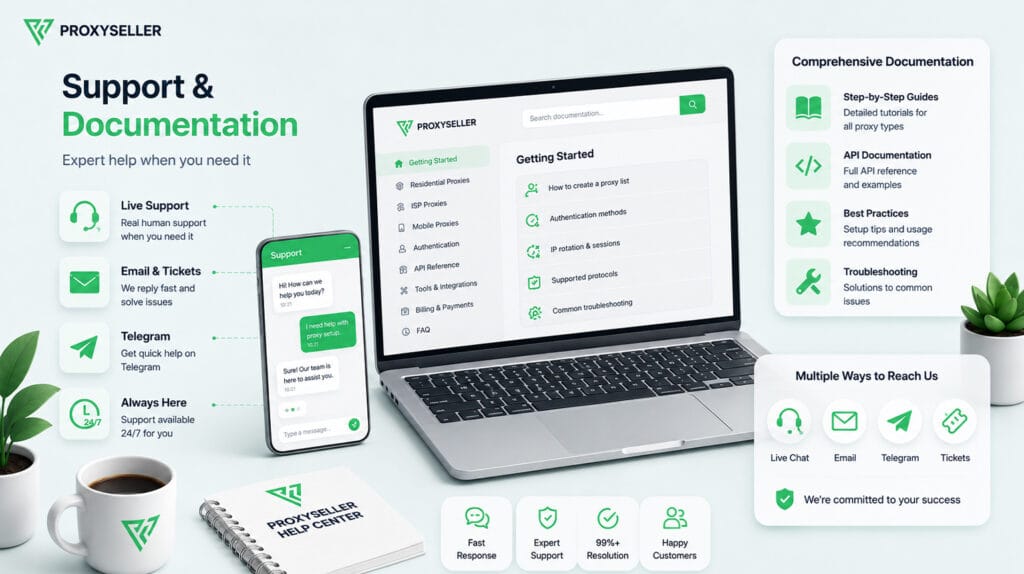
Proxy-Seller performs well on support and documentation, especially for a value-focused proxy provider. It offers multiple contact channels, fast live chat signals, detailed API documentation, SDK resources, setup guides, troubleshooting articles, and onboarding content.
The main weakness is not support availability. It is transparency around ongoing incidents and product changes. We did not find a mature public status page, formal incident archive, provider-wide changelog, or public roadmap.
Support Availability & Channels
Proxy-Seller offers more support channels than many budget proxy providers. Users can contact support through email and live chat, while Telegram, Teams, Skype or messenger-style contact, Discord, and social links add extra ways to reach the company or follow updates.
The strongest channel is live chat. Proxy-Seller describes its chat support as available around the clock, and third-party testing found fast human responses in live-chat interactions.
| Support Channel | Availability Signal | Best Use |
|---|---|---|
| Email Support | Official support email is publicly listed. | Account issues, billing questions, technical follow-up, and written support trails. |
| 24/7 Live Chat | Advertised as round-the-clock support. | Fast setup help, proxy not working, pre-sale questions, and urgent troubleshooting. |
| Telegram | Public support/contact route is available. | Messenger-style support, quick questions, and alternative contact when chat is not preferred. |
| Teams, Skype & Messenger-Style Contact | Listed or referenced across contact and sales paths. | Business communication, custom pricing, and direct contact for larger buyers. |
| Discord & Social Links | Community and social presence exists. | Public presence, announcements, brand updates, and additional contact visibility. |
This is a strong support-channel setup for the price tier. Email gives users a formal contact path, live chat helps with urgent issues, and messenger-style channels make Proxy-Seller more accessible for international buyers.
The main limitation is structure. We found clear evidence of email and real-time support, but not a fully structured public ticketing system with visible ticket IDs, SLA tracking, escalation status, or a helpdesk portal.
Proxy-Seller offers several ways to contact support, but we did not find clear public evidence of a formal ticketing portal, SLA dashboard, escalation tracker, or structured support-case history.
Overall, Proxy-Seller is strong on support availability. The provider offers enough contact options for most users, with live chat standing out as the most important channel for quick setup and troubleshooting.
Response Time & Helpfulness
Proxy-Seller has strong response-time signals, especially through live chat. Official pages describe 24/7/365 support, and third-party testing found human live-chat responses within minutes.
That is a major advantage for users who need quick help with setup, proxy connection issues, payment questions, or product selection before purchase.
Strong Support Signals
- Live chat is advertised as available around the clock.
- Third-party tests reported human replies within minutes.
- Support appears helpful for setup and configuration questions.
- Many user reviews praise fast responses and practical help.
Where Feedback Is Mixed
- Some users report unresolved proxy-quality or traffic issues.
- Harder cases may require follow-up instead of a quick answer.
- Support quality can feel less consistent when problems are complex.
- There is no public SLA or escalation-tracking system to verify outcomes.
The best use of Proxy-Seller support is for quick practical issues: choosing a proxy type, fixing setup mistakes, checking authentication, confirming order details, or asking about basic connection problems.
For deeper issues, the picture is more mixed. User feedback includes positive comments about fast and helpful support, but also complaints about harder cases such as unresolved traffic problems, quality concerns, or follow-up issues.
When contacting support, include the proxy type, order details, target location, protocol, authentication method, error message, and a short test result. This gives the support team a better chance of resolving the issue quickly.
Overall, Proxy-Seller is strong on response speed and generally helpful for standard support cases. It loses some points because harder technical or quality-related issues do not always appear to be resolved as consistently as initial live-chat questions.
Knowledge Base & Onboarding Docs
Proxy-Seller has strong self-serve documentation for a value-focused provider. Its resources cover API usage, SDKs, residential proxy setup, proxy list creation, rotation controls, Session ID + TTL, cURL testing, Python examples, anti-detect browser setup, and common proxy errors.
This makes the documentation useful for both beginners and technical users. Beginners can follow setup guides for browsers and operating systems, while developers can use API references, SDK pages, and cURL examples to automate proxy workflows.
Documentation Resource Index
API docs cover keys, proxy actions, order actions, balance, residential proxy controls, package data, and traffic usage.
SDK resources support major languages, helping developers connect Proxy-Seller to scripts, tools, and internal dashboards.
Setup guides cover residential proxies, Windows, macOS, iOS, Android, Chrome, Firefox, anti-detect browsers, and common proxy tools.
cURL and Python examples help users test proxies quickly before building larger scraping or automation workflows.
Troubleshooting content explains proxy errors, authentication problems, detection issues, WebRTC concerns, and setup mistakes.
The strongest documentation areas are residential proxy setup, API usage, rotation configuration, and tool integration. Proxy-Seller gives users enough material to generate lists, configure authentication, choose rotation behavior, export proxies, and connect them to external tools.
The main weakness is organization. The material is useful, but it is spread across API docs, setup guides, FAQ pages, SDK resources, and blog articles. This is fine for experienced users, but beginners may need to move between several pages to complete one workflow.
Proxy-Seller’s knowledge base is broad, but not perfectly unified. Some setup help lives in docs, some in blog tutorials, some in SDK pages, and some in product-specific guides.
Overall, Proxy-Seller’s documentation is strong for setup and developer use. It is not a fully polished learning academy, but it gives enough practical guidance for most proxy-aware users to configure, test, and automate the service.
Community Feedback & Public Ratings
Public feedback on Proxy-Seller is generally positive, but not perfect. Reviews and third-party testing tend to praise the provider’s pricing, product variety, setup speed, support availability, and flexible proxy options.
The negative feedback is more concentrated around proxy quality variation, geo mismatch, strict target failure, support resolution complaints, and occasional frustration when proxies do not perform as expected for a specific use case.
Review Sentiment Map
Highlights affordability, product variety, dashboard control, and fast support, while noting UX limits and mixed fit for enterprise-level needs.
Adds practical testing context around performance, target behavior, dashboard usage, and limitations under stricter conditions.
User feedback often praises setup ease, pricing, dashboard organization, and fast support, though some users want better analytics or smoother UX.
Feedback is more mixed, with some complaints about proxy quality, traffic problems, support follow-up, or use cases where proxies did not work as expected.
Supports the view that live chat is fast and the dashboard is functional, while still noting rough edges in some usage and reporting areas.
The overall pattern is clear: Proxy-Seller has a strong reputation for value, flexibility, and support access, but user experience can vary depending on the proxy type, target website, location, and workload.
This is normal for raw proxy providers. A proxy that works well for SEO monitoring or moderate scraping may not perform well against strict anti-bot platforms, login-heavy workflows, or targets with aggressive fraud detection.
Treat user reviews as use-case signals, not universal proof. Check whether the reviewer used the same proxy type, country, target site, protocol, and rotation settings that you plan to use.
Overall, public sentiment supports Proxy-Seller as a good-value, flexible proxy provider. The criticism does not erase its strengths, but it does show why users should test their exact workflow before scaling.
Status Page, Changelog & Public Presence
Proxy-Seller has a visible public presence through its website, blog, documentation, social channels, Telegram, Discord links, and GitHub SDK repositories. These are useful trust signals because they show the company is active and maintains developer-facing resources.
However, this is not the same as formal incident transparency. We did not find an official public status page, provider-wide incident archive, mature product changelog, or public roadmap.
Transparency Snapshot
No official public status page or incident-history archive was found.
Internal dashboard visibility appears to show proxy-level status and package information, but this is not a provider-wide public outage dashboard.
Proxy-Seller maintains an active blog, social/community channels, Telegram and Discord presence, and public GitHub repositories for SDKs.
No formal provider-wide changelog, regular release-notes page, or public product roadmap was found.
This matters because proxy users often need to know whether problems are caused by their own setup, target-site blocking, location stock, or provider-side incidents. A public status page would make outages, maintenance, and regional disruptions easier to verify.
The same applies to changelogs. Proxy-Seller’s blog and SDK repositories show activity, but they do not replace a structured changelog that tracks dashboard changes, API updates, proxy-network changes, pricing changes, or product-level improvements.
Proxy-Seller has useful public activity signals, but not mature incident transparency. Users should not expect a full public uptime dashboard, outage archive, roadmap, or provider-wide changelog.
Overall, Proxy-Seller has a healthy public presence, but weaker formal transparency around incidents and product changes. This is the main reason the support category does not score even higher.
Support & Documentation Score
Proxy-Seller performs strongly on support availability, response speed, setup content, and developer documentation. It offers live chat, email, Telegram-style contact, API docs, SDK resources, setup guides, and troubleshooting articles. The main deductions come from limited formal ticketing, mixed feedback on harder cases, no official public status page, and no mature provider-wide changelog.
- ✅ Email support and 24/7 live chat are available
- ✅ Telegram, Teams, Skype or messenger-style contact, Discord, and social links add extra reach
- ✅ Third-party testing reported fast live-chat responses
- ✅ API docs, SDK docs, residential setup guides, cURL examples, and troubleshooting articles are available
- ✅ Good onboarding coverage for browsers, anti-detect tools, Python, rotation, and Session ID + TTL
- ⚠️ No clearly structured public ticketing portal or SLA tracker found
- ⚠️ User feedback is mixed on harder proxy-quality or issue-resolution cases
- ⚠️ No official public status page, incident archive, roadmap, or mature provider-wide changelog found
Who Should and Shouldn’t Use Proxy-Seller?
Proxy-Seller is best for users who want affordable proxy infrastructure with strong control over proxy type, location, rotation, targeting, API access, and payment method. It is especially useful for hands-on users who can manage their own scraping stack, session behavior, retry logic, and target-specific limits.
It is less ideal for users who want a fully managed scraping browser, automatic CAPTCHA solving, built-in anti-detection, or enterprise-grade operational transparency.
Who Should Use Proxy-Seller?
Proxy-Seller is a good fit for hands-on users who want affordable proxy infrastructure, multiple proxy types, and strong control over rotation, targeting, and API-based workflows.
- SEO teams tracking SERPs across locations
- Scrapers who can manage request pacing and retries
- Developers needing API access and SDK support
- Agencies managing multiple proxy types under one account
- Social media automation users needing sticky sessions
- Budget-conscious buyers comparing residential, ISP, datacenter, and mobile proxies
- Users who prefer PayPal, card, and crypto payment flexibility
Who Should Avoid Proxy-Seller?
Proxy-Seller is not the best choice for users who need a managed unblocking platform, strict privacy guarantees, or enterprise-level transparency and team controls.
- Users needing a managed scraping browser or unblocker
- Privacy-first users requiring a formal no-logs proxy policy
- Beginners who cannot configure retries, delays, sessions, and fingerprints
- High-risk sneaker, ticketing, or aggressive anti-bot targets
- Users expecting guaranteed CAPTCHA bypass or built-in anti-detection
- Enterprise teams needing full RBAC and granular team roles
- Teams needing public status history, incident reporting, and mature changelogs
Quick Fit Verdict
Proxy-Seller is a strong fit for hands-on users who want affordable proxy infrastructure and detailed control. It is less ideal for users who expect the provider to handle the entire unblocking stack automatically.
Overall, Proxy-Seller works best as a flexible raw proxy provider. It gives users good tools, broad proxy coverage, strong pricing, and useful setup options, but the final success of many workflows still depends on how well the user manages configuration, pacing, rotation, retries, and anti-detection.
Pros & Cons
Proxy-Seller’s strengths are clear: broad proxy coverage, strong targeting and rotation controls, competitive pricing, and useful developer support. Its weaknesses are mostly around privacy guarantees, advanced reliability, and operational transparency, which matter more for high-risk or enterprise workflows.
Pros
- Excellent proxy type coverage
- Residential, ISP, datacenter IPv4/IPv6, and mobile proxies
- Large claimed residential proxy pool
- Strong residential targeting and rotation controls
- HTTP(S), SOCKS5, API, and SDK support
- Very competitive pricing
- Low-entry plans and flexible scaling
- Broad payment methods, including PayPal, cards, and crypto
- Strong documentation and setup guides
- 24/7 live chat availability
Cons
- No formal audited no-logs policy found
- Performance is good, not premium-perfect
- CAPTCHA pressure can appear under higher request load
- DNS leak concerns appeared in third-party testing
- No official public status page
- No mature provider-wide changelog or public roadmap
- Dashboard can feel technical for beginners
- Limited evidence of full RBAC team roles
- No true free trial
- Refunds are conditional and may exclude fees
Final Verdict: Is Proxy6 Worth It?
Proxy6 is worth considering if you need cheap static datacenter proxies for light automation, simple scraping, or long-running bot tasks. It offers SOCKS5 support, fast setup, practical tools, and fair reliability for the price.
The main trade-off is depth. Proxy6 does not offer rotating proxies, residential IPs, mobile proxies, advanced targeting, enterprise controls, or strong privacy transparency. Choose it when budget matters more than rotation, targeting depth, and premium proxy infrastructure.

Proxy-Seller is a flexible and affordable raw proxy provider with excellent network variety and strong controls, but it needs user-managed setup to perform well on stricter targets.
Choose Proxy-Seller If
- You need multiple proxy types in one account
- You want affordable residential or datacenter access
- You need sticky, per-request, and custom timer rotation
- You need ASN, ISP, ZIP, city, or carrier targeting
- You want API and SDK support
- You are comfortable managing your own scraping or automation stack
Look Elsewhere If
- You need managed CAPTCHA solving
- You need audited no-logs privacy
- You need enterprise-grade logs and incident reporting
- You want plug-and-play scraping with no configuration
- You need reliable access to strict anti-fraud targets
- You expect the provider to handle the full unblocking stack
Proxy Score Breakdown
Network Quality & Reach: 4.5 / 5
Performance & Reliability: 3.4 / 5
Security & Privacy: 3.0 / 5
Features & Flexibility: 4.5 / 5
Ease of Use & Dashboard: 3.8 / 5
Pricing & Value: 4.5 / 5
Support & Documentation: 4.2 / 5
Score Guide: 5.0 = Outstanding | 4.5 = Excellent | 4.0 = Great | 3.5 = Good | 2.5 = Average | 2.0 = Below Average | 1.0 = Poor
How we rate proxies: Each score is based on network quality, performance, proxy features, security and privacy, ease of use, pricing, support, documentation, and practical testing signals where available. We apply the same review framework across proxy providers for consistency.
Proxy-Seller Discount Code:
Use coupon code
HISCZR_358119
at checkout to get approximately 10% off your Proxy-Seller order.
Coupon availability and discount amount may change. Always confirm the discount is applied on the Proxy-Seller checkout page before completing your purchase.
Frequently Asked Questions
Is Proxy-Seller legit?
Yes, Proxy-Seller appears to be a legitimate proxy provider. It discloses a legal entity, publishes public policies, offers multiple payment methods, provides customer support channels, and has a long-running public presence across its website, documentation, reviews, and community channels.
That said, legitimacy does not mean perfect privacy, perfect uptime, or guaranteed success on every target. Users should still test their exact proxy type, location, protocol, and workload before scaling.
Does Proxy-Seller support SOCKS5?
Yes. Proxy-Seller supports HTTP(S) and SOCKS5 proxy workflows, depending on the proxy type and configuration.
SOCKS5 support is useful for browsers, scraping tools, automation apps, and software that needs non-browser proxy routing. Still, users should test SOCKS5 with their exact target app or residential workflow before committing to larger usage.
Is Proxy-Seller good for scraping?
Proxy-Seller can be good for general scraping, SEO monitoring, market research, and automation workflows, especially when users manage request pacing, retries, rotation, headers, and session behavior properly.
It is not a managed scraping browser, CAPTCHA solver, or full unblocker. For stricter targets, users should expect to handle anti-detection, browser fingerprinting, retry logic, and target-specific testing themselves.
Does Proxy-Seller offer residential proxies?
Yes. Proxy-Seller offers residential proxies and claims access to a large residential proxy pool with 20M+ residential IPs across 220+ GEOs.
Residential proxy features include rotating sessions, sticky sessions, custom TTL settings, and targeting options such as country, city, ISP, ASN, ZIP, and carrier, depending on stock, location, and plan availability.
Does Proxy-Seller have a free trial?
Proxy-Seller does not appear to offer a true free trial. Instead, it provides low-entry paid options that can be used to test the service before scaling.
Its refund policy is conditional, and some trial-style or short-term purchases may not be refundable. Always check the checkout page and refund terms before buying, especially if you only want to test one specific target.
What payment methods does Proxy-Seller accept?
Proxy-Seller supports a broad range of payment methods, including bank cards, PayPal, Bitcoin, stablecoins, and other crypto options.
This is one of its stronger value points, especially for international buyers who want more flexibility than card-only payment providers.
Is Proxy-Seller private or no-logs?
Proxy-Seller has a privacy policy and publishes legal terms, but we did not find a formal audited no-logs policy specifically proving that proxy traffic is not logged.
That means Proxy-Seller should not be treated like a strict no-logs privacy provider. It is better viewed as a practical proxy infrastructure service for scraping, SEO, automation, and geo-targeted workflows, not as a privacy-first anonymity tool.
What are the best Proxy-Seller alternatives?
The best Proxy-Seller alternative depends on what you need.
For enterprise managed infrastructure, providers like Bright Data or Oxylabs may be better fits. For budget-focused proxy buying, IPRoyal or Webshare may be worth comparing. For a more beginner-friendly proxy and scraping workflow, Decodo can also be considered.
Proxy-Seller sits in the middle: it is more flexible than simple budget datacenter providers, but less managed than premium scraping API or enterprise unblocker platforms.

Ash Sh.
Senior Research Strategist & Editor
I’m the senior research strategist and editor at VPNProxySolutions.com, where I focus on analyzing VPNs, proxy networks along with various online privacy technologies. With over seven years of experience in cybersecurity research, I’ve developed a structured approach to evaluating providers based on documentation, independent audits, public benchmarks and real-world use cases. My goal is to make complex digital privacy tools easier to understand, whether you’re comparing services, troubleshooting connections or just learning how anonymity works in practice.
About us