

Private Internet Access has built a strong reputation for privacy and customization. In this review, I focused on how it performs in security, speed, streaming, and everyday use. The snapshot below shows how PIA scored in each category.
Quick Summary
- Top Feature:
- Audited no-logs policy
- Open-source apps on all platforms
- Advanced privacy settings
- Port forwarding + SOCKS5
- Large server network
- WireGuard for fast speeds
- Smart DNS support
- Unlimited devices
- Best For:
- Users who want strong privacy, deep control, and top value
- Downside:
- Mixed streaming access and slower speeds on far-away servers
VPN Score Breakdown
Privacy & Security: 4.4 / 5
Speed & Performance: 3.6 / 5
Streaming & Unblocking: 3.2 / 5
Torrenting & P2P: 3.8 / 5
Apps, Features & UX: 4.6 / 5
Support, Doc & Rating: 3.9 / 5
Pricing & Value: 4.2 / 5
Table of Contents
Introduction to Private Internet Access VPN
Private Internet Access (PIA) is known for its strong privacy tools, open-source apps, and flexible settings. It focuses on giving users more control than most VPNs while keeping its long-term pricing lower than many competitors.
It’s a good fit for people who want reliable protection, solid torrenting support, and the freedom to customize how their VPN works. It also suits families or teams who need unlimited device connections across different platforms.
In this review, I evaluated PIA using verified scoring data and official documentation. The goal is to show how it performs in privacy, speed, streaming, apps, support, and overall value to help you decide if it fits your needs in 2025.
How we reviewed: This Private Internet Access VPN review is based on verified provider documentation, public audit results, and third-party benchmark data. We evaluated performance across seven key categories: speed, privacy, streaming, torrenting support, app features, customer service, and pricing. Every section reflects independent findings to help you make informed decisions.
How scores are calculated: Each score is based on documented features, independent audits, speed benchmarks, support responsiveness and user experience across devices. We apply consistent scoring criteria for all VPNs to ensure fair comparison. A full explanation will be available soon in our upcoming “How We Review” page.
Private Internet Access Privacy & Security
Private Internet Access (PIA) focuses on strong technical privacy. It uses open-source apps, RAM-only servers, and a strict no-logs policy verified by two Deloitte audits. PIA has also passed real legal tests without handing over user data.
The main drawback is its US jurisdiction, which is part of the Five Eyes alliance. There are no laws forcing VPNs to log data, but the country has broad surveillance powers. Because of this, PIA relies on its infrastructure rather than its location for user privacy.
Logging Policy & Independent Audits
PIA maintains a strict no-logs policy that has been verified by two Deloitte audits. It does not store IPs, DNS requests, timestamps, or activity data, and past subpoena cases show it had no logs to provide.
✅ No-Logs Policy (What PIA Stores vs Doesn’t Store)
PIA clearly states that it does not collect IP addresses, DNS requests, timestamps, bandwidth logs, or browsing activity. The policy applies across all apps and servers, and the service explains that only basic account details like email and payment information are kept separately for billing.
What PIA Stores
- ✅ Email address
- ✅ Payment details (handled by payment processor)
- ✅ Basic account info like subscription status
What PIA Does NOT Store
- ❌ IP addresses
- ❌ Browsing activity or history
- ❌ DNS requests
- ❌ Connection timestamps
- ❌ Bandwidth or session logs
- ❌ Traffic metadata
✅ Independent Audits (2022–2024)
No‑Logs Audits by Deloitte:
- June 2022 – First ISAE 3000 assurance audit: Deloitte verified PIA’s no-logs policy and reviewed its RAM-only server environment. The audit confirmed that the system design prevents any form of log storage and examined server configurations along with core management processes.
- April 2024 – Second ISAE 3000 assurance audit: The follow-up audit revalidated PIA’s no-logs compliance across the network. Deloitte reviewed the server environment, RAM-only architecture, and token-based dedicated IP system, confirming that no persistent storage mechanisms exist. A public summary and user-facing PDF were also made available.
No-Logs Verification
Two Deloitte audits confirmed PIA’s strict no-logs policy and verified that no usage data, IP addresses, or DNS queries are stored.
Deloitte Audit Results
Audits in 2022 and 2024 reviewed RAM-only servers, token systems, and infrastructure. The only limitation is that full global node coverage was not publicly confirmed.
RAM-Only Servers
Deloitte confirmed that all PIA servers run in RAM with no persistent storage, meaning all data is wiped on every reboot.
✅ Real-World Legal Test (Subpoenas)
PIA has been tested in real legal situations where US authorities issued subpoenas demanding user data. Each time, PIA reported that it had no logs to provide, which supports its no-logs policy far more strongly than marketing claims alone. These outcomes show that its RAM-only design and logging architecture protected users, even in a high-risk Five Eyes jurisdiction.
Documented Legal Requests & Outcomes
- FBI Subpoena (2015)
The FBI issued a subpoena to London Trust Media (PIA’s parent at the time). PIA stated it could only provide a cluster of shared IP addresses, because no usage logs, timestamps, or identifiable data were stored. - Federal Subpoena Case (2016–2018)
TorrentFreak and TechSpot reported a second subpoena related to an investigation. PIA again confirmed publicly that it had zero logs, and no user-identifying information could be produced. - Transparency Reports (Q2 2025)
PIA reported receiving 46 legal requests including subpoenas and warrants. In all cases, it produced no logs, noting that its infrastructure does not generate or store any activity records. - Public Statements
PIA’s support portal states: “We have not and still do not maintain metadata logs… we are unable to provide information on our customers’ usage,” confirming their consistent response over multiple years.
🧠 Logging Policy & Independent Audits – Summary
Strict No-Logs Policy
PIA does not store IPs, DNS requests, timestamps, bandwidth data, or browsing activity. Only basic account details are kept for billing.
Deloitte No-Logs Audits
Two ISAE 3000 audits (2022 & 2024) confirmed PIA’s no-logs system, RAM-only servers, and token-based IP implementation.
Real-World Legal Tests
PIA received multiple US subpoenas and produced zero logs, as confirmed by transparency reports and independent media coverage.
Infrastructure-Level Enforcement
All servers run in RAM, logs are disabled, and all data is wiped on every reboot to prevent persistence.
Audit Scope Limitation
Deloitte did not publicly confirm complete coverage of every external third-party exit node.
Jurisdiction & Legal Protections
PIA is based in the United States and owned by Kape Technologies. The US has no mandatory VPN logging laws but is part of the Five Eyes alliance, which raises baseline privacy concerns. Ownership is transparent, and while Kape’s past is noted, it does not impact PIA’s technical privacy protections.
🇺🇸 US Jurisdiction (Five Eyes)
PIA operates under US law, a Five Eyes intelligence member. While the US does not force VPNs to store logs, broad surveillance powers still make the jurisdiction higher-risk for privacy-focused users. The lack of mandatory retention helps, but the environment remains less favorable than privacy-friendly regions.
 Corporate Ownership Transparency (Kape Technologies)
PIA clearly discloses its ownership under Kape Technologies, with public company details and an open corporate structure. Kape’s history as “Crossrider” raises some reputation concerns, but there’s no evidence of privacy violations after the acquisition. The ownership background affects perception more than technical privacy, and PIA maintains transparent documentation and publicly listed HQ information.
 Ownership Transparency (Kape Technologies)
Fully disclosed ownership under Kape. Past Crossrider reputation noted, but no privacy violations post-acquisition.
🇺🇸 High-Risk Jurisdiction (USA – Five Eyes)
Based in the US, a Five Eyes country with broad surveillance powers. No mandatory VPN logging laws, but high legal pressure potential.
Strong Privacy Protection Despite US Jurisdiction
Although the US is a Five Eyes country with broad surveillance powers, PIA’s independently audited no-logs design, RAM-only servers, and past subpoena cases show that it cannot store or hand over identifiable user data. The technical architecture—not the jurisdiction—ultimately enforces user privacy.
Encryption & Protocol Security
PIA delivers strong baseline security with modern encryption, open-source apps, and a fully RAM-only server network. Its implementation of WireGuard, robust OpenVPN settings, and audited diskless infrastructure make it technically solid and reliable for privacy-focused users.
Encryption Standards PIA uses industry-standard ciphers including AES-256-GCM and ChaCha20 (WireGuard), backed by 4096-bit RSA handshakes and full Perfect Forward Secrecy. All apps are fully open-source, allowing independent code inspection.
No Legacy Protocols
PIA removes outdated options like PPTP and L2TP, ensuring all connections use modern, secure protocols.
Supported VPN protocols include:
 WireGuard
Modern, fast, and secure with ChaCha20 encryption and minimal overhead. Best for Speed
 OpenVPN (TCP/UDP)
Highly configurable open-source protocol with strong security and stability. Best for Stability
📲 IKEv2 (Mobile)
Reliable for mobile use, stable when switching between Wi-Fi and cellular networks. Best for Mobile
RAM-Only Servers
Every PIA server runs entirely on volatile RAM. Nothing is written to disk, logs are disabled, and data wipes instantly on reboot. This setup was independently verified in the 2024 Deloitte audit.
Advanced Security Features
PIA includes a strong set of advanced security tools that work alongside its encryption and protocols. Many features are enabled by default, and independent tests show reliable protection across the board. Some tools, like MACE or Multi-Hop, are platform-dependent, but overall coverage remains solid.
Leak Protection (DNS, IPv6 & WebRTC): PIA uses encrypted DNS on all servers, automatically blocks IPv6 leaks, and prevents WebRTC exposure in supported browsers. Independent testing found no DNS, IPv6, or WebRTC leaks, although WebRTC protection may still rely on browser settings.
Kill Switch Reliability: PIA provides both a Standard (Enabled by default) and an Advanced Kill Switch. The advanced option blocks traffic even before the VPN app launches, offering excellent fail-safe protection. It performed very consistently across Windows, macOS, Linux, Android, and iOS.
Obfuscation & Censorship Resistance: PIA includes Shadowsocks-based obfuscation that hides VPN traffic by making it look like regular HTTPS. It works well in mild to moderate censorship environments. That said, results in China or Russia are mixed, which is expected for most non-specialist VPNs.
Leak Protection Status
- Encrypted DNS on all servers
- IPv6 leak blocking enabled by default
- WebRTC protection confirmed in tests
- No DNS, IPv6 or WebRTC leaks detected
Multi-Hop: PIA supports multi-hop through a VPN → Proxy (SOCKS5/Shadowsocks) chain. It adds a second routing layer, though it’s not as strong as a full double-VPN design. Availability is strongest on desktop apps.
MACE (Ad, Tracker & Malware Blocking): PIA’s MACE feature blocks ads, trackers, and known malicious domains at the DNS level. It’s fast and lightweight, but it’s desktop-only due to App Store restrictions and must be enabled manually.
 Tor Over VPN Support: PIA works smoothly with the Tor Browser when used as VPN → Tor. There are no dedicated Onion-over-VPN servers, but the manual setup remains secure and functional.
Open Source, Bug Bounty & Transparency: All PIA apps are fully open-source with active GitHub repositories. The VPN also runs a public bug bounty program on YesWeHack, rewarding researchers for security discoveries. While transparent, PIA has not yet published a full app-level security audit.
Multi-Hop Routing
Adds a second hop via SOCKS5 or Shadowsocks for extra privacy.
MACE Blocking
Blocks ads, trackers, and malicious domains at the DNS level.
Tor Compatibility
Works with Tor Browser (VPN → Tor) for layered anonymity.
Open-Source Apps
Full transparency with public GitHub repos + active bug bounty.
Transparency & Trust Signals
PIA backs its privacy claims with verifiable actions, open-source development, and a strong audit trail. Despite operating under a Five Eyes jurisdiction, its technical design and public disclosures reinforce trust through independent oversight and transparent governance.
- Regular Audits:
PIA completed two ISAE 3000 audits by Deloitte (2022 & 2024). Both confirmed its no-logs policy, RAM-only server architecture, and token-based IP system, with no persistent data storage. - Open-Source Ecosystem:
All PIA apps are fully open source with active GitHub repositories. A public bug bounty on YesWeHack invites external researchers to validate code quality and report vulnerabilities. - Transparency Reports & Legal History:
Quarterly transparency reports show multiple subpoenas received but zero logs ever disclosed. The well-documented 2016–2018 cases demonstrated that PIA could not provide user data even under legal pressure. - Corporate Ownership Disclosure:
PIA is owned by Kape Technologies and clearly lists its parent company and HQ details. Kape’s past raises some concerns, but no privacy issues have occurred under current ownership. - Ethical Positioning:
PIA supports internet freedom, open-source development, and user privacy. Its audits and RAM-only design reinforce a transparent, trust-driven approach despite the US jurisdiction.
🧠 Bottom Line
PIA demonstrates consistent, independently verified trust signals through open-source apps, repeat audits, transparent reporting, and a proven no-logs track record — even when legally tested.
Privacy & Security Score
PIA delivers strong privacy through audited no-logs, RAM-only servers, modern encryption, and a proven track record in legal cases. US jurisdiction and Kape ownership introduce theoretical risks, but PIA’s technical design prevents meaningful data collection.
- ✅ Strict no-logs policy with clear wording & transparent scope
- ✅ Two Deloitte ISAE 3000 audits (2022 & 2024) verified no-logs & server design
- ✅ RAM-only, stateless servers with logs disabled at OS level
- ✅ Modern AES-256/ChaCha20 encryption with PFS and open-source clients
- ✅ Reliable leak protection, kill switch, and secure protocol suite
- ⚠️ Based in the US (Five Eyes) — mitigated by architecture, not jurisdiction
- ⚠️ Owned by Kape Technologies, which has a past ad-tech reputation
Speed & Performance
Whether you’re streaming, gaming, or just browsing, Surfshark delivers impressive real-world speeds. Thanks to its default WireGuard protocol and upgraded 10 Gbps servers, it maintains fast, stable connections across the globe, even during peak hours. But how does it really hold up in independent tests?
Speed Overview – How Fast Is PIA in Practice?
Private Internet Access delivers solid everyday performance, especially on nearby servers where download speeds stay smooth and upload speeds remain consistently high. WireGuard provides the best results, keeping browsing, HD streaming, and gaming responsive in most regions.
Performance becomes more mixed on long-distance routes. Independent tests show that PIA can drop below 50% of baseline speeds in parts of Asia, Africa, and Australia, which affects 4K streaming and large file downloads. Even so, upload speeds stay strong across all regions, and latency on nearby servers is good enough for competitive online gaming.
Overall, PIA is fast where it matters most for daily use, but it isn’t as globally consistent as the fastest premium VPNs.
Speed Overview – At a Glance
- Fast on nearby servers: Strong performance with WireGuard and smooth everyday browsing/streaming.
- Mixed long-distance performance: Speeds drop more noticeably on Asia, Africa, and AU routes.
- Excellent upload speeds: Consistently retains 75–90% of baseline across all tested regions.
- Low ping for gaming: Nearby servers show sub-50 ms latency in independent tests.
- Strong infrastructure: 10-Gbps servers and real-time server load indicators help maintain reliability.
Global Speed Test Results
/ Download & Upload Performance:
Independent tests show that PIA delivers strong performance on nearby servers, with download speeds typically retaining 50–75% of the baseline in the US and Europe. Long-distance performance varies more, especially in Asia, Africa, and Oceania. Upload performance is a standout, consistently keeping 75–90% of the line speed across nearly all reviewed locations.
What this means for users:
- Fast for everyday tasks, HD streaming (nearby servers)
- Upload-heavy tasks (cloud backups, video calls, torrents) run especially well
Latency & Cross-Region Consistency:
Ping performance is one of PIA’s strengths when connecting to nearby servers, with multiple external tests showing sub-50 ms latency, suitable for gaming, calling, and responsive browsing.
However, cross-continent routes show a more noticeable decline. Speeds and latency vary significantly across Asia, Africa, and Oceania — consistent with a “fast nearby, moderate globally” pattern.
What this means in practice:
- Great gaming performance on local servers
- Long-distance performance is usable but not competitive with the fastest VPNs
Verification & Transparency
PIA’s speed results are well-documented thanks to extensive testing from reputable reviewers. Outlets such as TheBestVPN, PCWorld, Top10VPN, VPNRanks, CyberInsider, and PrivacyJournal all published real benchmark data with baselines, screenshots, or methodology.
Because speeds are verified by multiple independent sources, PIA receives full credit for transparency.
Why this matters:
- High confidence that results reflect real-world performance
- No reliance on self-reported marketing claims
| Location | Download (Mbps) | Upload (Mbps) | Ping (ms) | Source & Notes |
|---|---|---|---|---|
| Baseline (No VPN) | ||||
| Baseline connection | 450.26 | 25.33 | — | TheBestVPN (2025) baseline before WireGuard tests |
| North America (Nearby Servers) | ||||
| 🇺🇸 Atlanta, GA (US) | 420.65 | 22.42 | — | TheBestVPN (2025) WireGuard test, strong US speeds |
| 🇺🇸 New York, NY (US) | 405.18 | 22.08 | — | TheBestVPN (2025) WireGuard test; also CyberInsider (2025) reports ~500 Mbps on 1000 Mbps baseline |
| 🇺🇸 Dallas, TX (US) | 396.54 | 21.87 | — | TheBestVPN (2025) WireGuard test, consistent uploads |
| 🇺🇸 Seattle, WA (US) | 299 | — | — | CyberInsider (2025) WireGuard on 1000 Mbps baseline (~70% loss noted) |
| 🇺🇸 Los Angeles, CA (US) | 263 | — | — | CyberInsider (2025) WireGuard on 1000 Mbps baseline |
| 🇨🇦 Toronto (Canada) | 368.45 | 21.76 | — | TheBestVPN (2025) WireGuard test; strong nearby-region performance |
| 🇨🇦 Vancouver (Canada) | 55.27 | 5.64 | 30 | PrivacyJournal (2024) WireGuard test from Oregon baseline 57.02 / 5.94 |
| Europe | ||||
| 🇬🇧 London (UK) | 332.18 | 20.92 | — | TheBestVPN (2025) WireGuard test; solid UK results |
| 🇬🇧 London (UK) | 261 | — | — | CyberInsider (2025) WireGuard test, similar to US West speeds in their lab |
| 🇬🇧 Manchester (UK) | 39.32 | 5.56 | 360 | PrivacyJournal (2024) WireGuard test; illustrates long-distance latency impact |
| 🇬🇷 Greece | 3.87 | 3.32 | 444 | PrivacyJournal (2024) noted one overloaded server causing sharp drop |
| Asia | ||||
| 🇯🇵 Tsukuba (Japan) | 289.76 | 19.65 | — | TheBestVPN (2025) WireGuard test; noticeable drop vs US but still usable |
| 🇭🇰 Hong Kong | 55.59 | 90.09 | 470 | VPNRanks (2023) on 100 Mbps line; high ping, decent upload retention |
| 🇸🇬 Singapore | 89.67 | 93.5 | 121 | VPNRanks (2023) strong results for Asia region on 100 Mbps baseline |
| Oceania | ||||
| 🇦🇺 Sydney (Australia) | 35.63 | 4.35 | 402 | PrivacyJournal (2024) WireGuard test; slower at long distance but not a dealbreaker |
| 🇦🇺 Australia | 85.5 | 94.09 | 310 | VPNRanks (2023) on 100 Mbps line; good throughput, high ping expected |
| Africa | ||||
| 🇿🇦 South Africa | 26.49 | 4.69 | 364 | PrivacyJournal (2024) noted download below 50% baseline outside North America |
| 🇿🇦 South Africa | 59.5 | 90.84 | 303 | VPNRanks (2023) on 100 Mbps line; strong upload retention, higher latency |
| Cross-Source Summary | ||||
| Overall (multiple regions) | ~50% avg | ~77% avg | Good overall | PCWorld (2025) multi-day global testing: solid but not top-tier fastest |
| Local & International averages | 96 / 86 | 92 | 6 | Top10VPN (2024) speed rating tie with NordVPN; low loss on local/international |
Note on data sources: Speed results above are compiled from independent third-party reviews and testing labs (Top10VPN, PCWorld, TheBestVPN, VPNRanks, PrivacyJournal, CyberInsider, TechRadar, Security.org, and Cybernews). Tests were conducted on different networks and baselines, so real-world results may vary.
Protocol Performance & Best Settings
PIA’s real-world performance depends heavily on which protocol you use. While it supports modern options across all major platforms, choosing the right one can make a noticeable difference in speed, stability, and battery usage.
Protocol Comparison (What to Use and Why)
 WireGuard is generally the fastest and most efficient option. It’s ideal for everyday browsing, streaming, downloads, and gaming on nearby servers.
 OpenVPN (UDP/TCP) offers flexibility. UDP prioritizes speed, while TCP is useful on restricted or unstable networks where UDP traffic is blocked.
- 📲 IKEv2 is optimized for mobile devices, handling network changes smoothly when switching between Wi-Fi and cellular connections.
Performance & Reliability Notes
Across independent testing and user feedback, WireGuard consistently delivers the best speeds on PIA. OpenVPN remains reliable for compatibility scenarios, while mobile implementations are tuned to balance performance and battery usage.
Connection times and fallback behavior are generally stable, though detailed, platform-wide benchmarks are limited. In practice, most users report quick connections and smooth reconnections during normal use.
Practical Recommendations
- For maximum speed: Use WireGuard on a nearby server.
- For restrictive networks: Switch to OpenVPN TCP.
- On mobile devices: Stick with WireGuard or IKEv2 and avoid frequent server switching for better stability.
WireGuard (Best for Speed)
Fastest option for most users. Best for streaming, downloads, and gaming on nearby servers.
OpenVPN (TCP/UDP)
Use UDP for better speeds, or TCP when networks block UDP or you need stronger stability.
📲 IKEv2 (Mobile Roaming)
Great for phones. Reconnects quickly when switching Wi-Fi to mobile data or moving between networks.
Best default setting: WireGuard on the nearest recommended server delivers the fastest and most consistent performance on both desktop and mobile.
Network Infrastructure, Stability & Uptime
Private Internet Access prioritizes control, capacity, and stability over flashy speed claims. Its infrastructure choices aim to reduce congestion, keep sessions stable, and give users visibility into real-time performance.
Instead of relying on rented virtual servers, PIA focuses on high-capacity links and owned hardware, which helps maintain consistent speeds on nearby servers and long-running connections.
Infrastructure & Stability Snapshot:
10 Gbps Network
High-capacity links across the network support steady throughput on nearby servers.
Colocated Bare-Metal Servers
PIA owns and controls its hardware, avoiding shared VPS performance issues.
Live Load & Latency
Apps display real-time server load and ping to help avoid congestion.
Stable Sessions
Very few unexpected disconnects reported in normal use.
Censorship Limits
Performance drops in heavily restricted or censored regions.
Bottom-Line Takeaway
PIA’s infrastructure favors stability and control over aggressive global speed optimization, which works well for everyday use but less so under heavy censorship.
Real-World Use: Streaming, Torrenting & Gaming
Raw speed numbers only matter if they translate into smooth everyday use. In practice, PIA’s performance varies by use case and server location, with clear strengths in torrenting and solid results for streaming and gaming when used correctly.
▶️ Streaming Performance (HD & 4K)
On nearby servers in the US and Europe, PIA handles HD streaming reliably and often supports 4K playback on fast connections. Independent tests confirm smooth playback on major platforms under good conditions.
That said, performance becomes less predictable on long-distance routes. Some tests in parts of Asia and Australia reported buffering or reduced quality, especially during peak hours. Streaming works best when you stay close to your physical location.
🔁 Torrenting & P2P Performance
Torrenting is where PIA truly stands out. P2P traffic is allowed on all servers, and real-world tests show strong download speeds and stable peer connections.
Advanced tools like port forwarding and SOCKS5 proxy support give experienced users more control, making PIA one of the more capable VPNs for heavy torrenting and seeding.
🎮 Gaming Latency & Stability
For online gaming, PIA delivers low ping and stable sessions on nearby servers. Independent reviews report smooth gameplay in FPS and competitive titles, with no noticeable lag or sudden disconnects.
Latency does increase on distant servers, so server selection matters. For best results, connecting to the closest low-latency location is key.
📱 Mobile vs 💻 Desktop Performance
On mobile devices, PIA remains usable for browsing, streaming, and gaming, but speeds don’t always match desktop performance. Some tests show a noticeable gap, especially on long-distance connections. Still, everyday use remains smooth on stable networks.
Streaming
Very good on nearby servers, mixed results on long-distance routes.
Torrenting
Excellent speeds, P2P on all servers, advanced tools included.
Gaming
Low ping on nearby servers, higher latency on distant locations.
Practical takeaway
PIA performs best when you stay close to your region and choose the right server. Torrenting is a clear strength, while streaming and gaming are solid with realistic expectations.
Speed & Performance Score
PIA delivers reliable everyday speeds with excellent uploads, low latency on nearby servers, and strong torrenting performance. While its 10 Gbps infrastructure adds stability, download speeds and consistency drop on distant regions, mobile devices, and restricted networks.
- ✅ Reliable, mid-tier download performance on nearby servers with consistent results
- ✅ Excellent upload performance, often retaining 75–90% of baseline speeds
- ✅ 10 Gbps colocated servers with real-time load & latency visibility
- ✅ Strong torrenting performance with port forwarding and SOCKS5
- ⚠️ Download retention weakens across Asia, Africa, and Oceania
- ⚠️ Cross-region performance is less consistent than top-tier speed leaders
- ⚠️ Mobile speeds noticeably trail desktop results
Streaming & Unblocking
Private Internet Access (PIA) can unblock many popular streaming platforms, but access is inconsistent rather than universal. Some services work on select servers or regions, while others remain hit or miss, especially UK-focused platforms. That said, once a working server is found, playback is generally smooth and stable. This section’s score reflects how reliably PIA unlocks content, not its raw streaming speed or bandwidth performance.
Streaming Access – Major Platforms
Streaming results with PIA vary by platform and region, and success often depends on using the right server. Based on provider claims and independent testing, some mainstream services are accessible on select locations, while others remain unreliable or mostly blocked.
Platform availability snapshot:

Works on select servers, but access can be inconsistent across locations and devices.
Mixed results across libraries like 🇬🇧 🇯🇵 🇨🇦 🇦🇺 🇩🇪, depending on the streaming-optimized server used.

Generally accessible on supported regions when using the streaming-optimized servers.

Can work via US servers, but often needs server switching to find a working option.

Typically accessible in supported regions, though app-based detection can vary by device.

Possible in some cases, but independent verification is limited compared to other major platforms.

Mostly blocked in testing and public reviews, with inconsistent access even on UK servers.
Largely blocked, and any access tends to be trial-and-error rather than reliable.
Takeaway
PIA is usable for mainstream, US-focused platforms like Disney+ and Prime Video, and it can unlock Netflix on select servers. However, access is not universal, often requiring server switching, and UK-centric services such as BBC iPlayer and ITV remain a clear weak point. As a result, PIA suits casual streaming needs better than users who rely on consistent access to region-specific libraries.
Streaming Tools & Smart DNS Support
PIA includes built-in tools designed to improve streaming access, even though results still depend on the platform and region. The apps offer streaming-optimized servers with generic labels, which makes it easier to rotate locations when a service is blocked. In addition, Smart DNS is available for select devices, extending access to smart TVs, game consoles, and media boxes that do not support VPN apps natively.
It’s worth noting that Smart DNS improves device compatibility, not guaranteed unblocking. Some platforms may still detect traffic depending on region or service updates. On the plus side, server switching is unrestricted, allowing users to try multiple locations quickly without artificial limits. The main limitation is clarity: servers are not labeled by platform, so finding a working option can take trial and error.
🛠️ Streaming tools at a glance:
Smart DNS Support
Extends streaming access to smart TVs, consoles, and media boxes that don’t support VPN apps natively.
Streaming-Optimized Servers
Offers streaming-friendly servers, though they use generic labels rather than platform-specific tags.
Unlimited Server Switching
Allows unrestricted switching between locations when testing access to different streaming services.
No Platform-Specific Server Labels
Servers are not labeled for Netflix, iPlayer, or other platforms, so finding a working option may require trial and error.
Bottom line: PIA’s streaming tools are useful and flexible, especially for non-app devices, but the lack of platform-specific labeling means results can vary and may require manual testing.
Regional & Censorship-Based Unblocking
PIA’s performance depends on the type of restriction involved, and it’s important to separate regional licensing blocks from government-level censorship.
For standard geo-blocks, PIA can access some regional libraries, including content in 🇮🇳 India, 🇯🇵 Japan, and a few other locations. Results vary by server, and success often requires manual switching rather than a single reliable location.
Government-imposed censorship is a different case altogether.
In highly restrictive environments such as 🇨🇳 China, 🇮🇷 Iran, and similar regions, PIA is not a dependable option. Access may work intermittently for some users, but it usually requires manual configuration, repeated retries, or protocol adjustments.
Even then, consistency is not guaranteed, and PIA does not position itself as a China-ready VPN.
Regional Content Access
Can unblock some region-locked content in countries like India and Japan, with mixed reliability depending on the server.
Restricted Regions
Not reliable in China, Iran, or similar environments, and may require manual setup without consistent results.
Bottom line: PIA can handle basic geo-restrictions in some regions, but it is not designed for heavy censorship bypass and should not be relied on in tightly controlled networks.
Streaming Playback Quality (Access-Dependent)
Once access to a streaming platform is established, PIA generally delivers smooth HD and 4K playback, especially when connected to streaming-optimized servers. Stability tends to be better on nearby locations, where server load is easier to manage.
That said, strong playback quality does not offset inconsistent access. This section reflects what happens after a platform is unlocked, while unblocking reliability is scored separately and remains the limiting factor for streaming overall.
Streaming & Unblocking Score
PIA offers usable streaming access for several mainstream platforms, supported by Smart DNS and flexible server switching. However, inconsistent unblocking and weak performance on UK-focused services limit its overall reliability for streaming.
- ⚠️ Mixed success unlocking Netflix across regions
- ✅ Smart DNS support expands compatibility to TVs and consoles
- ✅ Unlimited server switching helps find working locations
- ❌ BBC iPlayer and other UK platforms remain largely blocked
Torrenting & P2P
Private Internet Access (PIA) is one of the most torrent-friendly VPNs from both a technical and policy perspective. Torrenting is explicitly allowed, with strong tools and peer support that suit casual and advanced users alike. The main caveat is U.S. jurisdiction, which affects DMCA risk perception despite PIA’s proven no-logs design. This section evaluates policy clarity, safety, and usability, not just torrenting speed.
P2P Server Support & Restrictions
PIA takes a network-wide approach to torrenting. P2P traffic is allowed on all servers, with no country-level blocks, no bandwidth caps, and no provider-side throttling. There’s no need to hunt for P2P-only locations, and the apps do not trigger automatic disconnects when torrent traffic is detected.
This policy is clearly stated in PIA’s official documentation, which confirms that torrenting is supported across the entire server network without special restrictions.
- ✅ P2P on All Servers
Torrenting is permitted across the entire network, with no P2P-only server limitations. - ✅ No Caps or Throttling
Unlimited bandwidth with no provider-imposed speed limits for torrent traffic. - ✅ No Country-Level Blocks
P2P traffic is not restricted or disabled in specific regions. - ✅ No Forced Disconnects
Torrent activity does not trigger session drops or automatic blocking
Bottom line: PIA removes friction for torrenting by allowing P2P everywhere, without hidden limits or special server rules.
Privacy & Legal Protections (DMCA Safety)
Jurisdiction reality comes first. PIA is based in the 🇺🇸 United States, a 5-Eyes country with strong DMCA enforcement. That legal environment directly impacts how torrenting risk is perceived and is a key reason this area doesn’t score higher, regardless of the VPN’s internal policies. (What is DMCA?)
Operational protection tells the other half of the story. PIA runs a proven no-logs design that has been tested repeatedly under legal pressure. Across multiple subpoenas and court requests, the company has consistently reported no data to provide, a claim backed by public transparency reports and documented court cases.
🔔 It’s important to be clear about what this means in practice. PIA does not claim to ignore or refuse DMCA requests. Instead, any protection for torrent users comes from the absence of logs, not from non-cooperation. In short, the policy shields users operationally, even though the jurisdiction remains a structural drawback.
🛡️ Real-World DMCA Protection History
PIA’s no-logs claims are backed by real-world legal cases, not just policy statements. According to its transparency reports and public court records, the service has been subpoenaed multiple times in the United States, including in copyright-related investigations. In each case, PIA stated it had no logs or identifying data to provide, a position that courts accepted. Importantly, there is no documented instance where PIA handed over user data or exposed torrent activity in a DMCA or copyright context, which is why this sub-factor receives full marks despite the jurisdiction penalty.
💡 Why No-Logs = DMCA Protection: Without stored IPs, timestamps, or activity records, PIA cannot link torrent traffic to individual users, making takedown requests unenforceable.
📌 What is the DMCA?
The DMCA is a U.S. law that lets copyright holders act against illegal downloads. ISPs may throttle or send warnings, but VPNs with strong privacy policies help protect users from these actions.
Torrenting Features & Tools.
PIA stands out for torrenting thanks to a well-rounded toolset that improves peer connectivity and makes advanced setups practical without complex configuration. These features directly support better seeding, higher peer counts, and more stable swarm participation, especially for regular P2P users.
Port Forwarding
Built-in, dynamic port forwarding improves incoming connections and seeding on supported regions.
SOCKS5 Proxy
Torrent-client friendly proxy option for traffic separation and efficient routing.
Split Tunneling
Routes torrent apps through the VPN while other traffic stays outside, available on desktop and Android.
Traffic Obfuscation
Shadowsocks-based obfuscation helps keep P2P traffic active on networks using DPI or throttling.
⚠️ The only notable limitation is platform-related: split tunneling isn’t available on iOS, which is a system-level constraint rather than a PIA-specific choice.
Bottom line: PIA’s torrenting toolkit is one of the strongest available, combining easy port forwarding, client-level controls, and effective obfuscation, with only minor platform limitations.
P2P Performance & Peer Connectivity
In day-to-day torrenting, PIA shows reliable download and upload potential, particularly when its torrent-focused features are enabled. Performance improves noticeably during active swarms, where connection quality matters more than raw speed.
A key factor here is port forwarding. When enabled, it allows more incoming peer connections, which directly improves seeding efficiency and swarm stability, especially for private trackers or long-running torrents.
However, performance is not uniformly elite across all regions. While many servers deliver good results, the available data does not consistently show sustained performance at or above 75 percent of a base connection worldwide. This keeps PIA just below the top performance tier for torrenting.
From a connectivity perspective, PIA remains a strong performer:
- DHT and PEX are fully supported, ensuring reliable peer discovery
- NAT or firewall-related issues are not observed when port forwarding is configured correctly
- Swarm participation remains stable, even during extended seeding sessions
This makes PIA particularly well suited for users who seed regularly or rely on consistent peer connectivity, rather than short, burst downloads.
Torrenting & P2P Score
PIA is a strong option for torrenting thanks to unrestricted P2P access, advanced tools, and a proven no-logs record. The final score reflects jurisdictional DMCA exposure and performance variability across regions rather than a lack of torrenting support.
- ✅ Torrenting allowed on all servers with no country-level restrictions
- ✅ Excellent torrenting tools, including port forwarding, SOCKS5, and split tunneling
- ✅ Proven no-logs design backed by real-world court cases and transparency reports
- ⚠️ U.S. jurisdiction increases DMCA risk perception despite strong operational protections
- ⚠️ Torrenting performance not consistently top-tier across all regions
Apps, Features & UX
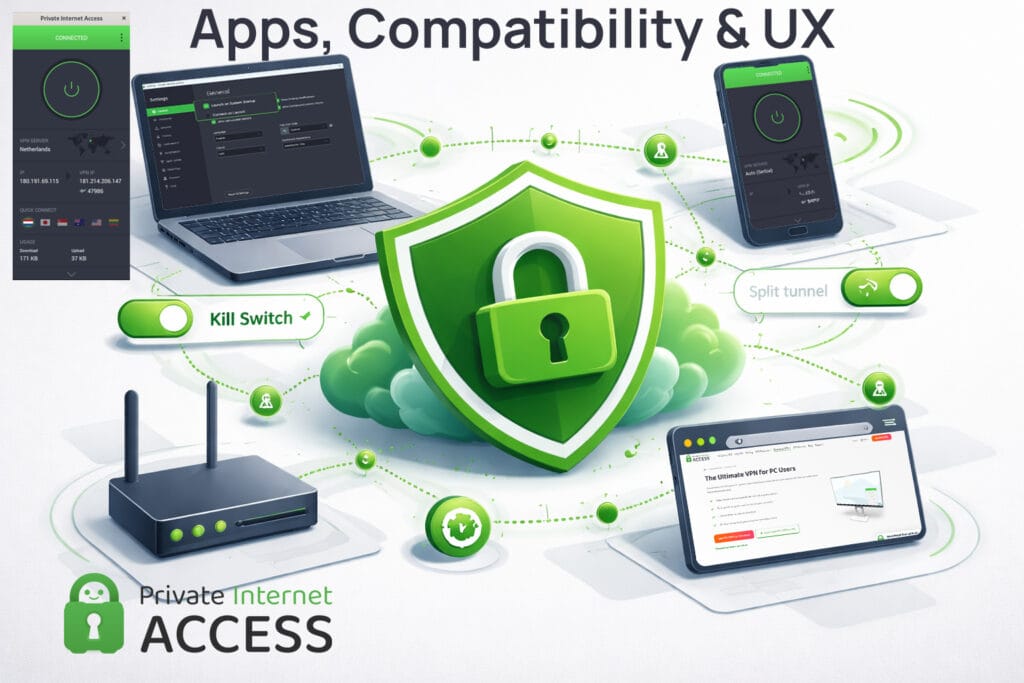
Private Internet Access (PIA) is a flexible, power-user-friendly VPN built for managing many devices with ease. It combines broad platform support, deep customization, and unlimited connections under one account. The trade-off is polish, with lighter onboarding and fewer in-app tips than beginner-focused VPNs. This section looks at usability, consistency, and flexibility, not privacy or speed.
Platform Availability & Device Support
PIA offers native apps across almost every major platform, delivering a consistent experience whether you’re on desktop, mobile, or a TV-based device. Setup is straightforward on supported platforms, and most features carry over cleanly between apps.
Desktop Apps
Native apps for Windows, macOS, and a full Linux GUI, offering consistent features and controls.
Mobile Apps
Dedicated apps for iOS and Android with strong feature parity and stable day-to-day performance.
Smart TV Support
Native apps for Fire TV and Android TV, plus Smart DNS for consoles and unsupported TVs.
Browser Extensions
Chrome and Firefox extensions provide full VPN functionality, not simple proxy tools.
Routers & Consoles
Supports manual router setups using OpenVPN or WireGuard, with Smart DNS extending coverage to consoles and whole-home setups.
💡 Why this matters: The inclusion of a full Linux GUI app sets PIA apart, while the overall platform coverage ensures a consistent, native experience across most devices users rely on daily.
Advanced Settings & Customization
PIA delivers deep control without clutter, giving power users access to advanced tools while keeping the interface manageable. Settings behave predictably across reconnects, so once configured, they stay reliable in daily use.
Kill Switch
Platform-appropriate kill switch protects traffic during drops, with reliable behavior on reconnect.
Split Tunneling
Available on desktop and Android, allowing precise control over which apps use the VPN.
Protocol Switching
Easy switching between supported protocols for balancing stability and compatibility.
Custom DNS
Supports custom DNS settings for users who want finer control over routing and filtering.
Automation Rules
Connection rules and auto-connect options help streamline use across trusted and untrusted networks.
📌 Platform note: Some advanced controls are limited on iOS due to operating system restrictions, not app design choices.
User Interface & Ease of Use
PIA’s apps focus on clarity and control, making them easy to navigate once you’re familiar with the layout. The experience is consistent across platforms, with small differences between desktop and mobile.
- 🖥️ Desktop experience: Clean layout with one-click connect, fast server search, and quick access to advanced settings.
- 📱 Mobile experience: Lightweight and responsive apps with most core features preserved, including split tunneling on Android.
- ✅ What works well: Clear toggles, predictable navigation, and stable reconnect behavior during daily use.
- ⚠️ Where it falls short: Minimal onboarding, limited in-app guidance, and no cloud-based settings sync between devices.
Bottom line: PIA’s interface prioritizes function over guidance, which suits experienced users but may feel sparse for beginners.
Simultaneous Connections & Device Policy
PIA offers unlimited simultaneous connections, which is a clear differentiator in daily use. There are no device-type restrictions, and connection limits do not change based on plan length or pricing tier.
This flexibility makes it easy to protect every device in a household at the same time, from phones and laptops to TVs and streaming boxes. For larger setups, installing PIA on a router extends coverage to the entire network, effectively bypassing per-device management altogether.
PIA is especially well suited for families, power users, and multi-device households that want simple, unrestricted coverage.
Apps, Features & UX Score
PIA delivers one of the most flexible and feature-rich app experiences available, with broad platform support and deep customization designed for multi-device use.
- ✅ Native apps across all major platforms, including a full Linux GUI
- ✅ Advanced features & customization without clutter, suited to power users
- ✅ Unlimited simultaneous connections with no plan-based limits
- ⚠️ Onboarding is minimal, with no cloud-based settings sync between devices
- ⚠️ No cloud-based settings sync.
Support, Documentation & User Ratings
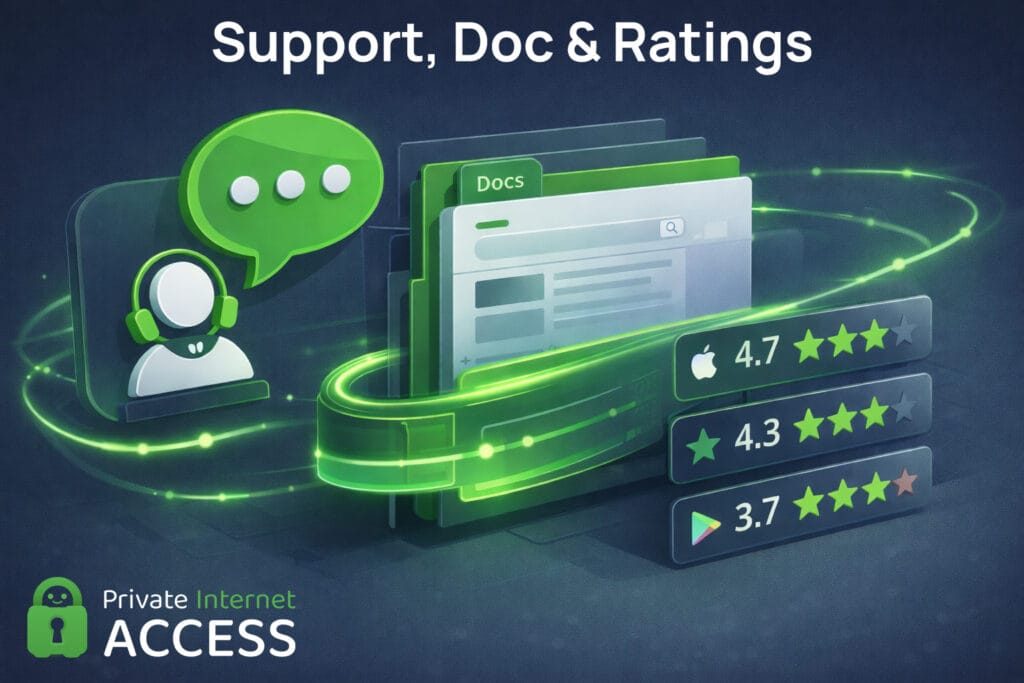
PIA’s support experience is strong overall, mainly because it combines 24/7 live chat, a proper ticket system, and one of the deepest help centers in the VPN space. That said, it is not a “premium concierge” setup. Chat is usually available but not instant, email replies can take longer, and the apps still offer limited onboarding for first-time users. This score reflects how easy it is to get help, how good the documentation is, and what large-scale user ratings show, not just one-off experiences.
Customer Support Channels
PIA offers a well-rounded support structure that prioritizes availability and visibility rather than premium hand-holding. Help is easy to find, consistently online, and supported by both official channels and an active user community.
24/7 Live Chat
Launched in 2024, always visible via “Chat Now” widget, confirmed human support.
Email & Ticket System
Dedicated helpdesk with ticket tracking, email replies, and follow-ups.
True 24/7 Coverage
No business-hour limits; chat and tickets work nights and weekends.
Community & Social Support
Large Reddit community plus active Twitter/X and Facebook responses.
Language Limitation
Human support is English-only; no multilingual chat, email, or chatbot.
Bottom line: PIA makes it easy to get help at any time through multiple channels, backed by a strong community. The main drawback is the lack of multilingual support, which keeps it from matching the most globally oriented VPN providers.
Response Speed & Quality
PIA’s support experience is reliable and well-structured, but it does not aim for ultra-fast or concierge-level service. Live chat is genuinely available around the clock and consistently reachable, though response times are moderate rather than instant. Email and ticket support is dependable and well-tracked, but turnaround times are slower compared to top-tier competitors. Overall, support quality is competent and professional, especially for common issues, with more complex cases handled through escalation.
- Live Chat Speed: Connects in 1–3 minutes with real agents.
- Email Turnaround: Replies in 6–24 hours, slower on weekends.
- Agent Knowledge: Strong on basics; advanced issues need escalation.
- Follow-Up: Tickets are tracked with clear confirmations.
Overall, PIA delivers solid, reliable support that gets the job done, even if it lacks the speed and polish of premium VPN support teams.
Documentation, Guides & Onboarding Help
PIA’s documentation is built around self-service and technical depth. Instead of relying on in-app tutorials, it provides one of the most comprehensive help centers in the VPN market. This approach strongly favors power users and advanced setups, while beginners may need to rely more on external guides.
Setup Guide Depth
Full platform coverage, with exceptional Linux and advanced router documentation.
Advanced Network Setups
Detailed guides for pfSense, OpenWRT, MikroTik, ASUSWRT, and similar platforms.
Smart TV & Console Guides
Android TV, Fire TV, Apple TV (Smart DNS), PlayStation, and Xbox support.
Advanced Feature Docs
Clear documentation for port forwarding, SOCKS5, split tunneling, obfuscation, and kill switch behavior.
Searchable Knowledge Base
Modern Zendesk-style portal with fast search, filters, and screenshot-rich articles.
Onboarding Limitations
No in-app tutorials or first-time walkthroughs, only minimal tooltip hints.
Multimedia Support: Screenshot-heavy guides with a limited number of official YouTube tutorials, but no embedded videos or diagrams inside the help center.
PIA’s documentation is among the best available for advanced users, routers, and custom setups. However, the lack of in-app onboarding means complete beginners may face a steeper learning curve despite the excellent written resources.
User Ratings & Public Sentiment
Surfshark maintains a strong reputation across industry review sites and user communities, backed by a clear commitment to transparency.
Large-scale user feedback paints a split but coherent picture of PIA. Overall sentiment toward the service is positive, but app-level experiences vary by platform. This subsection separates service reputation from individual app ratings, which is critical for fair interpretation.
User Ratings (as of mid-2025):
- Trustpilot (Service-Level View):
Holds a 4.3 / 5 rating with very high review volume and stable trends. Reviews are detailed, balanced, and show strong authenticity signals, reflecting satisfaction with the overall service rather than a single app.  Apple App Store (Strong Point):
Maintains an excellent 4.7 / 5 rating, backed by a large number of reviews. Feedback consistently highlights stability, smooth reconnections, and reliable day-to-day performance on iOS. Google Play (Weak Point):
Rated 3.7 / 5, largely driven by Android-specific issues. Common themes include device fragmentation, aggressive power-saving behavior, reconnection loops, and background service interruptions. These complaints target the app experience, not privacy or core VPN functionality. Community Reputation (Reddit & Forums):
Sentiment is mixed-positive. PIA is widely respected for privacy, transparency, and open-source practices. Recurrent criticism centers on Android app reliability and streaming consistency, rather than trust or logging concerns.
 Trustpilot (Service-Level View):
 Apple App Store (Strong Point):
 Google Play (Weak Point):
 Community Reputation (Reddit & Forums):
Across platforms, reviews show a natural mix of praise and criticism with no signs of manipulation, incentivized spam, or artificial score inflation.
❗ Key clarification: App store ratings reflect platform-specific app behavior, not the overall quality, trustworthiness, or privacy posture of the VPN service itself.
Transparency, Trust Signals & Public Accountability
PIA has built its reputation on verifiable actions rather than marketing claims. When tested by legal pressure or infrastructure seizures, the company has consistently documented what happened and what data was, or was not, available.
🧾 Transparency Reports:
PIA continues to publish transparency reports (most recently through 2024), detailing subpoenas and legal requests. While the structure has evolved over time, disclosures remain public and explicit. The warrant canary was intentionally discontinued, with a clear explanation provided rather than quietly removed.
👤 Ownership & Leadership Transparency:
The company’s founder, leadership team, and parent ownership are publicly disclosed. The acquisition by Kape Technologies was openly addressed, with detailed explanations about operational independence and privacy safeguards. There are no hidden ownership layers or anonymous operators.
✔️ Verified Trust Events:
PIA’s no-logs claims have been tested in real-world scenarios, including a Russia server seizure where no user data was found and U.S. court subpoenas that produced no logs. All apps are fully open source, and major decisions, including policy changes, have been publicly explained.
⚖️ Public Accountability Record:
There is no documented history of cover-ups or delayed disclosures. When incidents occur or policies change, PIA addresses them directly and in public channels.
Bottom line: PIA demonstrates long-term transparency through consistent disclosure, verifiable legal outcomes, and open communication—key trust signals that extend beyond short-term marketing assurances.
Support, Docs & Ratings Score
PIA offers reliable 24/7 support access and one of the most detailed help centers in the VPN space, backed by strong public trust signals. However, average response speeds, weak onboarding, and English-only support prevent it from reaching top-tier status.
- ✅ 24/7 live chat and ticket support with verified off-hours availability
- ✅ Extensive documentation, especially for Linux, routers, and advanced setups
- ✅ Strong transparency record and long-term public trust
- ⚠️ Support speed is dependable but not instant
- ⚠️ Limited onboarding and English-only human support
Plans, Pricing & Refunds
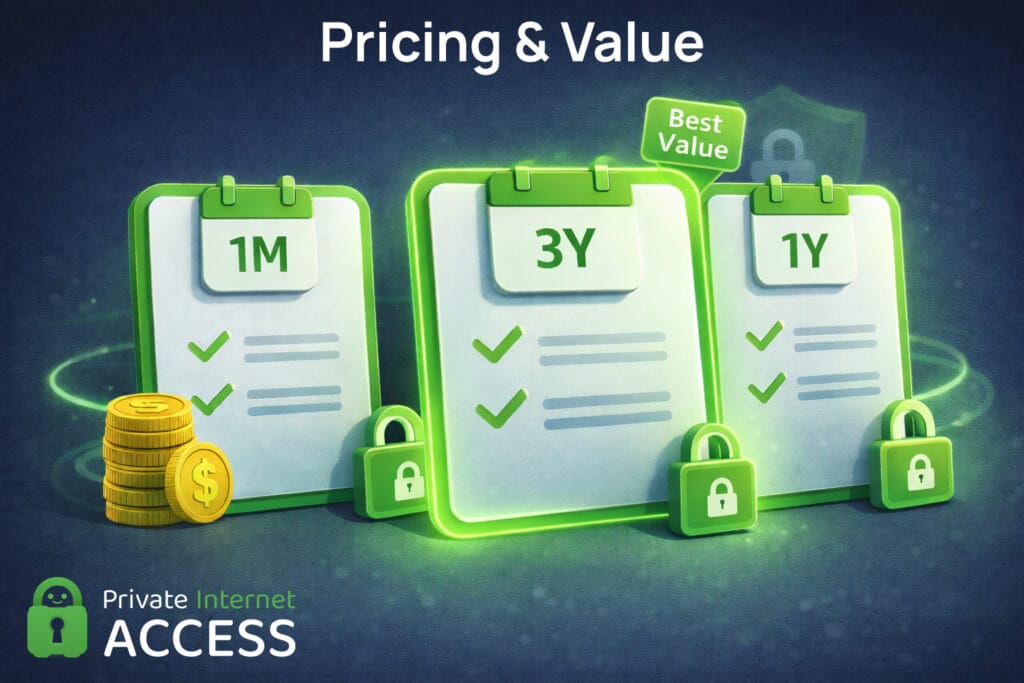
Private Internet Access is positioned as a value-focused VPN, not a premium-priced one. Its long-term plans are heavily discounted and include all features with no tier restrictions, while month-to-month pricing is less competitive. This section focuses on cost fairness, transparency, and overall value, not performance.
Subscription Plan Options
Private Internet Access offers a simple, three-tier pricing structure that scales with commitment length rather than features. All plans include the same capabilities, but the cost drops sharply the longer you subscribe.
What’s available and how pricing scales:
| Plan Length | Approx. Monthly Cost | Best For | What You Get |
|---|---|---|---|
| Monthly | $11.95/mo | Short-term or temporary use | Full VPN feature set, no restrictions |
| 1 Year | $3.33/mo | Balanced value without long lock-in | Same features as monthly, lower effective cost |
| 3 Years (+4 months) | ⭐ $1.98/mo | Best long-term value | Identical features, steep introductory discount |
📝 Note: Prices shown are approximate and based on promotional rates available at the time of review (as of 2025). Renewal prices are higher after the initial term and may vary by region or currency.
🎯 Key takeaway: PIA’s multi-year plan offer strong long-term value (≈ $1.98/month) with the full VPN feature set included and 4 extra months, while the monthly option is priced higher and best suited for short-term use rather than ongoing value.
Features & Value Across Plans
One of PIA’s strongest pricing advantages is full feature parity across all subscriptions. There are no stripped-down plans or locked tools — every user gets the same capabilities regardless of billing length. The difference in value comes purely from how much you pay over time, not what you unlock.
Every subscription includes the complete PIA feature set — no limitations or exclusions.
💰 Value positioning:
PIA’s long-term plans deliver an especially strong cost-to-feature ratio, making them a smart choice for torrenting users, multi-device households, and power users who want full control without paying extra for “premium” tiers.
Payment Methods & Trial Access
PIA offers flexible payment options, including privacy-friendly choices, but trial access is more limited than some competitors. Most users will rely on the refund window rather than a traditional free trial.
- Credit & Debit Cards: Supports Visa, Mastercard, American Express, Discover and more (varies by region).
- Digital Wallets: Pay easily with PayPal, Google Pay, Apple Pay and Amazon Pay depending on your region.
- Cryptocurrency (Non-Recurring): Supports Bitcoin, Ethereum and more
- Regional & Alternative Methods: Includes iDEAL for EU users, Paygarden gift cards in the US, and other region-specific options shown at checkout.
Checkout always displays both the first-term discount and the standard renewal rate, ensuring full transparency.
Trial Access & Testing Options
PIA does not offer a traditional free trial on desktop platforms. Instead, trial access is platform-dependent and limited in scope.
Mobile App Store Trials
Limited-time trials may be available via Google Play (Android) and the Apple App Store (iOS), depending on region and current store policies.
No Direct Desktop Trial
Windows, macOS, and Linux don’t get a standalone free trial, so testing typically relies on the refund policy.
Practical Implication
Trial availability is controlled by the app stores, not PIA, and can change without notice.
❗ Positioning:
PIA’s trial access is functional but restrictive, making it less beginner-friendly than VPNs with universal free trials, while still offering a low-risk testing path via its refund policy.
Refund Policy & Renewal Terms
PIA offers a 30-day money-back guarantee on its plans, which aligns with industry standards and gives new users a reasonable window to test the service. Refunds are available for most direct purchases, but the process and eligibility depend on how the subscription was bought.
Key refund highlights:
- Applies to all plan lengths, from monthly to multi-year
- Applies to the first subscription only
- No usage limits or restrictive conditions other than must be requested within 30 days
- Refunds for card, PayPal, and crypto payments are handled directly by PIA
- App Store purchases (Apple App Store or Google Play) must follow the platform’s own refund rules
- Crypto payments are fully eligible
- Auto-renewal is enabled by default, and renewal prices are higher than the introductory rate
Overall, PIA’s refund policy is fair and transparent, but it requires more user attention than providers with platform-independent refunds or opt-in renewals, especially for mobile subscribers.
Feature-to-Cost Value Ratio
PIA delivers one of the strongest feature-to-price ratios in its category, mainly because plan length doesn’t change what you get. Whether you pay monthly or go long term, the feature set stays the same, so the real “value swing” comes from how much the price drops on multi-year deals.
The biggest trade-off is short-term value. The monthly plan is usually priced above the budget segment, while long-term plans tend to land in the “excellent value” range once discounts apply.
Full Feature Parity
No basic vs premium tiers. All plans unlock the same core VPN features.
Unlimited Devices
Connect as many devices as you want under a single subscription.
Modern Protocols
WireGuard and OpenVPN supported across apps with solid server capacity.
Security Toolkit
Kill switch, leak protection, and MACE blocking included by default.
Torrenting & P2P
Full P2P support with port forwarding and SOCKS5 for better seeding.
Advanced Routing
Split tunneling, multi-hop, and obfuscation for complex networks.
Router & Power-User Setups
Strong manual router support for whole-network VPN coverage.
Inconsistent Download Retention
Download speeds vary by region, with weaker retention on long-distance servers compared to top-tier rivals.
Unblocking Isn’t Universal
Tools help, but access varies by platform and region (UK services are the weak spot).
🎯 Bottom line: PIA’s pricing delivers strong long-term value, with all core features unlocked on every plan and generous payment flexibility, including anonymous options. The trade-offs are a higher month-to-month cost, limited trial access, and some performance inconsistency on distant servers, but for users committing long-term, the cost-to-features ratio remains one of PIA’s strongest advantages.
Pricing & Value Score
PIA positions itself as a value-first VPN, offering aggressive long-term pricing with no feature restrictions across plans. While short-term pricing and trial access are less competitive, the overall cost-to-features balance remains strong for committed users.
- ✅ Full feature access on every plan with no tier-based restrictions or caps
- ✅ Strong long-term pricing makes PIA one of the better value options for multi-year users
- ✅ Excellent cost-to-feature ratio for torrenting, multi-device households, and power users
- ✅ Broad payment flexibility, including crypto, gift cards, prepaid cards, and regional methods
- ⚠️ Refund process is fair but not “no-questions-asked” across all payment methods
- ⚠️ Free trial exists only via mobile app stores and requires payment details
- ⚠️ No permanent free plan for long-term testing or light usage
Pros & Cons
Pros
- Strong torrenting tools (port forwarding, SOCKS5)
- Proven no-logs history backed by court cases
- Unlimited device connections
- Advanced customization and controls
- Wide app support, including Linux GUI
- 24/7 live chat and deep documentation
- Trusted privacy-first reputation
Cons
- Streaming access is inconsistent overall
- Not reliable in heavily censored regions
- US jurisdiction may concern some users
- Android app stability is mixed
Final Verdict
Surfshark continues to stand out in 2025 as one of the most versatile and value-packed VPNs on the market. Backed by an audited no-logs policy, a RAM-only server network, and unlimited device support, it offers a rare combination of strong privacy, reliable streaming access, and advanced extras like multi-hop and Camouflage Mode. Its performance remains competitive across global regions, with excellent speeds for both streaming and P2P use.
It’s an ideal pick for budget-savvy users, digital nomads, and households with many devices, as well as those seeking advanced privacy tools without sacrificing ease of use. While there’s no permanent free plan and the 7-day trial now requires payment details, Surfshark’s long-term plans deliver some of the best value in its class.
If you want a secure, high-performing VPN with unlimited connections and modern security features, Surfshark is a smart, future-proof choice.
Want to try it risk-free?
All plans include a 30-day money-back guarantee, letting you test the service on all devices before committing.
Low-cost and feature-rich, PIA offers strong security, reliable
speeds and full customization – excellent value for the price.
How scores are calculated: Each score is based on documented features, independent audits, speed benchmarks, support responsiveness, and user experience across devices. We apply consistent scoring criteria for all VPNs to ensure fair comparison. A full explanation will be available soon in our upcoming “How We Review” page.
Frequently Asked Questions
Is Private Internet Access (PIA) safe to use?
Yes. PIA uses strong encryption and modern VPN protocols, and its apps are open-source, which makes security easier to verify.
Does PIA keep logs?
PIA claims a no-logs policy, and it has a long track record of public “no-logs” proof points from real-world legal events where it could not produce user data.
Does PIA work with Netflix and streaming apps?
It can work for streaming, but results are not as consistent as top “streaming-first” VPNs. If streaming is your main goal, expect some trial-and-error by server.
Is PIA good for torrenting?
Yes. PIA is one of the stronger choices for P2P thanks to solid performance and support for port forwarding on supported setups.
How many devices can I use with one PIA account?
PIA allows unlimited simultaneous connections, which is great for families and multi-device households.
Does PIA offer a free trial?
Not as a standard desktop trial. Limited trials may be available through the Apple App Store or Google Play, depending on region and current store rules.
Does PIA have a money-back guarantee?
Yes. PIA includes a 30-day money-back guarantee, but app-store purchases may need to be refunded through Apple or Google.
Is PIA better than NordVPN, ExpressVPN, or Surfshark?
It depends on your priorities. PIA is usually the better value for customization, open-source apps, and unlimited devices, while those rivals tend to be stronger for “set-and-forget” ease and streaming consistency.

Ash Sh.
Senior Research Strategist & Editor
I’m the senior research strategist and editor at VPNProxySolutions.com, where I focus on analyzing VPNs, proxy networks along with various online privacy technologies. With over seven years of experience in cybersecurity research, I’ve developed a structured approach to evaluating providers based on documentation, independent audits, public benchmarks and real-world use cases. My goal is to make complex digital privacy tools easier to understand, whether you’re comparing services, troubleshooting connections or just learning how anonymity works in practice.
About us